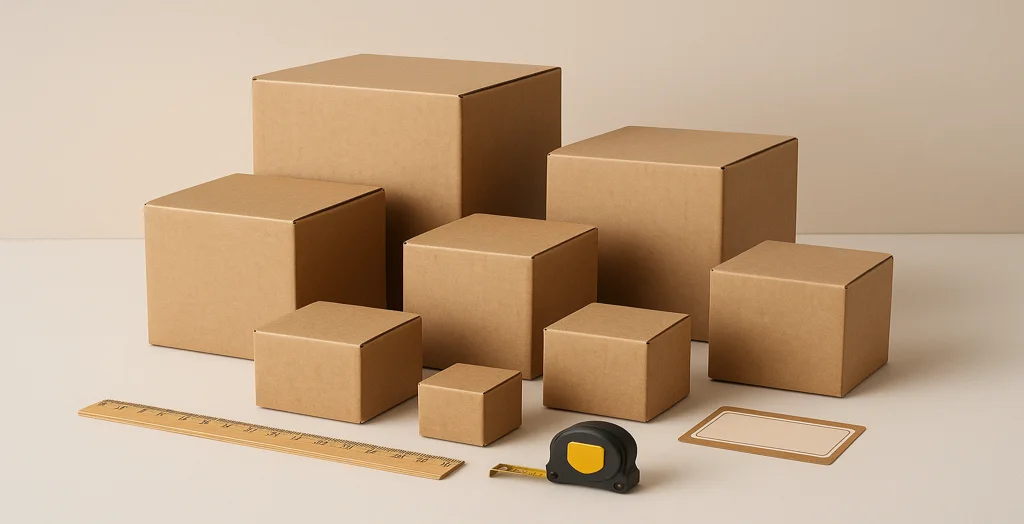
Three numbers decide whether a parcel ships at a fair rate or gets hit with a surcharge. Length, width, height. Get the order wrong, and the carrier’s system doesn’t care that you meant well.
Corrugated box dimensions look simple on paper.
They’re not. A box listed as 12x8x6 means one thing on a supplier’s page and something slightly different once you’ve measured it on your packing table (the inside and outside numbers rarely match). And that gap? It’s where most small sellers lose money without ever noticing.
Here’s what 20 years on warehouse floors teaches you: carriers bill for the space a box takes up, not just what’s inside it. A 5-pound candle shipped in a box built for 20 pounds still gets priced like a big package. Rules around oversized and dimensional charges keep tightening in 2026, so a sloppy measurement habit that slid by two years ago can now eat a real chunk of a 10-order or 1,000-order month.
So which side is the length, anyway?
Why the L x W x H order trips up sellers right now
A seller packs a 12x9x3 candle set into a box, then types it into the label screen as 3x12x9. The carrier scan reads a different shape, the label gets flagged, and a correction fee shows up two weeks later. Sound familiar?
That mix-up is getting more expensive. Carriers keep tightening how they audit parcels in 2026, and their scanners check measurements against what you entered. Wrong order, wrong data. Not a huge gap on one parcel — it adds up fast across 300 orders a month.
Here’s the rule. Corrugated box dimensions are always listed as length, width, then height — those are inside measurements. Length is the longest side of the opening. Width is the shorter side of that opening. Height is the depth, measured from the opening down to the bottom.
- Measure the open top first, then the depth.
- Round up to the next full inch.
- Divide L x W x H by the carrier’s divisor (commonly 139 or 166) to get billable weight.
Flip the order, and your flat box looks like a tall one on paper. Billable weight can jump with it.
How to measure inside dimensions of a corrugated box the right way
Inside measurements are the only ones that count. Carriers bill off the outside, but your product lives on the inside, so every corrugated box dimensions listing you read should be checked against what’s actually in the carton.
Length, width, height: which side is which
Look at the open top. The longer side of that opening is the length. The shorter side is the width. Height runs from the bottom panel up to the top of the flaps. Always write them in that order. Mix them up, and a 12x8x4 becomes a 4x8x12, which is a different box entirely.
Inside vs. outside measurements and why the gap matters
Single-wall board is thin, but it adds up. Outside measurements usually run about 1/4 inch bigger per side than the inside (more with a thicker flute). Why care? Because that gap decides whether your item fits and what the carrier charges.
Quick measuring steps for an 8×10 item or any rectangular product
- Measure the product’s longest side in inches. For an 8×10 frame, that’s 10.
- Measure the next side (8), then the thickness.
- Add 1/2 inch to each for padding.
- Find a box with inside dimensions at or just above those numbers.
Skip the guesswork. A tape measure beats a chart every time.
Cube, tall, and flat boxes: how each shape changes your dimensional weight
Why does a 4-pound candle set sometimes bill like a 14-pound package? Shape is usually the culprit. Corrugated box dimensions are listed as length, width, then height, and carriers read all three.
The cubic volume formula and the divisor carriers use
Multiply length by width by height in inches. Then divide by the carrier’s divisor, which is commonly 139 for domestic ground. Round up. A 12x12x12 cube gives 1,728 cubic inches, so 12.4 lbs billed as 13. Tall or flat, same math. Different pain.
Where air space hides in a cube box
Cubes feel efficient (they stack nicely on a shelf, I’ll give them that). But a cube is the worst fit for most products, and every extra inch gets multiplied three ways. Go from 12 to 13 inches, and your volume jumps 27%.
Measure your product, add about 1 inch per side for cushioning, and stop there. Anything past that is void fill you’re paying carriers to haul.
When a flat box or mailer beats a standard box
A 12x9x2 mailer is 216 cubic inches. That’s 1.6 lbs dimensional. Same book in a 12x12x6 box? 864 cubic inches, or 6.2 lbs. Ouch.
- Flat items (prints, apparel, books): go with a low-profile mailer.
- Tall items (bottles, vases): use a tall box, not a cube.
- Compact, dense items: a snug cube works fine.
Match box size and corrugated type to your product
Roughly 1 inch of extra box height can push a package into the next dimensional weight bracket. One inch. That’s all it takes for a rate jump on a 12x10x8 shipment.
So corrugated box dimensions and wall type have to be picked together, not one after the other. Get the length, width, and height right first. Then match the board to the weight inside.
Single-wall vs. double-wall and what flute type does for protection
Single-wall board, usually rated 32 ECT, handles most items up to about 65 lbs. Double-wall (44 ECT) steps in around 80 lbs, or when the product is fragile and the box rides long distances. Flute is the wavy layer in the middle. Here’s what most sellers miss: a finer flute gives a smoother print surface, while a larger flute cushions better and stacks stronger.
- Under 20 lbs, sturdy goods: single-wall
- Glass, ceramics, dense items: double-wall
- Flat apparel or prints: a corrugated mailer
Standard sizes vs. custom sizes: when 1 inch saves real money
Standard sizes win under a few hundred orders a month. They’re in stock, and swapping stock is easy. Custom only pays once one product ships in volume (think 1,000+ units). Before that? Measure your product, add 1 inch of padding per side, and pick the closest standard box on a size chart. Skip anything with more than 2 inches of dead space.
A simple size-check routine for sellers shipping 10 to 1,000 orders a month
Forget the idea that you need a spreadsheet wizard or a pile of sample boxes to get this right. You don’t. A one-page check, done once a quarter, catches most of the air space you’re paying to ship.
Build a short size chart for your top five products
Pick the five items that make up most of your orders. Measure each one in inches, always in length, width, height order, and write down the weight too. Then list the corrugated box dimensions you currently use for each (inside measurements, not outside).
- Product size: 8x10x2 inches, 1.5 lbs
- Current box: 12x12x6 inches
- Air left over: 3 cubic inches of nothing but trouble
Spot the gap. Fix the worst one first.
Test with a calculator before you reorder
Before you buy another case, run the new size through a dimensional weight calculator. Multiply length x width x height, divide by the carrier’s divisor (commonly 139 or 166), and compare that number to the scale weight. The higher one gets billed.
Does the new box drop the billable weight by even a pound?
Then reorder. If it doesn’t, keep what you’ve got.
Carriers read a box in one order, and they don’t care what you meant. Length first, width second, height last. Get that sequence wrong on a listing, or a rate calculator, and the surcharge shows up anyway, usually weeks later on an invoice nobody wants to open.
Corrugated box dimensions are really a question about air. Every inch of empty space gets billed like product, whether the box is a cube, a tall carton, or a flat one. Sellers who measure the inside, check the shape against the item, and step down to a mailer when the product allows it tend to find savings that repeat on every single order. That’s the part worth remembering.
So here’s the next step. Pull your five best-selling products today and measure each one with a tape, inside dimensions only. Write the L x W x H numbers on one sheet. Then run each through your carrier’s dimensional weight calculator using the current divisor, and flag any box that bills more than 20% above actual weight. Fix those first, before the next reorder goes out.

