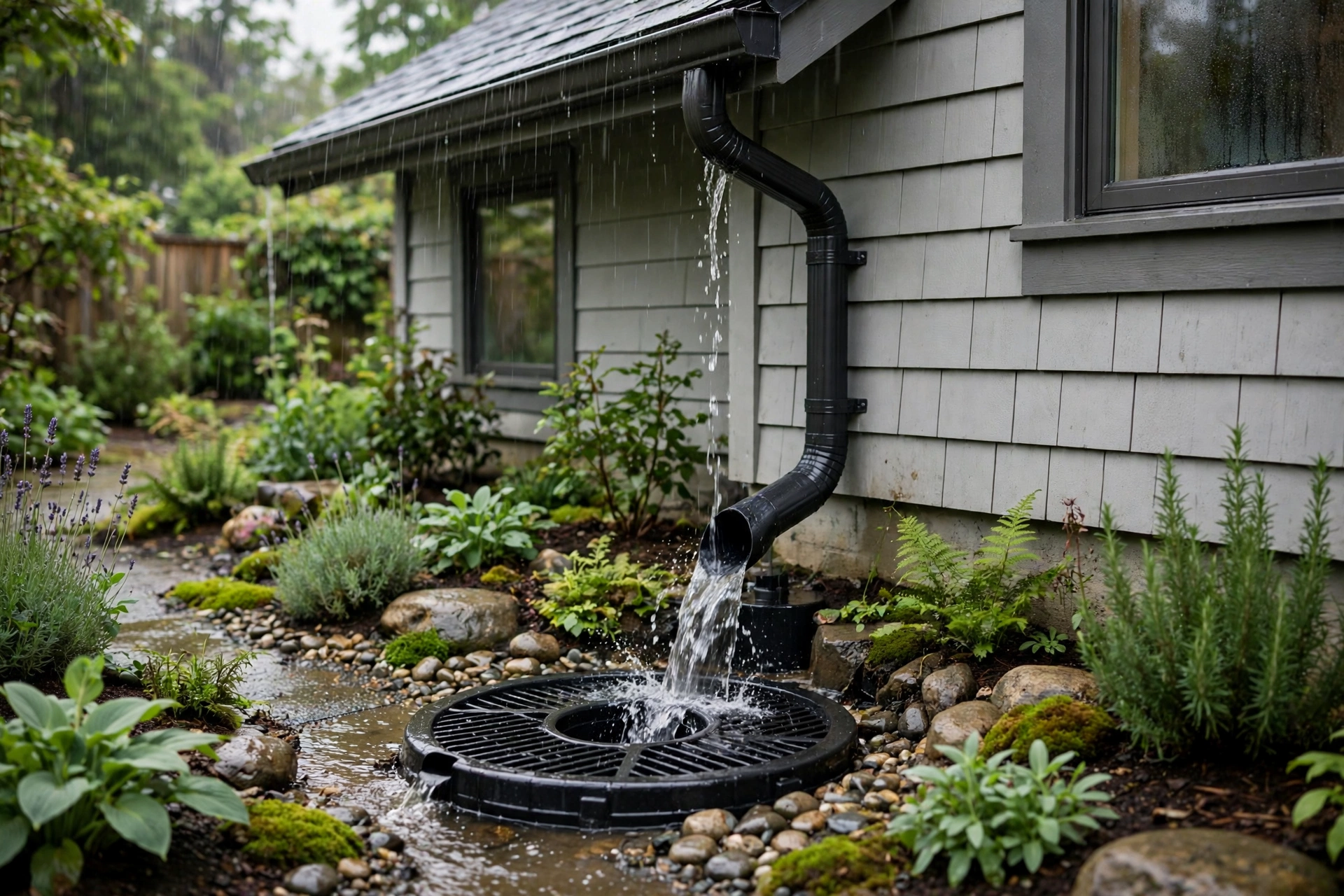
Most homeowners only notice their downspouts when something goes wrong. A gutter overflows during a storm, water sheets down the siding, or a basement corner turns damp after heavy rain. In many homes the downspout connects straight into a storm drain that carries roof water away as fast as possible. That solves the immediate problem, but it throws away thousands of litres of free water every year and loads municipal drains that are already under strain.
The short answer is that a downspout disconnection system breaks that direct link and gives roof runoff somewhere useful to go. The water is redirected into an underground storage tank, a dry well, or an infiltration area where it can be stored for garden use or allowed to soak into the ground under controlled conditions. Done well, the system protects the foundation, cuts mains water use, and keeps storm drains from surging during heavy rain.
Why Roof Runoff Deserves a Plan Before It Leaves the Gutter
A typical roof collects a surprising amount of water. A modest roof of around 100 square metres can shed roughly 1,000 litres from a single 10-millimetre rainfall event, and a wet season can send tens of thousands of litres past the eaves. When every downspout on a street feeds the same storm drain, that volume arrives all at once, which is why drains back up and streets flood during storms the same system handled easily a generation ago.
The water itself is not the problem. Roof runoff is relatively clean compared with road runoff, and it is free. The problem is only the route it takes. Sending it straight to the drain wastes a resource and adds load to infrastructure. Giving it a planned destination, storage or infiltration, turns the same rainfall into something the household can use.
What Downspout Disconnection Actually Means for a Home
Disconnection simply means breaking the direct connection between a downspout and the storm drain or sewer. Instead of disappearing into a pipe, the water is redirected at ground level or below it. The simplest version is a downspout that discharges onto a lawn through a splash block, but the version this article covers goes further: the water is piped underground into a storage tank where it waits until it is needed.
- A diverter or first-flush device at the downspout that separates the first dirty wash from the cleaner water that follows.
- A buried pipe, laid with a steady fall, that carries water from the diverter to the tank without pooling or freezing.
- An underground storage tank with an inlet, an overflow, and a way to draw water out for use.
- An overflow route that sends excess water to a safe infiltration area when the tank is full.
- A filter or leaf screen at the gutter outlet so debris never reaches the buried parts of the system.
Each part has one job, and the system only works when all five do theirs. A tank without an overflow will flood the foundation it was meant to protect. A diverter without a filter will clog the buried pipe within a season. Planning the whole chain before digging is what separates a system that lasts decades from one that becomes a buried problem.
Sizing an Underground Storage Tank to Your Roof and Rainfall
Tank size starts with two numbers: how much roof feeds it and how much rain falls. Measure the roof area that drains to the connected downspouts, then look at local rainfall records for a typical month and for the wettest month. A roof of 100 square metres in a climate with 60 millimetres of rain in a month produces about 6,000 litres in that month, minus losses from evaporation and the first flush.
| Roof area feeding tank | Monthly rainfall | Suggested tank size | Typical use |
|---|---|---|---|
| 50 sq m | 40 mm | 1,000-1,500 litres | Small garden watering |
| 100 sq m | 60 mm | 2,000-3,000 litres | Garden and lawn |
| 150 sq m | 80 mm | 4,000-5,000 litres | Garden, lawn, washing |
| 200 sq m | 100 mm | 5,000-10,000 litres | Whole-garden irrigation |
These figures are starting points, not rules. A household that waters a large vegetable garden will empty a small tank in a dry week, while a home with modest planting may find a 2,000-litre tank rarely fills. The honest way to size is to track how much water the garden actually uses in a dry month, then size the tank to cover two to three weeks of that use.
Choosing Between Cisterns, Dry Wells, and Infiltration Trenches
Not every home needs a storage tank. Where the goal is only to keep water away from the foundation and let it soak into the ground, a dry well or an infiltration trench does the job with fewer moving parts. The choice depends on whether the household wants to use the water or simply dispose of it safely.
| System | How it works | Best for | Maintenance |
|---|---|---|---|
| Underground cistern | Sealed tank stores water for later use | Homes that irrigate gardens | Pump, filter, annual clean |
| Dry well | Gravel-filled pit lets water soak away | Free-draining soils, small roofs | Clear inlet screen yearly |
| Infiltration trench | Long gravel trench spreads water out | Narrow plots, long roof runs | Inspect and flush yearly |
| Rain garden | Planted depression holds and filters runoff | Visible landscaping, gentle slopes | Seasonal planting care |
Soil decides more than preference does. A dry well in heavy clay will fill and stay full, which defeats the purpose. A cistern in sandy soil is wasted money if the same water would have soaked away harmlessly. A simple percolation test, digging a hole, filling it, and timing how fast it drains, answers the question before any money is spent.
How First-Flush Diverters Keep Stored Water Cleaner
The first few millimetres of rain wash dust, bird droppings, pollen, and grit off the roof. If that wash goes straight into the tank, the stored water turns murky and the pump filter clogs. A first-flush diverter catches that first dirty flow in a small chamber and only lets the cleaner water that follows pass into the tank. The chamber then drains slowly and resets itself for the next storm.
- Size the diverter chamber to hold roughly the first 0.5 to 1 litre per square metre of roof.
- Fit it where it can be reached for cleaning, since a diverter buried under a deck never gets cleaned.
- Use a slow-drip drain on the chamber so it empties itself between storms.
- Add a leaf screen at the gutter outlet so large debris never reaches the diverter at all.
- Check the diverter after the first heavy storm of the season, when the roof is dirtiest.
A diverter is a small device with an outsized effect on water quality. Stored water that passes through one stays clear enough for garden irrigation and washing, while water that skips it often smells within weeks. The cost is modest and the maintenance takes minutes, which makes it one of the best returns in the whole system.
Routing Pipes Underground Without Creating New Problems
Buried pipework is the part of the system most often installed badly, because mistakes are invisible until they cause trouble. The pipe from the downspout to the tank needs a steady fall of at least 1 in 100 so water keeps moving, and it should run in a straight line where possible. Every bend is a place where leaves settle and a blockage starts.
Depth matters too. In cold climates the pipe must sit below the frost line or it will freeze solid in winter and split. Where the pipe crosses a driveway or a path, it needs a sleeve or a stronger pipe class so vehicle weight cannot crush it. Marking the route on a simple sketch and keeping a copy with the house documents saves the next owner from digging through the pipe with a spade.
Overflow Routes That Protect the Foundation When Tanks Fill
Every storage tank fills eventually, usually during the heaviest storm of the year, exactly when an overflow failure does the most damage. The overflow must be planned as carefully as the inlet. It should leave the tank near the top, run downhill away from the house, and discharge onto a permeable surface at least a couple of metres from the foundation.
- Size the overflow pipe at least as large as the inlet pipe so it can never be the bottleneck.
- Discharge onto lawn, a gravel bed, or a rain garden, never onto a driveway that slopes back toward the house.
- Fit a mesh screen on the overflow outlet to keep out insects and rodents.
- Test the overflow with a hose before the first real storm, not during it.
- Keep the overflow route clear of stored items, planters, and garden beds that could block it.
An overflow is insurance, and like all insurance it is only useful if it works when called on. A tank that overflows against the foundation wall can do more damage than a connected downspout ever did, because the water arrives in a concentrated stream at exactly the wrong place.
Seasonal Care for Disconnected Downspouts and Buried Tanks
A disconnected system needs less attention than gutters, but it still needs a routine. Twice a year is enough for most homes: once in late autumn after the leaves fall, and once in spring before the heavy rain season. Clear the gutter screens, flush the diverter chamber, and check that the tank inlet and overflow are clear. In autumn, drain any above-ground pipework that could freeze.
The tank itself deserves a look every year or two. Open the inspection hatch, check for sediment at the bottom, and look at the pump and filter if one is fitted. A tank that is never opened will slowly fill with silt, and the pump will start to struggle. A quick annual check keeps the system working at full capacity and avoids the cost of digging out a tank that has silted up.
When Local Rules Shape the Design
Some councils encourage downspout disconnection and may even offer rebates for rainwater harvesting. Others require the work to meet stormwater rules, especially where the property drains toward a neighbour or a public drain. Before digging, check whether a permit is needed for a buried tank, and whether there are rules about how close a soakaway can sit to a boundary or a septic system.
The rules are usually straightforward, and most are common sense written down: keep soakaways away from foundations, do not direct water onto neighbouring land, and do not connect stored rainwater to the drinking supply without proper backflow protection. A short call to the local building office before work starts is cheaper than redoing a tank that breaks a rule.
Downspout Disconnection FAQs: Storage, Overflow, and Upkeep
Can I disconnect my downspouts if my home is connected to a storm sewer?
In most areas, yes, provided the redirected water stays on your own property and does not create a nuisance for neighbours. Some councils require a permit or a simple notification, and a few restrict disconnection where the soil cannot absorb the water. Check local stormwater rules before cutting any pipe, and keep the original connection point accessible.
How big should an underground storage tank be?
It depends on roof area, rainfall, and how the water will be used. A 100-square-metre roof in a climate with 60 millimetres of monthly rain produces about 6,000 litres a month. A tank of 2,000 to 3,000 litres usually covers two to three weeks of garden watering for a typical home. Size for the dry spells between rains, not for the wettest month.
Will stored rainwater smell or go stagnant?
It can, if the tank receives the dirty first flush or sits in sunlight. A first-flush diverter, a leaf screen, and a sealed, buried tank keep the water clear and cool, which slows algae and bacteria. An annual clean of the tank and a working overflow also help. Stored rainwater suits gardens and washing, but it is not drinking water without treatment.
What happens when the tank fills during a heavy storm?
The overflow takes over. A properly sized overflow pipe carries excess water to a lawn, gravel bed, or rain garden well away from the foundation. The overflow should be at least as large as the inlet and tested with a hose before the storm season. A tank without a working overflow can flood the foundation it was meant to protect.
Can I install a downspout disconnection system myself?
The above-ground parts, diverters, screens, and splash blocks, are straightforward DIY work. Buried pipework and tanks are heavier work and often need excavation, correct falls, and frost protection, so many homeowners hire a contractor for that stage. If the tank connects to any plumbing, a licensed plumber should make the connection.
Final Thoughts: Turning Roof Runoff Into a Household Resource
A downspout disconnection system is one of the rare home improvements that pays in several directions at once. It protects the foundation by giving water a planned route, it cuts the mains water bill for garden irrigation, and it takes pressure off storm drains that flood streets during heavy rain. The work is not complicated, but it rewards planning: size the tank to real use, fit a first-flush diverter, give the overflow a safe route, and check the system twice a year.
Start with one downspout and one tank if the full system feels like too much at once. Even a single disconnected downspout feeding a modest buried tank will show the benefit within a season, and the rest of the roof can follow once the first part proves itself.

