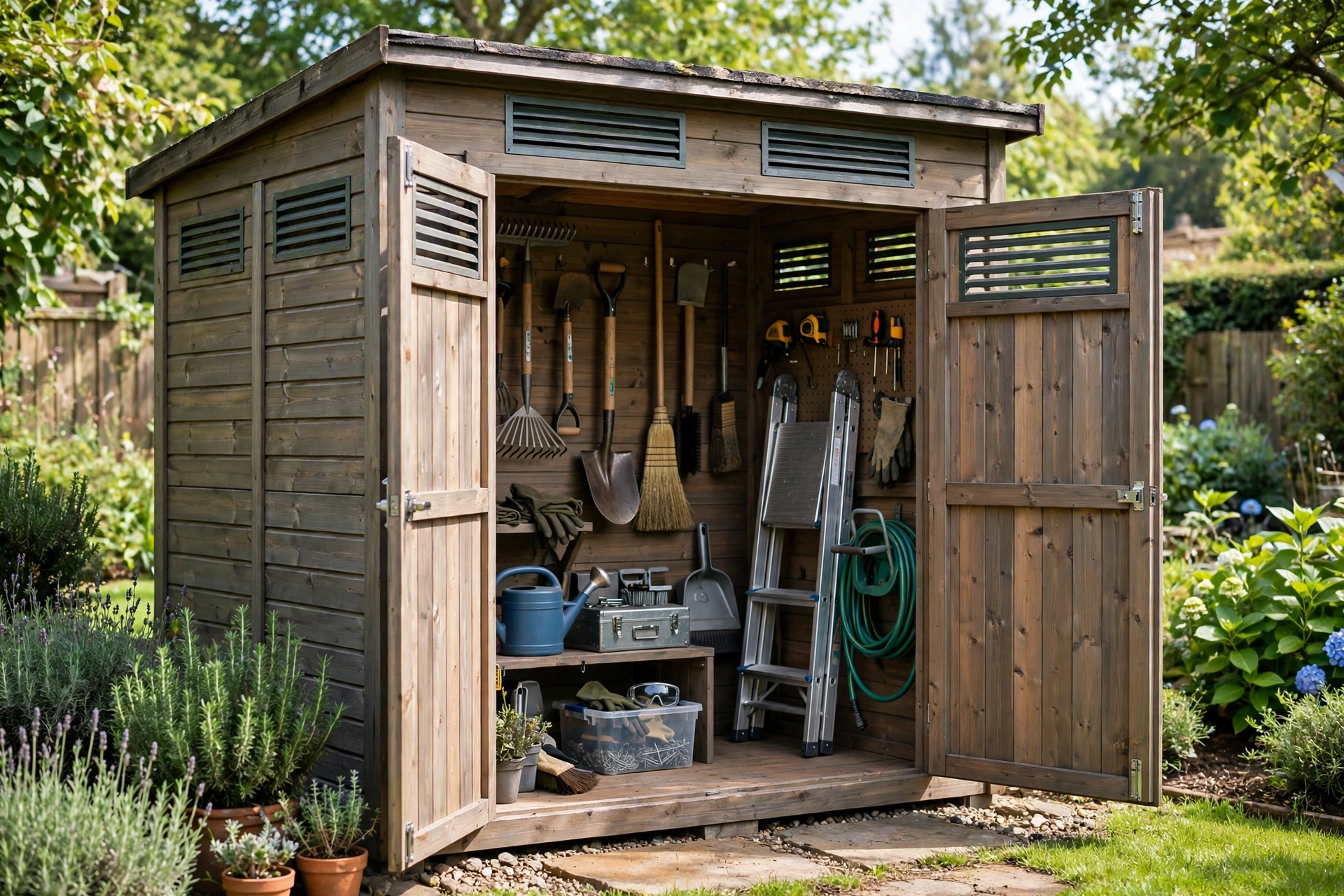
A mower, a pressure washer, and a rack of garden tools can quietly take over a garage, and every one of them lasts longer when it lives under a roof of its own. A ventilated outdoor storage structure gives that gear a dry home built for the yard rather than borrowed from the house. Done well, it protects engines from rain, keeps steel edges from rusting, and puts everything within a few steps of the work.
The short answer is that ventilation, not sealing, is what keeps stored equipment dry. Tools rust from condensation far more than from rain. Warm daytime air carries moisture inside, the temperature falls at night, and that moisture condenses on cold steel. A structure that moves air freely through itself keeps inside surfaces close to outside temperatures, so condensation has little chance to form.
Why Sealed Sheds Rust Tools Faster Than Open Air
It feels logical to seal a storage shed tight against the weather, but a sealed box in the sun heats up during the day and cools overnight, and the air inside sweats onto every cold surface. Tools stored in a watertight plastic box often rust faster than tools hanging on an open wall, because the box traps humid air and gives it nowhere to go. The shed becomes a damp box that works against the equipment inside it.
The fix is counterintuitive: let air in on purpose. Vents high and low on opposite sides let warm air escape at the top while cooler air enters at the bottom, and that slow convection keeps the inside close to outside conditions. The structure still needs a sound roof and walls that shed rain, but airtightness is the enemy, not the goal.
How Cross-Ventilation Keeps Stored Equipment Dry
Cross-ventilation works on a simple principle: air enters low on one side, warms slightly as it passes through the structure, and leaves high on the opposite side. The temperature difference between the low inlet and the high outlet drives the flow without any fan. The key is placing the openings on opposite walls so the air has to travel across the whole interior rather than short-circuiting through two vents on the same side.
- Fit low inlet vents on one wall and high outlet vents on the opposite wall so air crosses the interior.
- Use screened louvre vents that keep out insects and wind-driven rain while letting air through.
- Add a ridge or gable vent at the top so warm air has a clear exit even on still days.
- Keep the vent area roughly one square foot for every 150 square feet of floor, split between inlets and outlets.
- Leave the vents open year-round, since closing them in winter traps the moisture that causes rust.
In humid regions a small solar-powered exhaust fan at the ridge adds insurance on still, muggy days, but for most climates passive vents are enough. The test is simple: on a cool morning, check whether the inside of the roof is wet. If it is dry, the ventilation is working. If it beads with water, more vent area or a better high-low split is needed.
Siting the Structure for Sun, Wind, and Drainage
Where the structure sits matters as much as how it is built. A spot that catches the prevailing breeze will ventilate itself, while a sheltered hollow behind a fence will stay damp. Afternoon shade is worth more than morning sun, because direct sun on a metal roof drives the daily heating and cooling cycle that causes condensation. A site with a slight slope lets rainwater run away instead of pooling against the walls.
Think about the path to the work as well. The structure should sit close enough to the garden and driveway that carrying a mower or a ladder is easy, but far enough from the house that fuel smells and engine noise stay outside. Leave clear space around the door so it opens fully without hitting a fence or a planting bed.
Materials That Resist Corrosion Instead of Inviting It
The structure itself should be built from materials that tolerate damp air, because even a well-ventilated store is not a dry room. Pressure-treated timber, galvanised steel fixings, and a metal or fibre-cement roof all hold up far better than untreated softwood and plain steel screws. Inside, metal shelving with a powder-coated finish outlasts bare steel, and plastic bins beat cardboard boxes that turn to pulp in a humid summer.
| Material | Where it is used | Why it works | Watch out for |
|---|---|---|---|
| Pressure-treated timber | Frame and cladding | Resists rot and insects | Check treatment rating for ground contact |
| Galvanised steel fixings | Screws, brackets, hinges | Coating resists rust | Cut ends need cold-galvanising paint |
| Fibre-cement or metal roof | Roof covering | Sheds water, no rot | Condensation drip without anti-condensation layer |
| Powder-coated steel shelving | Interior storage | Hard finish resists moisture | Chips in coating rust first |
The cheapest material is rarely the cheapest over ten years. A shed built from untreated timber and plain screws can look fine for two seasons and then start shedding fasteners and softening at the base. Spending a little more on treated timber and galvanised fixings at the start is what makes the difference between a structure that lasts twenty years and one that rots in five.
Designing Vents, Louvres, and Ridge Openings That Actually Move Air
Vents only work if they are sized and placed with intent. A single small vent near the door does almost nothing, because air takes the shortest path. The effective pattern is low inlets on the cool side of the building and high outlets on the warm side, with the ridge vent tying the system together. Louvre blades angled downward keep rain out while letting air pass, and insect mesh behind the louvre stops wasps from nesting in the vent.
- Place low vents within 300 millimetres of the floor so cool air enters at the bottom.
- Place high vents at the gable peak or ridge so warm air escapes at the top.
- Angle louvre blades downward and outward to shed wind-driven rain.
- Back every vent with fine insect mesh that can be removed and cleaned.
- Keep stored items at least 150 millimetres clear of vents so airflow is never blocked.
A useful check after the first month is to tape a strip of tissue paper over an outlet vent on a calm day. If it flutters outward, warm air is leaving as intended. If it hangs still, the inlet area is too small or the outlet is blocked, and the structure is ventilating in name only.
Raising the Floor So Ground Moisture Never Reaches the Gear
The floor is where most storage structures fail first. A floor laid directly on soil wicks moisture upward all year, and anything stored on it sits in damp air. Raising the floor on battens, a gravel pad, or a low plinth breaks that contact and lets air move underneath. Gravel underneath the structure is better than soil or grass, because it drains and does not hold moisture against the base.
Inside, the same logic applies. Hang long tools vertically on wall hooks so their business ends never touch the floor, and keep boxes on shelves rather than stacked on the ground. A tool that hangs in moving air stays dry. A tool that lies on a damp floor in a pile will rust at the contact points first, which is exactly where it needs its edge.
Organising the Inside So Air Reaches Every Tool
A crowded store ventilates badly, however good the vents are. When every shelf is packed solid and tools lean in a heap, air cannot reach the middle of the pile, and the damp collects there. Plan the interior on paper before building: a wall rail with hooks for long-handled tools, a shelf for hand tools, and a clear bay for the mower or pressure washer, with a walkway down the middle that stays empty.
- Hang long tools vertically by the head or handle so nothing rests on the floor.
- Keep a clear walkway to the back wall so nothing has to be dragged out to reach the rear.
- Store fuel, oil, and batteries in a separate ventilated corner away from the door swing.
- Leave one shelf or bay empty, because storage always grows into the space left for it.
- Label the wall positions so every tool has a home and the layout survives the first busy weekend.
Organisation is maintenance in disguise. When every item has a place and the walkway stays clear, the structure gets used properly, the vents stay unblocked, and a quick look inside tells you at a glance whether anything is damp or out of place. A tidy store is a dry store.
Protecting Fuel, Batteries, and Chemicals in a Separate Zone
Fuel cans, batteries, and garden chemicals need their own zone inside the structure, for safety as much as for corrosion. Petrol vapour is heavier than air and can pool at floor level, so the fuel corner needs its own low vent and must sit away from any ignition source. Batteries should stand upright on a shelf where they cannot tip, and chemicals need to be locked away from children and kept off the floor where a leak would spread.
Never store fuel and fertiliser together, and never keep a running generator inside the structure. The enclosure is for storage, not for operating engines. A small, clearly marked zone with its own ventilation keeps the risks contained and the rest of the structure safe for ordinary tools.
A Maintenance Routine That Keeps the Structure Working
A ventilated store needs little upkeep, but the little it needs matters. Twice a year, clear the vents of cobwebs and leaves, check the insect mesh, and look at the roof fixings. Oil the hinges, tighten any loose boards, and sweep the floor so dust does not hold moisture. After a storm, check that no branch has blocked a vent or damaged the roof edge.
| Task | When | What to look for | Time needed |
|---|---|---|---|
| Clear vents and mesh | Spring and autumn | Leaves, cobwebs, wasp nests | 15 minutes |
| Check roof and fixings | After storms | Lifted sheets, loose screws | 10 minutes |
| Oil hinges and locks | Twice a year | Stiff movement, surface rust | 10 minutes |
| Sweep floor and shelves | Monthly in use | Dust, damp patches, spills | 10 minutes |
The routine takes under an hour a year, and it is what keeps a twenty-year structure from becoming a five-year one. Most of the damage that kills storage structures is slow and invisible: a blocked vent here, a rusted screw there. A short seasonal check catches both while they are still trivial.
Ventilated Storage Structure FAQs: Corrosion, Vents, and Layout
Why do my tools rust inside a closed shed?
Tools rust from condensation, not rain. A sealed shed heats up in the sun and cools at night, and the humid air inside condenses on cold steel. Vents high and low on opposite sides keep the inside close to outside temperatures, so condensation has little chance to form. A loose-fitting lid and a raised base help the same way.
How much vent area does a storage structure need?
A commonly used rule of thumb is roughly one square foot of vent area for every 150 square feet of floor, split between low inlets and high outlets. Two screened louvre vents low on opposite walls plus a ridge or gable vent at the top will move a surprising amount of air without any fan. In humid regions, a small solar exhaust fan adds insurance.
Should the floor sit directly on the ground?
No. A floor on bare soil wicks moisture upward all year. Raise it on battens, a gravel pad, or a low plinth so air moves underneath, and put gravel rather than soil or grass under the structure. Inside, hang tools vertically and keep boxes on shelves so nothing rests on the floor where damp collects.
Can I store fuel and batteries in the same structure?
Yes, if they have their own zone. Keep fuel in a separate ventilated corner away from the door swing and any ignition source, since petrol vapour pools at floor level. Store batteries upright where they cannot tip, and lock chemicals away from children. Never store fuel and fertiliser together, and never run an engine inside.
Do I need a fan, or are passive vents enough?
For most climates passive vents are enough, provided they are placed low on one wall and high on the opposite wall. A fan helps in very humid regions or on still, muggy days when natural convection is weak. A small solar-powered exhaust fan at the ridge is a cheap addition that only runs when the sun is strong, which is when it is needed most.
Final Thoughts: Dry Air Is the Best Tool Preservative
A ventilated outdoor storage structure is a simple idea executed with care. The roof keeps the rain off, the raised floor keeps ground moisture out, and the vents keep the air moving so condensation never gets a foothold. None of the parts is expensive, and none of the work is complicated, but the combination is what makes tools last decades instead of seasons.
Build it with treated timber and galvanised fixings, site it where the breeze reaches it, and keep the vents clear. Then hang the tools, leave the walkway open, and let the air do the work. The structure will quietly protect everything inside it for years, and the only maintenance it asks for is an hour a year.

