Deep decorative features make a house beautiful and its walls vulnerable at the same time. Cornices, quoins, string courses, dentil mouldings, and deep window surrounds all project from the facade, and every projection is a shelf where rainwater can sit, creep sideways, and find its way behind the cladding. The short answer is that protecting an ornate exterior is not about removing the decoration; it is about giving water a clear, visible path off every ledge and back to the ground. That means drip edges on every horizontal surface, weep holes behind every deep trim, rain chains or scuppers where downpipes would spoil the look, and drainage accessories chosen to match the architecture rather than fight it. This guide explains how rainwater behaves on decorative facades, which accessories actually work, and how to fit and maintain them without damaging the features they protect.
Why Deep Decorative Features Trap Water Against Walls
A flat wall sheds water predictably: rain runs down the surface and drips off the bottom edge. A decorative wall does not. Every projecting course of brickwork, every stone cornice, and every deep timber surround interrupts the flow and creates a horizontal surface where water pools. From there it does three damaging things. First, it soaks into porous materials such as brick, stone, and render, where repeated wetting and drying cycles cause spalling and cracking. Second, it creeps sideways along the underside of the projection by surface tension, reaching the wall behind the feature. Third, it finds the smallest gap — a hairline crack in a mortar joint, a failed sealant line — and enters the wall cavity, where it can sit for weeks against timber or insulation.
How Decorative Projections Change the Way Rainwater Moves
To choose the right accessories, it helps to picture what rain actually does on an ornate wall. Wind-driven rain hits the facade at an angle, so water strikes vertical surfaces as well as horizontal ones. On a flat wall the water sheets downward, but on a cornice or a deep sill it collects on the top face, runs to the lowest edge, and then — instead of falling clear — clings to the underside and tracks back toward the wall. This is the capillary effect, and it is the reason a plain square-edged ledge is one of the worst details on a house: it gives water a continuous path back to the structure it is supposed to protect.
The second behavior to understand is concentration. A wide cornice or a deep pediment gathers rain from a large area and delivers it to a single point, usually a corner or a joint. That point receives many times more water than the surrounding wall, so it fails first. A drainage accessory placed at exactly that concentration point — a scupper, a rain chain, or a shaped drip — handles the load where it actually lands instead of spreading the protection thinly across the whole facade. Walk around the house during heavy rain and watch where the water runs; the wettest spots are a map of where accessories belong.
- Capillary tracking pulls water along the underside of flat ledges back toward the wall, defeating the projection entirely.
- Concentration points at corners and joints receive far more water than the rest of the facade and fail first.
- Wind-driven rain strikes vertical surfaces, so even sheltered decorative features get wet from the side.
- Splashback from the ground wets the lowest courses of brickwork and the base of deep features after every storm.
Once you can see these patterns, the accessory choices become obvious. Every horizontal ledge needs a drip edge that breaks the capillary path. Every concentration point needs a controlled outlet. Every deep recess needs a drainage route that cannot clog. The rest of this guide works through each accessory in turn, with the details that make the difference between a fitting that works for twenty years and one that fails in the first winter.
Rain Chains, Cups, and Scuppers That Suit Ornate Facades
Downpipes are practical but rarely beautiful, and on a house with deep decorative features they can look like an afterthought bolted onto a finished composition. Rain chains and rain cups offer an alternative that turns the drainage itself into a feature. A rain chain is a linked series of cups or rings, usually copper or stainless steel, that guides water visibly from the gutter outlet to the ground, where it splashes into a drain or a planted bed. Inspired by traditional Japanese rainwater systems, they suit heritage and modern properties alike, and they are supplied in standard 2.5-metre packs with fixing kits for the top, a base plate, and a retaining wire for the lower end.
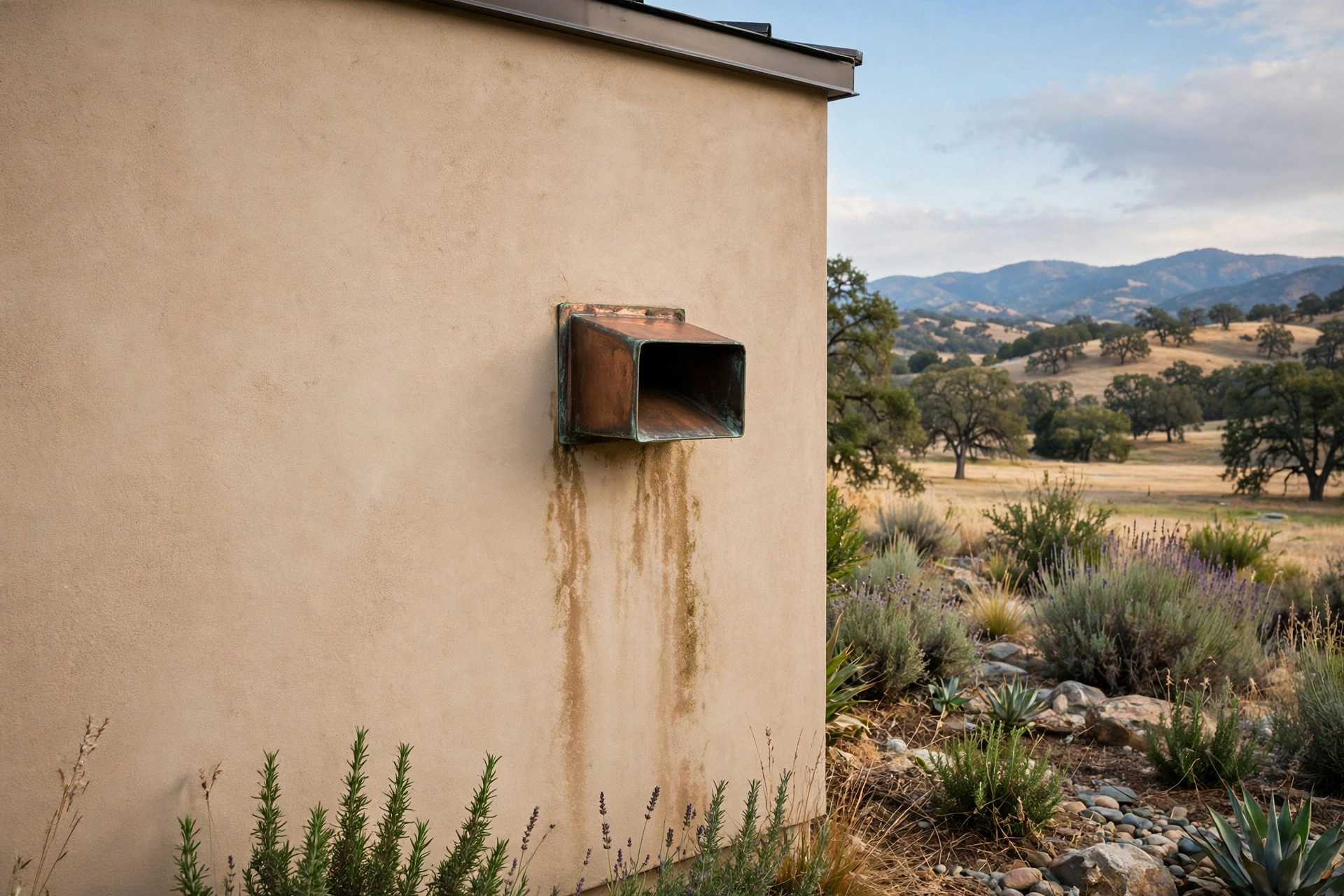
Scuppers serve a similar purpose where a flat roof, parapet, or deep cornice needs an outlet. A scupper is a shaped opening through the parapet or cornice that lets water escape in a controlled stream instead of ponding behind the feature. The best scuppers for decorative facades are made from the same material as the surrounding feature — lead, copper, or painted aluminium — so they read as part of the architecture. Where the facade is stone, a lead-lined scupper with a shaped drip edge looks intentional and lasts for decades.
- Rain chains replace downpipes where the water path should be seen, and they handle moderate rainfall well in sheltered positions.
- Rain cups slow the water as it descends, reducing splash at the base and adding movement and sound to the facade.
- Scuppers give flat roofs and deep cornices a controlled outlet, preventing ponding behind the feature.
- Hopper heads collect water from several small outlets and deliver it to a single downpipe or chain, keeping the facade tidy.
Rain chains have one real limitation: in very heavy rain or high wind, some water can blow off the chain. If the chain hangs above a path or an entrance, fit a small splash tray or a gravel bed at the base to catch the overspill. In exposed coastal or upland positions, a traditional downpipe is still the safer choice, and the chain can be reserved for sheltered elevations where its looks can be enjoyed without a performance penalty.
Drip Edges, Bell Casts, and Cornice Flashing
The drip edge is the single most important accessory on a decorative facade, and also the simplest. It is a small groove or projecting lip cut or fitted into the underside of a horizontal feature, placed a few centimetres back from the outer edge. Water running along the underside reaches the groove, cannot cross it, and falls clear of the wall. Without that groove, water tracks all the way back to the wall and into the joint. The classic bell cast — the flared, curved profile at the base of a rendered wall or a cornice — works on the same principle, throwing water outward and away from the surface below.
| Accessory | Best for | Typical material | Lifespan |
|---|---|---|---|
| Drip groove | Stone and render ledges | Cut into the feature | Life of the feature |
| Bell cast | Base of rendered walls | Render over a shaped batten | 20–30 years |
| Lead cornice flashing | Stone cornices and parapets | Code 4 or 5 lead | 40–60 years |
| Copper drip edge | Timber surrounds and bays | Copper strip | 30–50 years |
| Self-adhesive membrane | Retrofit flashing repairs | Butyl or bitumen tape | 10–15 years |
Weep Holes and Drainage Channels Behind Deep Trim
Some water will always get behind decorative trim, no matter how good the drip edges are. Weep holes are the escape route. A weep hole is a small opening, usually 10 millimetres wide, left at regular intervals in the lowest mortar joint behind a deep feature, through which trapped water can drain out. They are standard practice in cavity wall construction, but they are often forgotten when decorative features are added later. A string course, a deep window surround, or a stone plinth without weep holes is a reservoir waiting to fill.
Drainage channels work with weep holes to keep the cavity behind the feature dry. A dimpled drainage mat or a strip of drainage board fixed to the wall behind the trim creates a continuous air gap that water can run down to the weep holes. This is especially important behind deep timber features, where trapped water causes rot that is invisible until the timber is structurally compromised. If you are fitting new deep trim, insist on both the channel and the weep holes; if you are inspecting an old feature, look for the weep holes first, because their absence explains most damp problems in ornate facades.
- Space weep holes every 450 to 600 millimetres along the lowest joint behind the feature, and keep them clear of mortar droppings.
- Fit a drainage mat behind deep trim to create a continuous path for water to reach the weep holes.
- Check weep holes every autumn, clearing leaves, cobwebs, and insect nests with a thin wire or a blast of air.
- Never seal weep holes with silicone, even if they look untidy; a sealed weep hole is worse than no weep hole at all.
A quick test for hidden water behind a feature is to press a dry tissue against the lowest joint after rain. If the tissue comes away damp, water is trapped and the weep holes are either blocked or absent. Clear them first, and if the problem persists, have a specialist inspect the cavity behind the trim before the next wet season.
Keeping Decorative Drainage Clear Season After Season
Drainage accessories fail quietly. A rain chain slowly fills with leaves, a weep hole blocks with a spider’s nest, a drip groove fills with algae, and the water finds a new path — usually into the wall. The maintenance routine is short and worth doing twice a year, once in early autumn before the leaves fall and once in spring after the last frost. Walk the facade with a ladder, a stiff brush, and a bucket, and check every accessory in turn.
| Maintenance task | When | What to look for |
|---|---|---|
| Clear rain chains and cups | Autumn and spring | Leaves, moss, and bird nests in the cups |
| Check weep holes | Autumn | Blockages, mortar droppings, and insect nests |
| Inspect drip grooves | Spring | Algae and debris filling the groove |
| Check cornice flashing | Spring | Lifting edges, cracked sealant, and slipped lead |
| Clean scupper outlets | Autumn | Debris dams that force water back behind the feature |
While you are up the ladder, look at the wall itself. Green algae below a cornice means water is running where it should not. A white salty crust on brickwork means water is evaporating from inside the wall, carrying salts to the surface. Both are signs that an accessory has stopped working, and both are cheaper to fix now than after another winter of wetting and freezing.
When a Decorative Feature Needs a Specialist’s Eye
Some problems are beyond a ladder and a brush. If a stone cornice is cracked through, if a timber surround is soft when pressed with a screwdriver, or if damp appears inside the house in a line that follows a decorative feature, the work belongs to a conservation specialist or a roofer experienced with heritage facades. Cutting into a listed or period feature without understanding how it was built can destroy the very detail you are trying to protect, and in listed buildings it may also need consent before any work starts.
Drainage Accessory Questions for Decorative Exteriors
Can rain chains really replace a downpipe on a family home?
In sheltered positions and moderate rainfall, yes. A well-sized copper or stainless steel chain handles the flow from a typical domestic gutter, and the cups slow the water enough to keep splash under control. In exposed positions or areas with very heavy rainfall, a downpipe is safer, because wind can blow water off the chain. Many homes use chains on the front elevation, where they look best, and downpipes at the back, where performance matters most.
How do I know if the weep holes behind my string course are blocked?
Look for damp staining on the wall directly below the feature, and press a dry tissue against the lowest mortar joint after rain. If the tissue comes away damp, water is trapped behind the feature. Clear the weep holes with a thin wire or compressed air, and if no weep holes exist at all, have a specialist cut them into the lowest joint at 450 to 600 millimetre intervals.
Will a drip groove weaken a stone cornice?
No, provided it is cut correctly. A groove 10 millimetres wide and 8 millimetres deep, placed about 20 millimetres back from the outer edge, removes a tiny amount of material and has no structural effect on a solid stone cornice. The groove is one of the most effective details in traditional masonry, and many historic cornices were built with one from the start.
What material should I choose for flashing on a heritage facade?
Lead is the traditional choice and usually the right one for heritage buildings, because it is durable, flexible, and visually quiet once weathered. Code 4 lead suits most cornice flashing, while code 5 is better for larger areas. Copper is a good alternative where a warmer tone suits the building. Avoid aluminium on heritage facades, since it can look harsh and is less forgiving of movement in old masonry.
How often should decorative drainage accessories be inspected?
Twice a year is enough for most homes: once in early autumn before the leaves fall, and once in spring after the last frost. Check rain chains for debris, weep holes for blockages, drip grooves for algae, and flashing for lifting edges. After any severe storm, do a quick ground-level check for staining or overflow marks, which are the first signs that something has stopped working.
Final Thoughts: Letting Ornate Walls Drain as Well as They Look
Deep decorative features deserve protection that respects their beauty, and the best drainage accessories do exactly that. A drip groove cut into a stone cornice, a copper rain chain beside a deep window surround, a scupper that reads as part of the parapet — each one keeps water moving without spoiling the architecture. The work is mostly small, mostly cheap, and mostly visible, which is a rare combination in building maintenance. Walk the facade in heavy rain, note where the water actually goes, and fit the accessories where the water is. Do that, and the ornate walls will look as good in twenty years as they do today, because the water that would have damaged them will have been given somewhere better to go.

