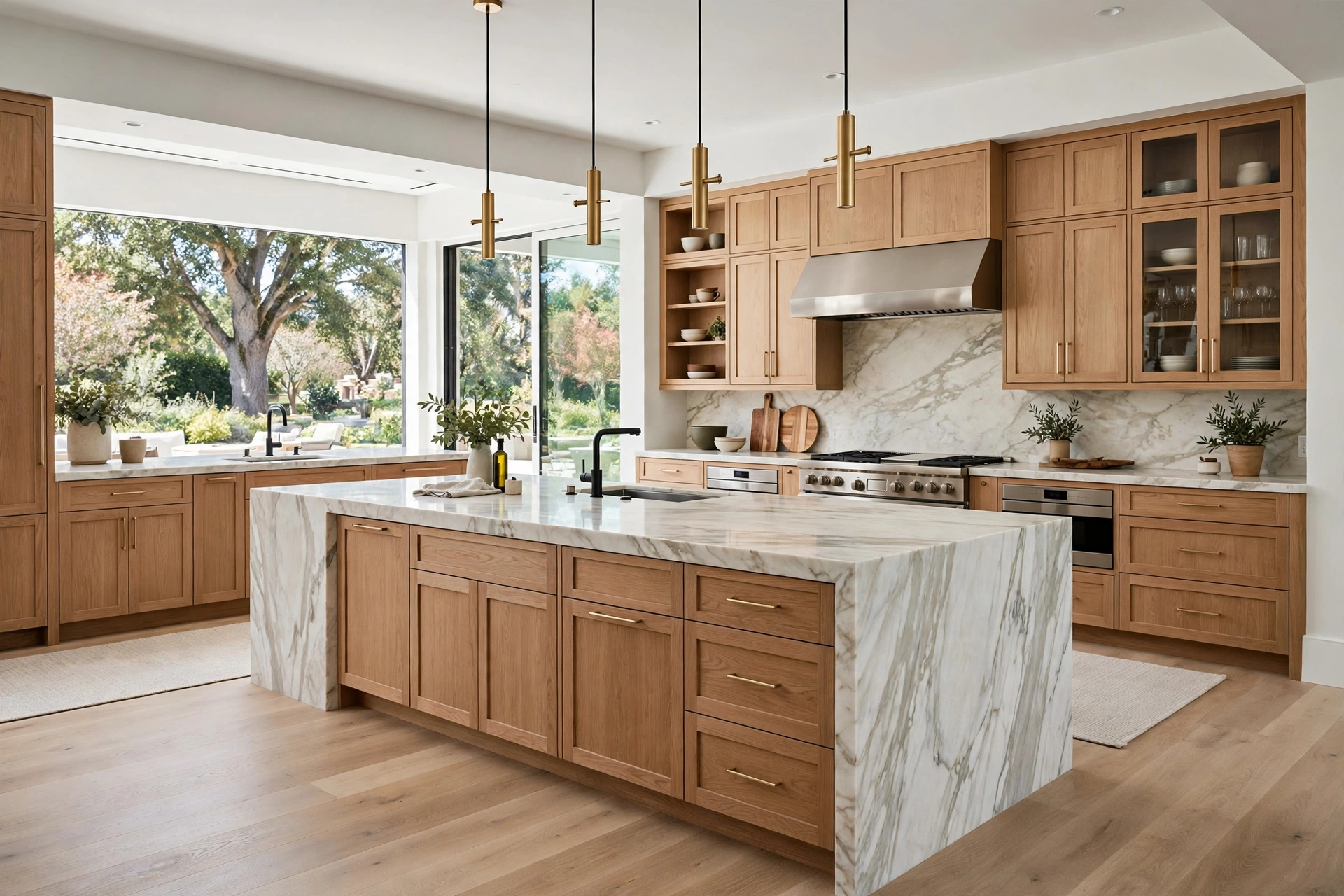
A luxury kitchen rarely comes from a single expensive object. It comes from the way the room holds together: a stone island that reads as one sculpted piece, cabinetry that fits the wall as if it grew there, and nothing visually noisy competing for attention. Waterfall countertops and customized cabinetry create that effect most reliably, because both are made to measure rather than bought off a shelf.
- In short: a luxury waterfall kitchen works when stone and cabinetry are designed as one piece of furniture. Pick a stone you love at full-slab scale, book-match the waterfall drop so the pattern flows over the edge, build cabinets to the exact island dimensions the stone requires, and keep the rest of the room quiet enough that the island can be the star.
A Waterfall Island That Behaves Like Furniture, Not a Countertop Slab
A waterfall countertop is a worktop that does not stop at the edge of the island. Instead, the same slab turns a corner and runs vertically down one or both ends, all the way to the floor. The top and the side panel are joined with a mitred edge, cut at matching 45-degree angles, so the stone’s pattern appears to pour over the edge. Done well, the island stops looking like a box with a lid and reads as a solid block of stone.
That furniture-like quality is why the concept suits luxury renovations: a waterfall island hides cabinet ends, toe kicks, and panel seams behind stone. The trade is real, though. The panel covers whatever sits behind it, so that end cannot hold drawers, and the island gains considerable weight. Settle both facts in design, because moving a panel after fabrication means ordering new stone.
Choosing the Stone That Carries a Whole Room on Its Shoulders
Not every beautiful stone makes a good waterfall. The vertical panel is lit differently from the top, viewed from standing height, and touched daily by knees, shoes, and vacuum cleaners. A stone that looks dramatic as a flat sample can look chaotic when its veining stretches down a full-height panel, and a soft stone can scuff at ankle level within a year. Judge every waterfall stone at full-slab scale, standing the slab upright if the supplier allows it.
Book-matching deserves a specific conversation with your fabricator: two adjacent slabs cut from the same block so veining mirrors across the mitre. With heavily veined marble or quartzite it adds hours of skilled labour, but it separates a waterfall that looks intentional from one that looks glued together. Ask to see a previous book-matched waterfall, and confirm in writing which slabs are reserved for your island.
Cabinetry Built Around Your Cooking, Not a Catalogue Grid
Customized cabinetry earns its price when it is designed around how you actually cook. A cabinet maker starts from your inventory and habits: the height of your tallest stockpot, the width of your baking trays, whether you decant dry goods into jars, and how many people cook at once. The result is a kitchen where every drawer has a reason to be exactly where it is, not a grid of standard boxes you learn to live around.
Frameless, or European-style, cabinets attach doors directly to the box, giving tight reveals and a seamless face that pairs naturally with a waterfall island. Inset cabinetry, where the door sits flush inside a face frame, reads more traditional and furniture-like. Inside the boxes, the luxury is in the fittings: full-extension drawers, pan drawers with dividers sized to your cookware, tall pantry pull-outs, and soft-close hardware throughout.
Pairing Wood, Lacquer, and Stone Without a Visual Clash
A waterfall island is a large, loud statement, so the cabinetry around it should contrast without competing. The current direction in luxury kitchens is warm and restrained: rift-sawn white oak or walnut for warmth and grain, paired with lacquered cabinetry in matte, muted tones such as greige, clay, or deep green. The wood gives the room its soul, the lacquer gives it calm, and the stone provides the drama.
Let one material lead and the others support. If the stone is boldly veined, keep cabinetry quiet: flat-panel doors in a warm neutral, minimal hardware, and a backsplash in the same stone carried up the wall. If the stone is calm and softly veined, the cabinetry can carry more personality: fluted fronts on the island base, a walnut accent wall, or unlacquered brass hardware that ages and warms over time.
The Island Layout That Lets a Waterfall Earn Its Floor Space
A waterfall panel adds roughly the thickness of the stone to each end of the island, and the island needs generous clearances to feel luxurious rather than cramped. Plan for 36 to 48 inches of clear floor around the island, more where someone opens a dishwasher or oven door. For seating, allow about 24 inches per stool and at least 12 to 15 inches of knee space under any overhang.
Outlets and services must be decided before the stone is templated, not after: a finished panel cannot easily gain an outlet, and cutting into one risks cracking it. Route wiring through the cabinet carcass, and plan sink, hob, and extraction around the panel supports.
- Keep 36 to 48 inches of walkway around the island.
- Allow 24 inches per seat, 12 to 15 inches of knee clearance.
- Fix outlets, sink, and hob positions before the stone is cut.
- Waterfall the side the room sees; keep cabinetry on the working side.
Hidden Storage That Keeps a Showpiece Kitchen Calm
A waterfall kitchen works best when the counters stay empty, and that only happens if everything has a home behind closed doors. An appliance garage with a pocket door hides the toaster, blender, and coffee machine while keeping them plugged in. A tall pantry wall with interior drawers replaces a cluttered countertop of jars. Add a tray divider, a vertical slot for cutting boards, and a charging drawer, then layer the lighting: under-cabinet LEDs for task work, interior cabinet lights for display units, and island pendants on a separate dimmer.
A Step-by-Step Path From First Sketch to Final Stone Template
Luxury renovations go wrong most often in sequencing, not taste. Keep the expensive, irreversible steps late, and never skip a step because the schedule is tight: a rushed template is how waterfall panels arrive the wrong size.
- Brief the designer with your cooking habits, inventory, and must-keep appliances.
- Approve the layout, island dimensions, and seating plan on paper.
- Choose the stone at full-slab scale and reserve the exact slabs.
- Finalise cabinetry finishes and hardware; confirm carcass dimensions against the stone plan.
- Fix every outlet, sink, hob, and plumbing position, then sign off.
- Template the island only after cabinets are installed and level.
- Inspect the mitred joints before installation day.
What a Waterfall-and-Custom-Cabinetry Kitchen Tends to Cost
Cabinetry is usually the largest share of a luxury kitchen budget, often 30 to 40 percent, with countertops and backsplashes taking a further 15 to 20 percent. A waterfall island adds a meaningful premium: published cost guides put a single waterfall edge at roughly $1,500 to $4,000 beyond a standard island top, depending on material and fabrication, with two-sided waterfalls higher again. Treat every figure here as a broad estimate, not a quote.
To control cost without cheapening the result, waterfall one side only, choose quartz over rare marble for the panels, and spend the saving on cabinetry interiors you touch daily. Ask for three prices: the design as drawn, with one waterfall side, and with standard island ends. Seeing the premium isolated makes the decision honest rather than emotional.
Waterfall Missteps That Quietly Cheapen a Luxury Kitchen
The first misstep is falling in love with a small sample: a four-inch chip cannot show how veining behaves across a ten-foot island and down a three-foot panel. The second is templating before cabinets are level; even a small error shows as a gap at the floor line no caulk can disguise. The third is forgetting the floor, since stone concentrates great weight on a small footprint and upper floors may need reinforcement. The fourth is treating the waterfall as indestructible: exposed corners chip at ankle height, and a chipped mitre is a specialist repair. Finally, do not let the island’s drama excuse a dull perimeter: give the wall cabinets one custom gesture, such as a furniture-style hood surround or a full-height stone backsplash.
Keeping Veined Stone and Fine Cabinetry Beautiful for Years
Wipe stone with a soft cloth and mild, pH-neutral cleaner, and wipe spills, especially wine, citrus, and oil, promptly. On marble and quartzite, reseal on your fabricator’s schedule, and test the seal with a few drops of water: if the stone darkens quickly, it is time to reseal. On quartz, skip abrasive pads and never place very hot pans directly on the surface. For cabinetry, wipe up sink water promptly, keep steam off door edges, and tighten a loose hinge the week you notice it. Once a year, check mitre joints, panel feet, and drawer glides, and book a specialist for anything that has moved or cracked.
When a Waterfall Kitchen Belongs With a Specialist Team, Not a Solo Contractor
A waterfall kitchen deserves a team that has done this exact job before: a designer who has specified waterfalls, a cabinet maker who builds to stone dimensions, and a fabricator with a track record of invisible mitres. Ask each for photos of completed waterfall projects and a reference you can contact, and be wary of any bid that prices the waterfall as a minor line item. Bring in licensed professionals for structural, electrical, gas, and plumbing work, and for floor reinforcement: permits and inspections are part of the luxury, not an optional extra.
Waterfall Countertop and Custom Cabinetry Questions Homeowners Ask Before Ordering Stone
Is a waterfall island worth the extra money in a luxury renovation?
It is worth it when the island anchors an open-plan room and you value a sculptural result over extra drawer space. It is harder to justify in a small or closed kitchen, where stone can overwhelm the room. Waterfalling one visible side gives most of the look for part of the premium.
Which stone is best for a waterfall countertop?
Quartz is the safest all-round choice: consistent pattern, easier mitre matching, no sealing. Marble gives the most dramatic veining but needs sealing and accepts patina. Quartzite offers natural movement with greater hardness, though slab variation complicates book-matching. Always choose at full-slab scale.
Does a waterfall island reduce storage?
Yes, on the sides covered by stone, since a panel replaces any drawers or doors there. Keep cabinetry on the working side of the island and add a tall pantry wall. If storage is tight, waterfall only the side facing the living space.
How long does a waterfall and custom cabinetry renovation take?
A full luxury renovation commonly runs several months, with cabinetry fabrication and stone templating among the longest lead items. Stone cannot be templated until cabinets are installed and level, so build buffer weeks into the plan for slab selection and fabrication.
Can a waterfall panel be repaired if it chips?
Small chips on quartz and granite can sometimes be filled and colour-matched by a specialist, but a damaged mitre corner is a skilled repair and may remain faintly visible. Protect exposed corners during construction and keep heavy objects away from panel feet.
Should the backsplash match the waterfall stone?
Carrying the same stone up the wall as a full-height backsplash creates a cohesive, high-end look. It adds material cost, so a quiet backsplash in a complementary tone is a good alternative. What looks unfinished is a busy tiled backsplash competing with a boldly veined island.
The Kitchen That Still Stops Guests at the Doorway in Ten Years
Luxury in a kitchen is a series of decisions that still look right a decade later: a waterfall island chosen at full-slab scale, cabinetry built around the way you cook, materials that contrast without competing, and a layout that respects clearances and services. Start with the stone and the cabinet maker, not the hardware catalogue. Your next step is a conversation: take your measurements, a list of what you cook and store, and photos of kitchens you admire to a designer who has built waterfall islands before, and ask to see the slab, the mitre, and the drawer that will hold your most awkward pan.

