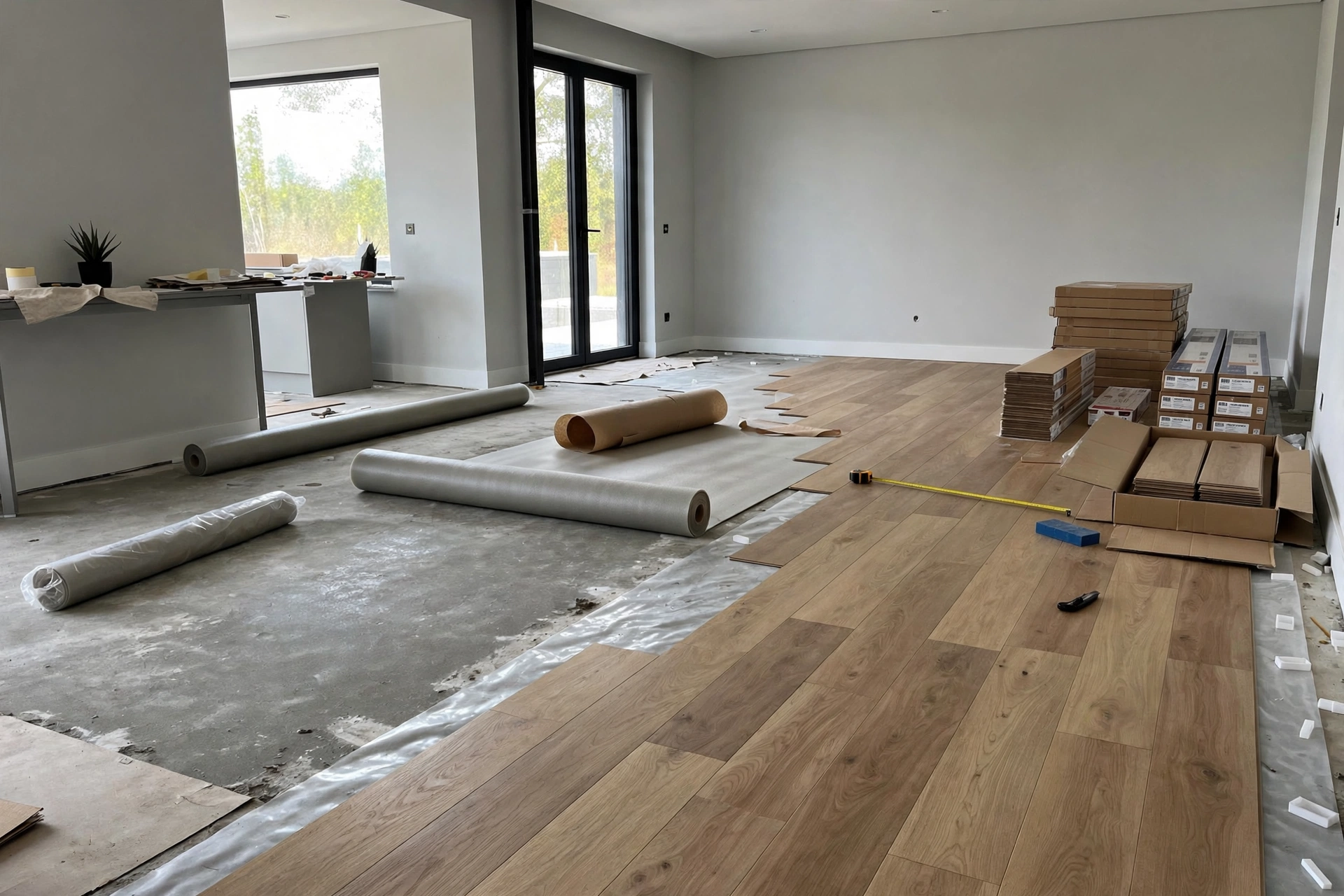
Vinyl plank flooring looks forgiving, yet over concrete it depends on a layer most homeowners never see. Concrete is porous, it wicks moisture upward, it stays cool, and it telegraphs every bump and dip to a thin plank above it. Choose the wrong underlayment, or skip it when your plank needs one, and the floor can feel hollow, sound loud, unlock at its joints, or trap moisture underneath a waterproof surface.
The direct answer is to start with your plank, not with a product on a shelf. If your plank has a pre-attached pad, you usually need only a vapour barrier over concrete, not a second cushion layer. If your plank is bare-backed, you need a dense, thin underlayment with a vapour barrier built in or added separately. In both cases, test the concrete for moisture, flatten it to the manufacturer's tolerance, and never stack two soft pads under a click-lock floor.
Why Concrete Changes Every Vinyl Plank Underlayment Decision
Concrete behaves differently from plywood, and that difference drives the whole choice. A plywood subfloor is relatively dry and forgiving, while a concrete slab, especially one at or below grade, can release moisture vapour year-round even when it looks dry. That vapour has nowhere to go once vinyl planks cover it, so it can condense, encourage mould in the dark layer below, and weaken adhesives or locking joints over time. A vapour barrier breaks that path, which is why it is treated as essential over concrete even when comfort layers are optional.
Concrete is also hard, cold, and unforgiving of unevenness. A thin vinyl plank will show bumps, dips, and trowel ridges through its surface, and a soft underlayment will not hide a subfloor that is out of tolerance. The underlayment's job is to provide a firm, even, moisture-controlled base, not to compensate for a slab that needs levelling. Understanding that limit keeps expectations realistic and prevents a soft product being blamed for a preparation problem.
Reading Your Plank First: Attached Pad, Bare Back, or Glue-Down
Check the back of your plank before shopping, because that single fact narrows the choice dramatically. Many rigid-core planks, including stone-plastic and wood-plastic composite products, arrive with a foam or cork pad already attached. That pad provides sound buffering and a small amount of cushion, and adding another foam layer underneath usually creates too much flex, which stresses click-lock joints until they separate. In that case, the usual requirement over concrete is a separate vapour barrier, unless the attached pad is already rated as a moisture barrier by its manufacturer.
Bare-backed planks, including many traditional luxury vinyl planks, need a separate underlayment almost everywhere, and certainly over concrete. Glue-down planks are different again: adhesive needs direct contact with a prepared slab or a suitable primer, so a floating underlayment must not be placed underneath them. Always read the flooring manufacturer's installation instructions first, since they specify allowed underlayment thickness, density, and vapour-barrier requirements, and following them protects both the floor and its warranty.
Moisture Testing a Concrete Slab Before You Choose a Barrier
Do not judge a slab by touch alone. A slab can feel dry while still releasing enough vapour to matter under a sealed vinyl floor, especially in basements and ground-floor rooms. Manufacturers commonly specify a moisture limit, often expressed as a relative-humidity reading from an in-situ probe test or a vapour-emission rate from a calcium-chloride test, and those limits vary by product. A simple surface meter can hint at a problem, but it does not replace the test method the manufacturer specifies.
If a test shows moisture above the product limit, address the source before laying underlayment, rather than hoping a thicker barrier will solve it. Check gutters, grading, and drainage outside, look for plumbing leaks, and allow a new slab adequate curing time, since fresh concrete releases moisture for months. A vapour barrier manages normal slab vapour; it does not fix active water intrusion, a leaking pipe, or a slab that is regularly wet. Those problems need repair first, and a flooring professional should assess them if the source is unclear.
Foam, Cork, Felt, and Rubber Underlayments Compared for Concrete
Foam underlayment is the most common budget option, offering moisture resistance when combined with a film barrier, plus modest sound reduction and warmth. It is light, easy to roll out, and suitable for many floating installations, provided it is dense enough and within the manufacturer's thickness limit. Very soft or thick foam, however, allows click-lock joints to flex, which is why thickness alone is never a sign of quality for vinyl plank floors.
Cork is naturally resistant to mould, offers good sound deadening and thermal insulation, and feels firmer underfoot than foam, which suits click-lock stability. Felt underlayments provide a dense, firm base and good sound control, while rubber underlayments are durable and effective for sound and impact, especially in multi-storey homes or busy rooms. Each material has a different cost, thickness, and vapour-barrier arrangement, so compare them by density, thickness, and whether a barrier film is included, rather than by marketing claims alone.
Thickness and Density Rules That Protect Click-Lock Joints
For floating vinyl plank, underlayment thickness is usually limited to a thin range, commonly around one and a half to three millimetres in total, including any attached pad, though the exact limit is set by the plank manufacturer. Exceeding that limit creates a soft, springy floor that lets joints flex with every footstep, and over time those joints can gap, unlock, or creak. Density matters as much as thickness: a dense, firm underlayment supports the locking system, while a soft, spongy one does not, even if both are sold as vinyl underlayment.
Never stack an attached pad and a separate foam pad to gain extra comfort, unless the manufacturer explicitly allows that combination for your product. That double-cushion mistake is one of the most common causes of unlocking joints and voided warranties, and it feels comfortable at first, which makes it harder to diagnose. If comfort is the goal, choose a plank with a thicker attached pad or a denser underlayment within the allowed total, rather than adding a second layer underneath.
Flattening, Cleaning, and Preparing Concrete for Underlayment
Prepare the slab by cleaning it thoroughly, removing dust, adhesive residue, paint, and loose material, and checking flatness with a long straightedge. Manufacturers commonly require flatness within about three sixteenths of an inch over a ten-foot span, though the exact tolerance varies, and any high spots should be ground down while low spots are filled with a suitable levelling compound. Allow levelling compound to cure fully before laying underlayment, since trapping moisture under vinyl defeats the purpose of the barrier.
Fill cracks that are stable and narrow according to the product guidance, and have wide, moving, or structural cracks assessed before flooring, since underlayment will not stabilise a slab that is still moving. Sweep and vacuum again immediately before installation, because grit trapped under underlayment can telegraph through thin planks and damage the vapour film. A clean, flat, dry slab is the foundation every underlayment choice depends on, regardless of material or price.
Laying a Vapour Barrier and Underlayment Without Creating New Problems
Roll out the vapour barrier or combined underlayment in the direction the instructions specify, butt edges tightly without overlapping unless the product calls for an overlap, and tape seams with the recommended tape to create a continuous barrier. Run the barrier slightly up the wall at the perimeter where instructed, so moisture cannot bypass it at the edges, and trim the excess only after the planks and skirting are in place. Keep the material flat and free of wrinkles, since a folded barrier can create a soft spot under a plank joint.
- Butt edges tightly, tape seams, and keep the barrier continuous.
- Do not overlap cushion layers or double up pads under click-lock planks.
- Keep the work area clean, so grit does not puncture the vapour film.
- Leave the expansion gap the plank manufacturer specifies around the room.
Install planks over the underlayment promptly once it is laid, and avoid walking on the barrier with dirty boots or dragging heavy boxes across it. If the barrier is punctured, patch it according to the manufacturer's guidance rather than ignoring a small hole, since moisture finds the weakest point first. A careful, continuous barrier is worth more than an expensive underlayment laid carelessly.
Underlayment Slip-Ups That Cost Homeowners a Vinyl Floor
The costliest slip-ups are stacking two pads, skipping a vapour barrier over concrete, laying planks over an uneven or damp slab, and choosing a thick, soft underlayment for comfort without checking the joint limit. Each mistake can look fine on installation day, then show up months later as gapping joints, hollow sounds, mould odour, or planks that unlock under normal foot traffic. By then, the repair often means lifting the floor, not simply replacing a single plank.
Avoid those outcomes by reading the plank instructions, testing moisture, flattening the slab, choosing a dense underlayment within the thickness limit, and keeping the vapour barrier continuous. If any step is unclear, especially moisture testing or slab levelling, a flooring professional's assessment is usually cheaper than a full floor replacement. The underlayment is a small part of the project cost, but it carries a large share of the floor's long-term success.
Final Thoughts: Choosing Vinyl Underlayment That Suits Concrete, Not Just Comfort
Choose underlayment for vinyl plank over concrete by starting with your plank, adding a vapour barrier every time, and selecting a dense, thin layer within the manufacturer's limit. Test moisture, flatten the slab, lay the barrier continuously, and never stack two soft pads under a click-lock floor. That sequence gives a quiet, warm, stable floor that stays locked together, rather than a comfortable floor that fails quietly underneath.
Vinyl Plank Underlayment FAQs: Concrete, Moisture, and Click-Lock Floors
Do I always need a vapour barrier under vinyl plank on concrete?
Yes, in practical terms. Concrete releases moisture vapour even when it feels dry, so a vapour barrier is needed over concrete even under planks with an attached pad, unless that pad is manufacturer-rated as a moisture barrier for concrete use.
Can I add foam underlayment under a plank with an attached pad?
Usually no. Adding a second cushion layer makes the floor too soft, stresses click-lock joints, and can void the warranty. Check the manufacturer's instructions, and choose a plank or underlayment combination that stays within the allowed total thickness.
What thickness of underlayment is safe for vinyl plank flooring?
Manufacturers commonly limit total underlayment, including any attached pad, to a thin range around one and a half to three millimetres, but the exact limit varies by product. Always follow the limit for your specific plank, and favour density over thickness.
How do I know if my concrete slab is too damp for vinyl plank?
Use the moisture test method your plank manufacturer specifies, such as an in-situ relative-humidity probe or a calcium-chloride vapour-emission test, rather than judging by touch. If the reading exceeds the product limit, address the moisture source before installing.
Is cork underlayment better than foam over concrete?
Cork often offers better sound deadening, warmth, and mould resistance, and a firmer feel underfoot, while foam is usually cheaper and easier to install. Either can work if it is dense, within the thickness limit, and paired with a proper vapour barrier arrangement.
Do glue-down vinyl planks need underlayment over concrete?
No. Glue-down planks need adhesive contact with a prepared slab or primer, so a floating underlayment must not go underneath them. Follow the adhesive and plank manufacturer's preparation instructions for concrete instead.

