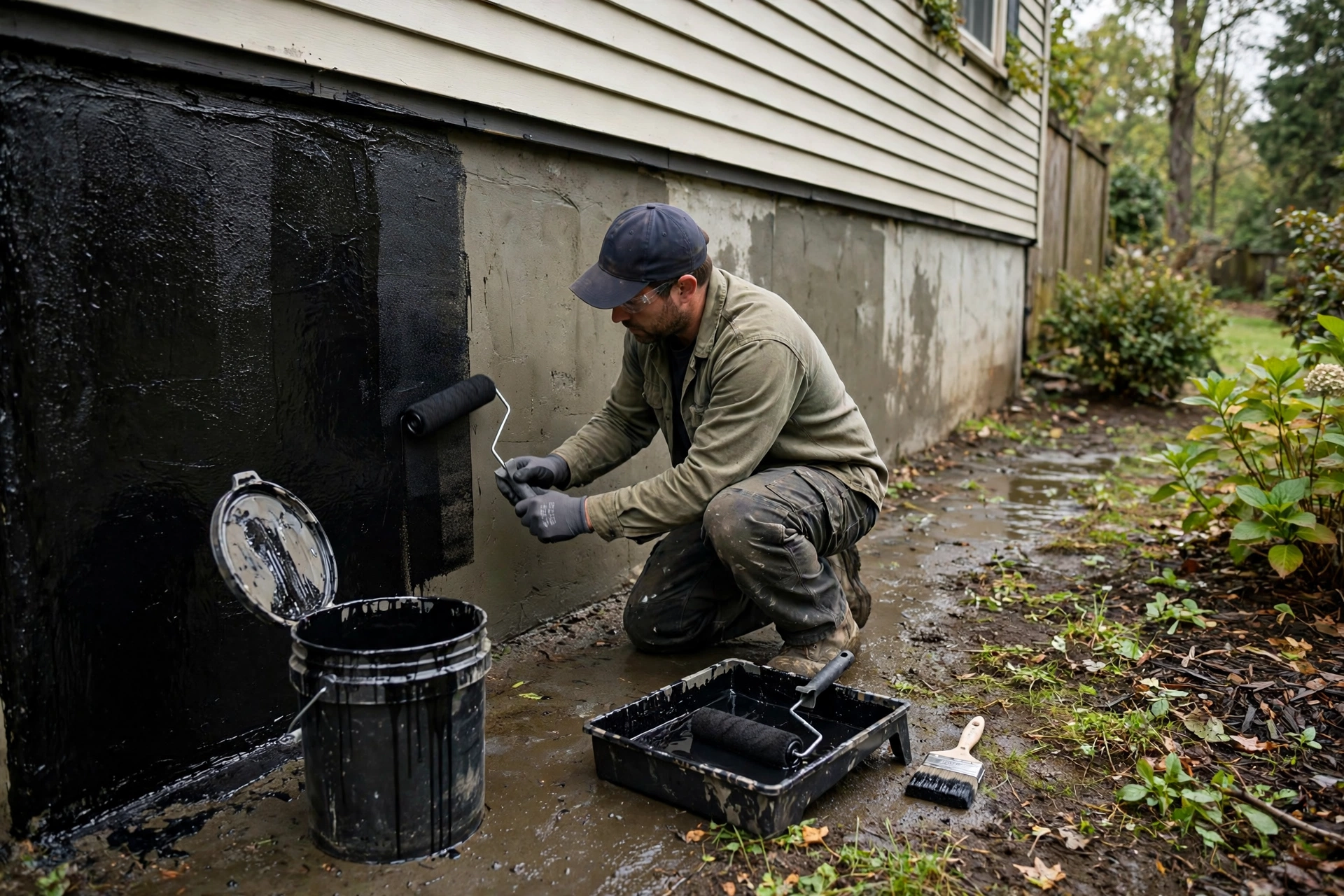
Damp walls that keep coming back are one of the most frustrating problems a homeowner can face. The paint bubbles, the plaster darkens at the base of the wall, a white salty crust appears, and the musty smell returns every wet season no matter how many times the inside is repainted or coated. The reason the problem repeats is simple: the water is getting in from the outside, and anything applied to the inside of the wall is fighting it from the wrong side.
The most effective answer for homes with recurring damp walls is exterior foundation sealing: excavating the soil beside the foundation, repairing the wall, and applying a continuous waterproofing membrane on the outside, protected by a drainage board and a working footing drain. Water is stopped before it ever enters the masonry, and the soil pressure that would push an interior coating off the wall instead presses the exterior membrane tighter against it. This guide explains how to diagnose the damp, choose the right sealing method, and build an exterior system that actually lasts.
Why Damp Walls Keep Coming Back After Interior Paint and Sealers
Interior coatings fail on damp walls for a structural reason, not because the product was poor. Water arriving from saturated soil pushes through porous concrete and blockwork under hydrostatic pressure, and an interior coating sits at the very end of the water’s path, with nothing behind it to resist that push. Sooner or later the pressure lifts the coating, drives moisture around its edges, or forces water through at the floor-wall joint. The wall behind the coating stays saturated, so freeze-thaw damage continues inside the masonry even while the room looks dry for a few months.
Hydrostatic pressure: the water table rises or saturated soil presses water through even solid concrete and hairline cracks.
Seepage: water enters through specific defects such as cracks, pipe penetrations, cold joints, and failed mortar.
Condensation: warm, humid indoor air meets cool foundation walls and drops to its dew point, leaving the wall wet from the inside.
Rising damp: groundwater wicks upward through masonry by capillary action where the damp-proof course has failed.
A simple plastic sheet test helps separate them: tape a small square of clear plastic to the damp wall for 24 hours. Moisture on the wall side of the sheet points to water coming through the wall; moisture on the room side points to condensation.
What Makes Exterior Foundation Sealing Different From Interior Damp-Proofing?
The difference between damp-proofing and waterproofing is the difference between resisting vapour and resisting liquid water under pressure. Damp-proofing, such as the thin spray-on asphalt coating applied to the outside of many new foundations before backfilling, resists moisture vapour and light seepage. It is a code minimum in many places, it is not rated for liquid water under pressure, and it degrades over the decades. Waterproofing is rated to resist liquid water under hydrostatic pressure, using elastomeric membranes and cementitious coatings with published performance ratings. A third category, penetrating sealers, sidesteps the surface entirely by reacting inside the concrete to block its capillaries.
Damp-Proofing, Waterproofing, and Penetrating Sealers Compared
Choosing a sealing material starts with matching the product to the wall, the soil, and the amount of water pressure involved. A wall that only ever sees light dampness can be served by a cementitious coating, while a wall sitting in saturated clay with a high water table needs a fully bonded elastomeric membrane and drainage. The comparison below sets out the realistic options for an existing home.
Excavating, Cleaning, and Prepping a Foundation Wall for a Lasting Seal
A membrane is only as good as the wall it sticks to. Most exterior sealing failures trace back to preparation: a dirty wall, a wet wall, an unrepaired crack, or a membrane applied over loose material. Excavation and preparation are the unglamorous half of the job, and they decide whether the seal lasts five years or twenty-five.
Expose the wall fully. Excavate down to the footing along the affected elevation, keeping the trench wide enough to work safely and shoring it if it is deep.
Inspect and record. Mark every crack, spalled area, failed joint, and pipe penetration, and look for efflorescence, the white powdery residue that shows water has been moving through the wall.
Repair the structure first. Fill non-structural cracks with fast-setting hydraulic cement, which expands slightly as it cures, and have any structural cracking assessed by an engineer before sealing over it.
Clean the surface. Power wash the wall, wire-brush off loose coatings and mineral deposits, and remove all dust, soil, and organic growth.
Let the wall dry. Most exterior sealants need a dry substrate for proper bonding and curing, so allow full drying time and check the forecast before applying.
Prime where required. Some sheet membranes need a compatible primer on the wall; follow the manufacturer’s instructions rather than skipping this step.
Safety during excavation deserves real attention. A trench beside a foundation can collapse without warning, so never enter an unshored trench deeper than about chest height, keep spoil and equipment back from the edge, and keep the excavation dewatered so nobody works in standing water. Underground services are another hazard: call the local utility locating service before any digging, and hand-dig near marked lines. If the foundation shows signs of movement, bowing, or major cracking, stop and get a structural engineer involved; sealing over a moving wall hides the problem instead of fixing it.
Liquid Membranes, Sheet Membranes, and Cementitious Coatings on Real Walls
On a real, imperfect foundation wall, the choice between liquid and sheet membranes is usually decided by the wall’s condition. Liquid-applied membranes, typically rubberized asphalt or polyurethane, are rolled or sprayed on in thick coats and cure into a seamless, flexible skin that follows the wall’s irregularities and bridges hairline cracks. Their weakness is thickness control: the wet film has to reach the specified thickness everywhere, and thin spots become the leak points. Sheet membranes, by contrast, arrive at a guaranteed thickness and offer superior tensile strength and puncture resistance, but every lap, corner, and penetration has to be detailed perfectly, and that takes time and care.
Liquid membranes suit rough, uneven walls and complex shapes, and they are the faster option on long, straight elevations.
Sheet membranes suit high water pressure and walls where a guaranteed thickness matters more than speed.
Cementitious coatings suit sound walls with only light dampness, and they tolerate a damp substrate better than most other products.
Always lap membranes so water runs over the joint, not into it, and carry the membrane down over the footing and up above finished ground level.
Protect the finished membrane immediately with a drainage board before any soil goes back, because backfill is what punctures most membranes.
Drainage Boards, Footing Drains, and Grading That Protect the Seal
A membrane without drainage is a dam, and dams eventually leak. The drainage layer beside the wall does two jobs: it gives water a fast path down to the footing drain, and it shields the membrane from damage during backfilling and from soil pressure afterwards. A dimple board, a semi-rigid plastic drainage mat, creates an air gap between the soil and the sealant so water can flow freely downward instead of pressing against the membrane.
Final Thoughts: Sealing a Damp Foundation Wall From the Outside for Good
Recurring damp walls are a message from the outside of the house, and they are answered from the outside. Interior coatings can manage light moisture, but a wall that keeps getting wet needs the water stopped before it enters the masonry: a repaired wall, a continuous waterproofing membrane, a drainage board, a working footing drain, and ground that slopes away from the house. Done once and done properly, that system protects the wall for decades, stops the freeze-thaw damage that quietly weakens masonry, and ends the cycle of repainting the same damp patch every year. The excavation is disruptive and the work is not cheap, so if the wall is ever exposed for another reason, that is the moment to seal it. And if the damp comes with structural cracking, bowing, or a floor that moves, bring in a structural engineer before the membrane goes on, because sealing a moving wall is money spent hiding a problem.
Exterior Foundation Sealing Questions Answered for Damp-Wall Homes
How much does exterior foundation sealing cost?
Costs vary widely with the length of wall, the depth of excavation, access for equipment, and the membrane system chosen. As a broad guide, exterior waterproofing of one elevation of a typical home usually runs into the thousands of dollars, and a full perimeter job considerably more. Interior coatings cost a fraction of that, which is why matching the solution to the severity of the damp is the best way to control the budget. Get at least two detailed quotes that itemise excavation, membrane, drainage, and backfill separately.
Can I seal a foundation from the outside without excavating?
Not effectively. The membrane has to bond to the wall on the water side, and that means exposing the wall down to the footing. Injection repairs and interior coatings can manage individual cracks or light seepage without excavation, but they do not give the wall a continuous exterior barrier. If excavation is impossible, focus on drainage, grading, and gutters first, because reducing the water load often reduces the damp dramatically.
How long does exterior foundation waterproofing last?
A properly installed elastomeric membrane protected by a drainage board and a working footing drain commonly lasts 20 years or more, and many systems are still performing well beyond that. Longevity depends on the membrane, the quality of the installation, and whether the drainage keeps working. A membrane that sits permanently under standing water, or one punctured during backfilling, will fail far sooner.
What is the difference between damp-proofing and waterproofing?
Damp-proofing resists moisture vapour and light seepage; the thin asphalt coating on many new foundations is damp-proofing, and it is not rated for liquid water under pressure. Waterproofing is rated to resist liquid water under hydrostatic pressure, using elastomeric membranes or cementitious coatings with published performance ratings. For a home with recurring damp walls and wet soil, waterproofing is the appropriate standard.
Should I fix the footing drain at the same time?
Yes, almost always. A membrane stops water entering the wall, but the footing drain is what relieves the pressure behind it. If the old drain is collapsed, silted, or discharging nowhere, replace it with a perforated pipe in washed gravel, wrapped in filter fabric and pitched to daylight or a sump, while the trench is open. Doing it later means digging the wall up again.

