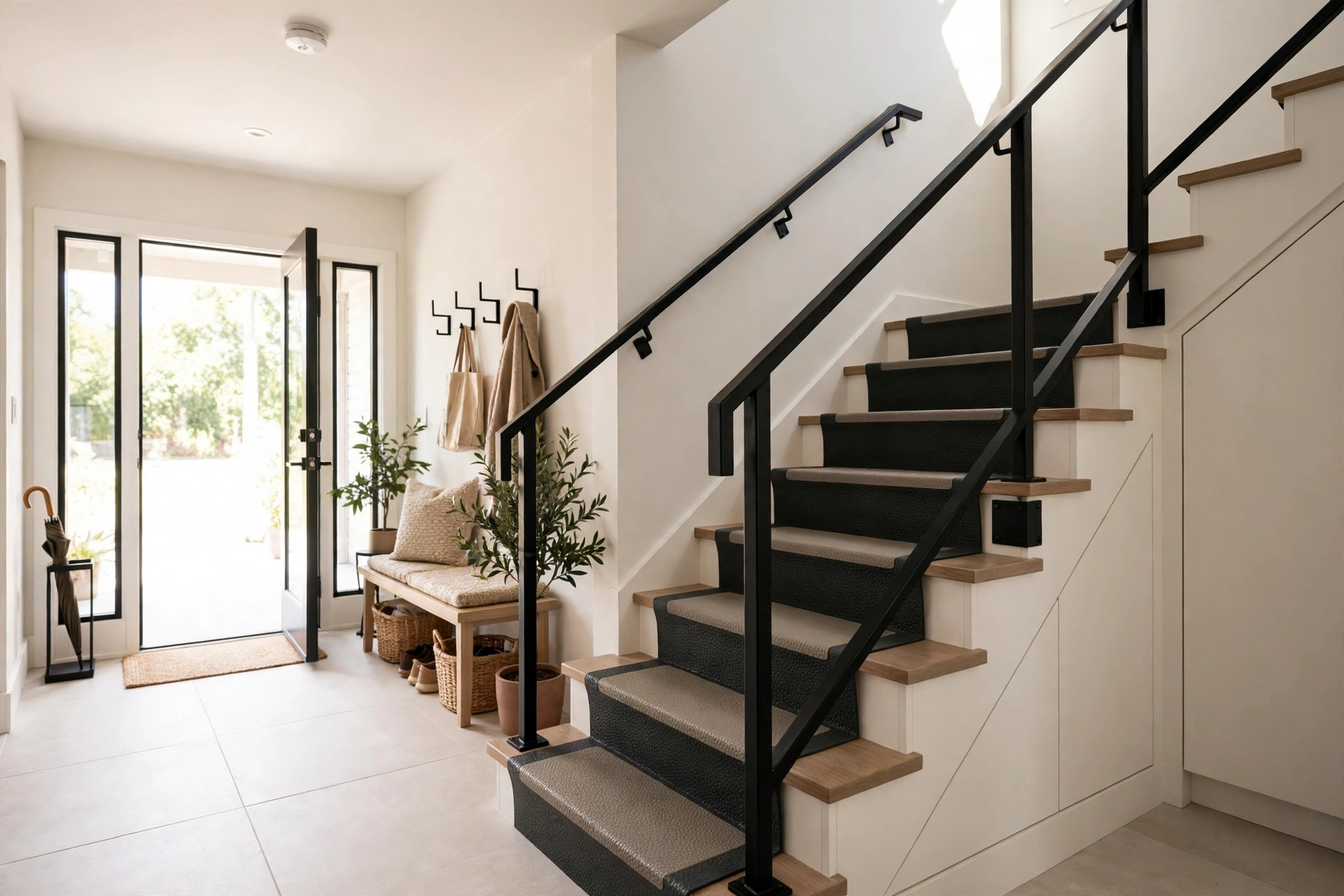
A staircase is the hardest-working feature in most homes. It carries daily foot traffic, links rooms of very different styles, and is where a poor material choice shows up twice: as a scuffed surface and as a slip or a handrail that gives way. A good renovation fixes both problems at once.
The direct answer is this: pair a durable, grippy tread with a firm, continuous handrail and a balustrade that cannot be leaned apart or climbed through. Solid or engineered hardwood with a matte, slip-resistant finish suits most homes, while a low-pile runner adds grip and quiet where children, older adults, or pets use the stairs daily. Glass opens up light in modern interiors; steel or wrought iron gives a slim, strong frame. No single material wins alone. The right combination depends on who uses the stairs, how much light the stairwell gets, and how much maintenance you will actually do.
Start With the Staircase You Already Have: Structure, Wear, and Grip
Before choosing a stain colour or glass panel, inspect what is underneath. A surface-only renovation fails if the structure moves, squeaks, or flexes. Walk the stairs slowly, holding the rail, and note any tread that bounces, any riser that varies in height from its neighbours, and any newel post that rocks when pushed. Uneven risers are a particular trip risk because feet learn a rhythm on the first few steps, then catch on a step that is even slightly higher or lower.
Check the handrail too: it should run continuously where the layout allows, feel comfortable to grip, and stay firm when pulled sideways. Balusters and posts should not flex or rattle. If the assembly shifts, fix it structurally first, by tightening, re-fixing, or replacing a post or stringer, before ordering finishes. Also check the top and bottom steps and the landing transitions. A tread that sits proud of the landing creates a lip that catches toes; one that sits low creates a small drop that is easy to miss in dim light.
Hardwood, Engineered Wood, and Laminate Treads: Warmth That Holds Up to Daily Foot Traffic
Hardwood remains the default tread choice for good reasons. Oak, maple, and walnut resist dents from shoes and furniture, can be sanded and refinished when worn, and can be stained to match existing floors or to stand out against painted risers. White risers with a mid-tone or dark stained tread is a classic combination, and the contrast also helps the eye pick out each step edge, which is a genuine safety benefit.
Finish matters as much as species. High gloss looks striking when new but can turn slippery, especially in socks, and shows scratches quickly. A matte or satin finish with a slip-resistant additive gives better traction and hides wear far more gracefully. Engineered wood offers a middle ground: a real hardwood veneer over a stable core resists gapping in homes with wide humidity swings, but it can only be refinished a limited number of times. Laminate is the budget option. It mimics wood well and resists stains, but it cannot be refinished, its edges can chip, and it needs stair-specific nosing pieces rather than improvised floor planks.
Carpet Runners, Vinyl, and Rubber: Softer Staircase Surfaces for Grip and Quiet
For households with young children, older adults, or pets, a softer tread surface is often wisest. Carpet is the most forgiving stair surface in a fall, it muffles footsteps between floors, and it grips well in bare feet and socks. A runner, which leaves a strip of wood visible on each side, is usually better than wall-to-wall carpet on stairs: it is easier to replace when worn and it preserves the staircase outline.
Choose the runner carefully. Low-pile, dense wool or nylon wears far better than thick, plush carpet, which compresses at the nosing and creates a rounded, unstable edge. A non-slip underlay or gripper system is essential, since a runner that creeps forward underfoot is more dangerous than a bare tread. Luxury vinyl suits basement or back stairs: it is water-resistant and easy to clean, though thin vinyl over an uneven base can flex and sound hollow. Rubber treads offer excellent grip even when wet and are very durable, but they look utilitarian, so they work best on utility stairs or as discreet nosing strips.
Glass, Steel, and Wrought Iron Balustrades: Open Light Without Giving Up a Firm Handhold
The balustrade, the handrail, posts, and infill panels along the open side, shapes the whole interior more than any other single element. Replacing heavy turned-wood balusters with glass or metal can turn a dark, enclosed stairwell into an open feature that borrows light from nearby rooms. But the balustrade is also a safety barrier, and its materials must be chosen for strength first and transparency second.
Frameless or channel-set glass panels give the most open result, keeping sightlines clear and making a narrow stairwell feel larger. The glass must be toughened or laminated safety glass of appropriate thickness, installed in a properly engineered channel or clamp system, not wedged into a timber groove. A slim wooden or metal handrail cap over glass panels is worth adding for grip and edge protection. Stainless steel cable systems look minimal but must stay tensioned and spaced closely enough that a small child cannot squeeze through or climb them. Wrought iron spindles are exceptionally strong, suit traditional and contemporary interiors alike, and are usually fixed with epoxy and discreet shoe plates.
Nosing, Lighting, and Handrail Details That Make Staircase Materials Safer
Most staircase falls do not happen because the tread material was wrong in the abstract. They happen at the edge of the step, in poor light, or when someone reaches for a rail that is not there. The nosing, the front edge of each tread, is the highest-wear and highest-risk part of the staircase. A rounded or bullnose profile hurts less if someone trips and chips less than a sharp square edge. A contrasting nosing strip, or a tread colour that clearly differs from the riser, helps everyone, especially people with reduced vision, see where one step ends and the next begins.
Lighting transforms both safety and appearance. A single ceiling light at the top often leaves the middle steps in shadow. Low-voltage LED strips under the nosing, recessed wall lights at intervals, or a strip beneath the handrail all wash light directly onto the treads where feet land. Motion-sensor strips are practical for night-time use. Whichever system is chosen, keep the light even along the whole flight; a bright pool at the top and darkness at the bottom is worse than modest, even lighting throughout.
- Keep riser heights and tread depths consistent; one odd step breaks walking rhythm and causes trips.
- Fit a handrail on at least one side, and both sides where the staircase is wide or used by older adults.
- Use closed risers where small children or pets use the stairs, so feet cannot slip through gaps.
- Fix runners, mats, and nosing strips firmly; any loose edge on a staircase is a hazard.
Matching Staircase Materials to Your Interior Without Dating the Renovation
A staircase renovation should look like it belongs to the house, not like a catalogue page dropped into it. Echo materials already present in the adjoining rooms: oak treads stained to match oak flooring create continuous flow, while slim black steel, pale wood, and glass suit a pared-back modern interior. In a traditional home, turned newel posts and warm wood tones feel right; in a heritage property, preserve original features and improve only their stability and finish.
Restraint keeps a renovation from dating quickly. One strong feature, such as glass panels or a bold runner pattern, is enough; combining glass, ornate iron, patterned carpet, and a statement paint colour on one flight usually fights itself. Judge colours in the stairwell’s actual light, not only in a shop: a stain that looks warm under showroom lighting can read cold in a north-facing stairwell, and a dark tread can turn a narrow stairwell into a tunnel. Take samples home and view them in morning and evening light before committing.
Staircase Renovation Material Budgets, Upkeep, and When a Specialist Should Take Over
Costs vary widely with scope, and any figure quoted without seeing the staircase should be treated as a broad estimate only. A cosmetic refresh, refinishing treads, repainting risers, and adding a runner, is generally the most affordable route. Replacing treads and the balustrade is a mid-range project, with glass panels and custom metalwork pushing the budget higher because of specialist fabrication and fitting. A full structural rebuild, including new stringers or a changed layout, is a major project priced only after an on-site survey.
Upkeep should be part of the material decision. Hardwood needs a suitable cleaner and a fresh finish every few years in busy homes; glass needs frequent wiping; carpet runners need vacuuming and occasional deep cleaning; metal fixings should be checked for looseness and corrosion. Choose a material whose maintenance you will actually do: a neglected hardwood staircase is less safe and less attractive than a well-kept carpeted one. Call in a qualified staircase contractor if stringers, posts, or floor structure are damaged, if the layout is changing, if a floating design is planned, or if glass balustrades need engineering. Floating treads rely on hidden steel fixings that cannot be judged from the surface, and older homes should be checked for lead paint before sanding begins.
Staircase Renovation Material FAQs
What is the safest tread material for a family staircase?
For most families, a low-pile carpet runner over hardwood, or matte-finished hardwood with anti-slip nosing strips, offers the best balance. Carpet is the most forgiving surface and the quietest, while hardwood with a slip-resistant finish is durable and easy to clean. Avoid high-gloss finishes and always fix runners firmly.
Is glass safe as a staircase balustrade material?
Yes, when it is the correct safety glass, properly specified and installed. Toughened or laminated panels in an engineered channel or clamp system form a strong barrier. Glass should never be improvised from ordinary sheet glass or held only by timber beading, and a handrail cap improves grip.
Should staircase risers be open or closed?
Closed risers are safer for homes with small children or pets, because feet cannot slip through gaps between treads. Open risers suit modern, light-filled designs and can make a staircase feel less bulky, but they demand extra care with tread depth and edge visibility.
Can I renovate treads without replacing the whole staircase?
In many cases, yes. Sound treads can be sanded and refinished, covered with hardwood tread caps, or fitted with a runner and new nosing strips, and the balustrade can often be updated independently. Full replacement is usually only needed when the structure or geometry is damaged.
How do I stop hardwood treads becoming slippery?
Choose a matte or satin floor-grade finish rather than high gloss, add a slip-resistant additive if the finish allows it, and fit contrasting anti-slip nosing strips. Keep treads clean and dry, avoid wax polishes that build up a slick layer, and consider a runner on the main family staircase.
What handrail material gives the best grip?
A smooth, round or softly oval hardwood handrail is easiest to grip for most hands and stays comfortable in cold weather, unlike bare metal. Metal rails work well in modern interiors but should have a profile the hand can wrap around, rather than a wide, flat bar, and must be firmly fixed and continuous.
Final Thoughts: Staircase Materials Worth Living With Every Day
The best staircase renovation is not the most dramatic one. It is the combination you stop noticing because every step feels secure, the handrail is always where your hand expects it, and the staircase quietly matches the rooms around it. Start with a sound structure, choose treads for grip and durability, let the balustrade bring in light without giving up strength, and spend attention on nosing edges, lighting, and fixings. Done that way, it will still feel safe years later, as a staircase used daily should.

