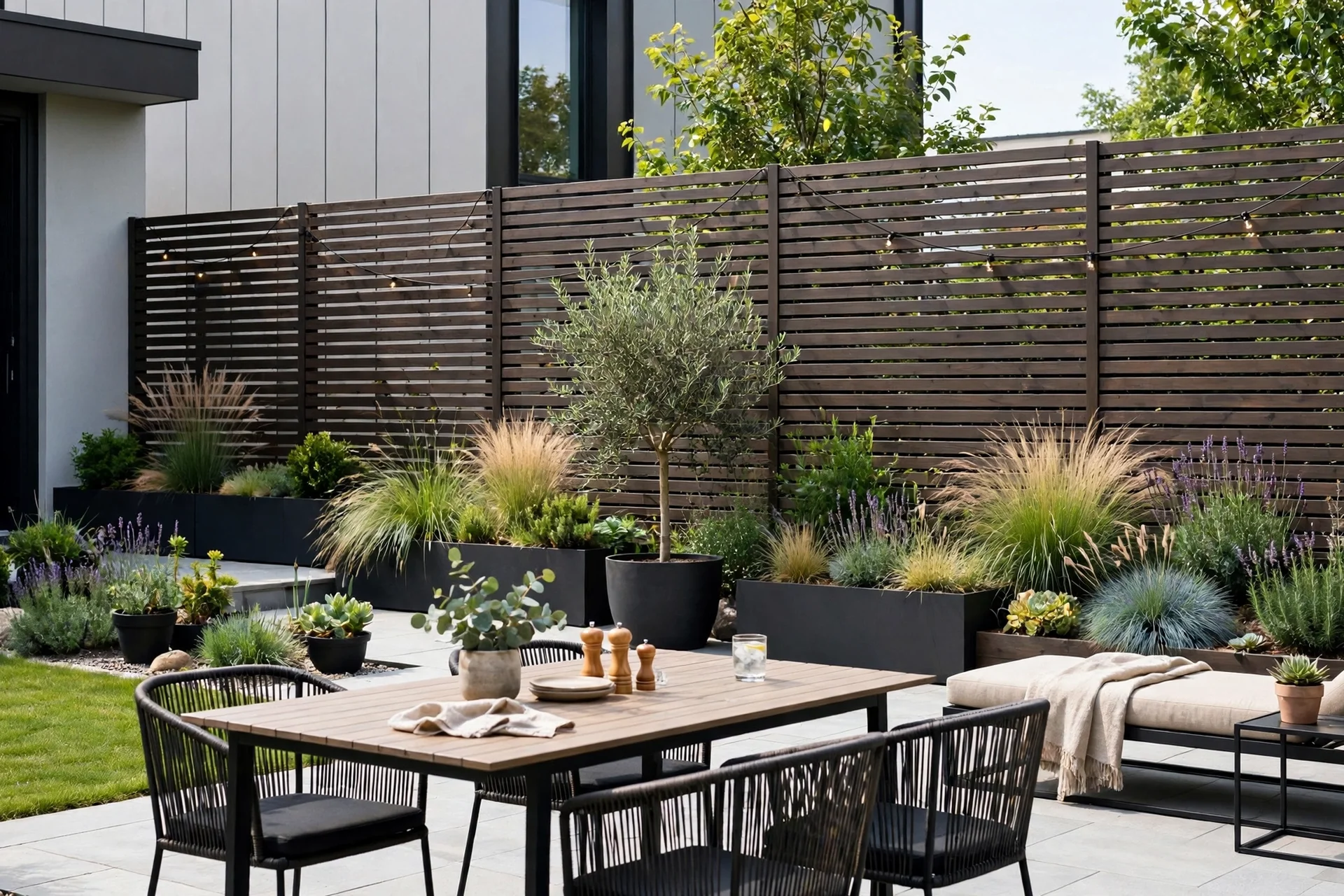
A good modern privacy fence does two jobs at once: it keeps your outdoor life out of sight, and it makes getting in without permission noticeably harder. The best designs do both without turning a home into a compound. That balance comes from solid screening, a height that matches your lot, a gate as strong as the fence around it, and materials that suit the house.
In short, the strongest residential formula is usually a 6-foot solid or louvered fence in the rear and side yards, on deep, well-braced posts, with a reinforced gate, a lock that cannot be reached through the fence, and lighting at every entry point. Horizontal slats, board-on-board cedar, composite panels, and powder-coated metal screens can all deliver that formula. The right choice depends on climate, budget, how much maintenance you will actually do, and what local rules and your homeowners association allow.
What a Security-First Modern Privacy Fence Actually Does Differently
Privacy and security are related, but they are not the same thing. A fence can block a view and still be easy to climb, push open, or lift off its hinges. A security-minded fence removes easy footholds on the outside face, avoids horizontal rails that act like a ladder, keeps gaps at the bottom too small to crawl under, and treats the gate as a door, not an afterthought.
Modern style helps: flat metal panels, tight slats, and louvered boards are hard to climb when the outer face is smooth. A solid fence also hides valuables from outside. The trade-off is that it can hide someone who has entered, so keep sightlines to the gate clear, add motion lights at gates and corners, and trim planting beside the fence.
Horizontal Slat, Louvered, and Mixed-Material Privacy Fence Designs That Read Modern
Horizontal slat fencing is the clearest signal of a modern fence. Long boards run side to side, making a small yard feel wider and echoing contemporary architecture. For real privacy, the slats must be close together, overlapping, or tongue-and-groove. A small shadow gap may still read as private from straight on, but it will leak views at an angle, so specify tight slats if full screening matters.
Cedar is the classic slat choice: rot-resistant, beautiful stained, and easy to repair board by board. Composite gives a similar look with far less upkeep. Powder-coated metal slats are the most durable, especially in matte black or charcoal. Louvered panels block direct views while letting breeze through, reducing wind load. Mixed materials often age best: black steel posts with cedar slats, or a low masonry plinth with timber above, break up a long run and close gaps on slopes.
- Horizontal cedar slats: warm and modern; needs sealing every few years.
- Composite slats: consistent colour, low maintenance, and resistant to warping.
- Powder-coated metal slats: crisp and durable; pair with a steel gate frame.
- Louvered panels: angled privacy with airflow, ideal for patios and windy lots.
- Board-on-board timber: overlapping boards stay private even as timber shrinks.
- Masonry plus timber or metal: a low wall with fencing above it grounds the design.
Comparing Privacy Fence Materials for Security, Style, and Upkeep
Material choice decides how your fence looks in five years, how much work it needs, and how hard it is to force or climb. Wood is warm but needs sealing; vinyl is clean and almost maintenance-free but can look flat; composite sits between them at a higher cost; metal is strongest, but needs detailing so it does not look industrial.
Costs vary by region, labour, terrain, and gates, so treat figures here as broad estimates, not quotes. A professionally installed 6-foot privacy fence often runs roughly $20 to $60 per linear foot for timber and vinyl, with composite and metal often higher. Get two or three local quotes for the same specification to compare fairly.
Ask about posts, not just panels: timber posts should be set deep, commonly around one-third of the post length in the ground, in concrete with drainage at the base. Steel posts resist warping and keep gates hanging true.
Gates, Locks, and Lighting: Where Most Privacy Fences Fail on Security
A tall, solid fence often fails at its gate: a sagging frame, a latch a child could lift, or a gap wide enough to reach through. A secure modern gate starts with a frame that matches the fence. A steel frame inside a timber gate, or a fully welded metal gate, resists twisting far better than boards screwed to a diagonal brace. Heavy-duty, through-bolted, adjustable hinges spread the load and let you re-level the gate as ground settles.
Lock choice matters as much as frame strength. A keyed, keypad, or smart lock works if the latch cannot be reached from outside. Self-closing hinges are essential for pool gates, where a gate left ajar defeats the barrier. For lighting, several softer lights beat one harsh floodlight: downlights over gates, low lights along dark passages, and motion lights at corners.
- Match the gate to the fence in height, solidity, and frame strength.
- Use through-bolted, adjustable hinges and a latch shielded from outside reach.
- Add self-closing hinges on side and pool gates.
- Light every gate and dark corner, and keep bins and planters away from gate hardware.
Height, Sightlines, and Slopes: Designing Privacy That Works on a Real Lot
Six feet is the practical sweet spot for rear and side yards: tall enough to block a standing adult’s view, without triggering stricter rules above that height. Front yards are usually limited to 3 to 4 feet, and corner lots often have a visibility triangle where even a low fence must stay open. Check zoning, permit thresholds, and association covenants first: the stricter of local code and association rules governs.
Height alone does not guarantee privacy: a neighbour on a raised deck or upstairs window can see over 6 feet, so add height only where that sightline falls. On slopes, stepped panels leave triangular gaps underneath, while racked panels follow the grade but suit only some systems. A plinth or gravel board can close remaining gaps. Build a few inches inside your line unless you have a written neighbour agreement.
Privacy Fence Planning Checklist Before You Order Materials or Hire a Crew
A short planning pass saves more money than any material discount. Confirm the boundary, rules, and underground services before you dig, and agree the specification in writing. Call your local utility-marking service — in the United States, 811 — a few days before digging; it is free in most areas and prevents the most dangerous fence mistake.
Agree the finished side early: many areas expect the finished face outward, or a good-neighbour design such as board-on-board or shadow-box, which looks finished from both sides.
Privacy Fence Security Mistakes That Undermine an Otherwise Solid Build
Most fences fail on small details. Horizontal rails on the outside face look tidy but give a climber a ladder, as do decorative lattice low on a fence, low trim that forms a step, and planting that grows into a foothold. Keep the outside face smooth, put rails and bracing inside, and train climbing plants on the inside face. Gaps are the second quiet failure: a gap under the gate, a shrunken panel, or a fence that stops short of a shed all create a way through. Check the bottom line after the first wet and dry seasons, when timber moves most, and add a gravel board at the base to protect timber from soil moisture and splashback, the main cause of rot.
Treat security hardware with restraint. Spikes and finials can deter climbing but must be legal and safe for children and pets; razor and barbed wire are generally inappropriate and often prohibited residentially. A smooth, tall fence, strong gate, and good lighting deter without looking hostile. Pool gates must be self-closing and self-latching, with a non-climbable zone — a qualified installer should confirm compliance. Walk the line twice a year to catch loose posts early.
Privacy Fence Security and Style FAQs
How tall should a modern privacy fence be for both privacy and security?
Six feet is the standard for rear and side yards: it blocks a standing adult’s view and discourages casual climbing, while staying within the limit many areas allow without a special permit. Front yards are usually limited to 3 to 4 feet. If a deck or upstairs window overlooks your garden, add height only where that sightline falls, rather than raising the whole boundary.
Which privacy fence material is hardest to climb?
Smooth, solid panels are hardest to climb because they offer no footholds. Powder-coated metal, solid vinyl, and tight composite all perform well, provided rails are kept on the inside face. Timber can match them if built board-on-board or tongue-and-groove with a flush outside face, but exposed outside rails will undo that advantage on any material.
Are horizontal slat fences actually private?
They are private when slats are tight, overlapping, or tongue-and-groove. Widely spaced slats are a screen, not a privacy fence, and will leak views at an angle even if they look solid from straight on. If you love the horizontal look, specify a minimal shadow gap, check the fence from an angle before approving the build, and consider a louvered profile that blocks angled views while letting air through.
What makes a privacy fence gate secure without looking like a fortress?
A gate that matches the fence in height and solidity, on a steel frame with through-bolted, adjustable hinges and a lock that cannot be reached through the gate. A keypad or smart lock in slim, modern housing, a flush latch shield, and a self-closing hinge give real security without bars or spikes. Finish the gate to match the fence exactly, so it reads as part of the design.
Do I need a permit or HOA approval for a privacy fence?
Often, yes for one or the other. Many areas require a permit above 6 feet, on a corner lot, or in an easement, while others require one for any new fence. Associations commonly require written approval and may restrict height and materials more tightly than local code. Check both before ordering.
How much does a modern privacy fence cost, in broad terms?
As a broad planning estimate, a professionally installed 6-foot privacy fence commonly ranges from roughly $20 to $60 per linear foot for timber and vinyl, with composite and metal often higher, depending on region, terrain, gates, and demolition. A 100-foot run therefore often falls in the low-to-mid thousands before gates and extras. Local quotes for an identical specification are the only reliable comparison.
How do I keep a modern privacy fence looking modern?
Keep one timber tone and one metal colour, keep the top line level or cleanly stepped, and maintain the finish: seal timber every few years, wash vinyl and composite, and touch up powder-coat chips before rust starts. Replace damaged boards promptly and re-level gates at the first sign of sag.
Final Thoughts: Choosing a Privacy Fence That Still Looks Modern
The fence that works best is rarely the tallest or the most expensive. It is the one whose height matches the sightlines it must block, whose outside face offers no easy climb, whose gate is as strong as the panels beside it, and whose materials suit both your climate and the upkeep you will genuinely do. Start with those four tests, check local rules and association approval, then choose the design — horizontal cedar, louvered composite, or powder-coated metal — that makes that secure specification look like it belongs to your house.
Walk your boundary, stand where a passer-by would stand, and look for gaps, footholds, and dark corners before you commit. Fix those in the design, not after the build, and you will end up with outdoor privacy that feels calm rather than closed in: a garden you can actually use, behind a fence that protects it without announcing itself.

