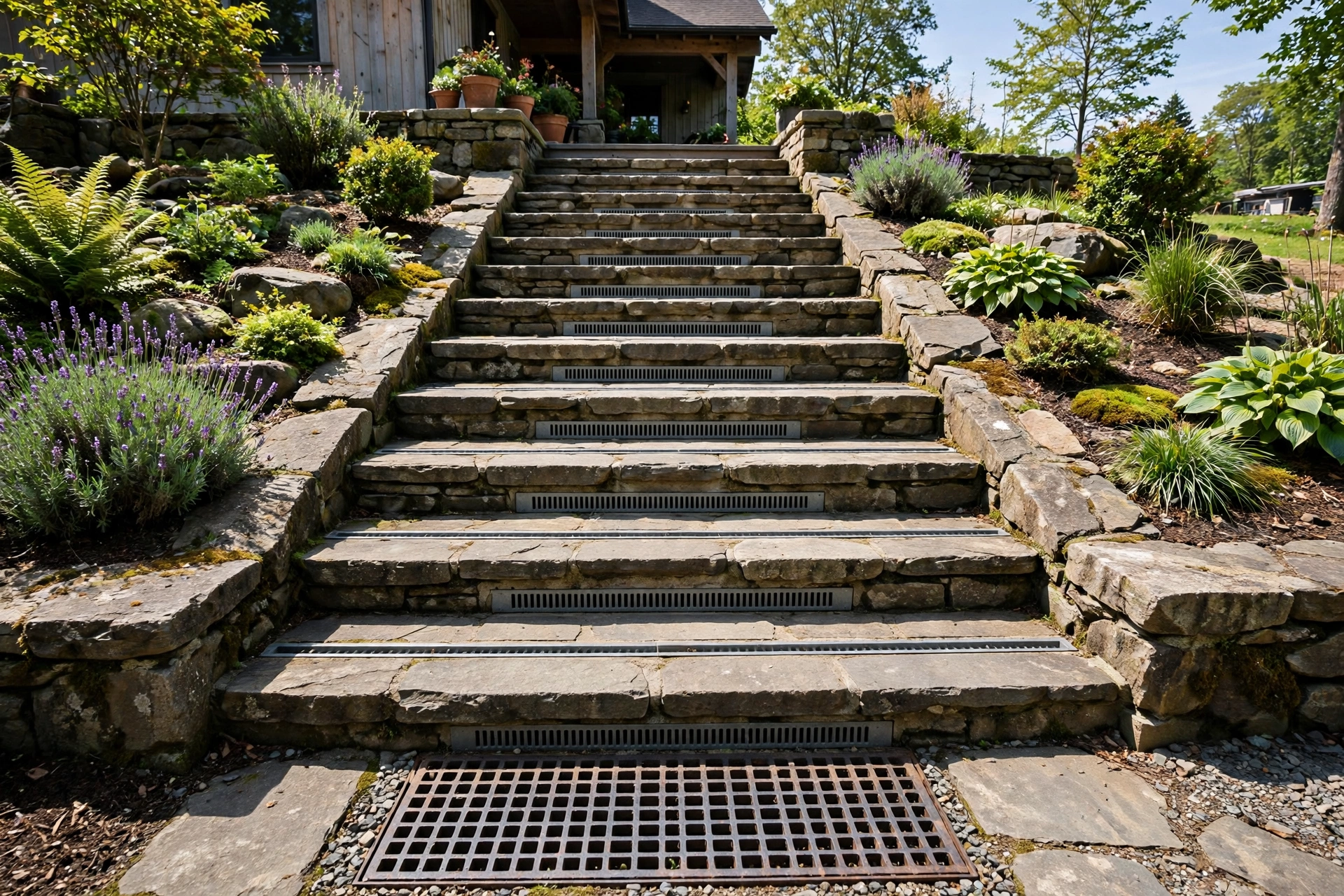
An exterior staircase spends much of its life wet, and the difference between a stair that lasts twenty years and one that needs rebuilding in five is almost always drainage. Water that pools on treads, collects on landings, or sits against stringer bases drives corrosion in steel, rot in timber, spalling in concrete, and freeze-thaw cracking in every material at once. Designing the water away from the stair, rather than fighting it after the damage appears, is the single most effective durability decision a homeowner or builder can make.
Modern staircase drainage is not one feature but a chain of small decisions: tread type, landing slope, stringer base detail, riser treatment, and the gutters above. Each decision moves water one step further from the structure, and a weak link anywhere in the chain sends water back to the parts that fail first. This article works through that chain in order, from the tread underfoot to the ground below.
What Makes Exterior Staircase Drainage Fail in the First Place
Most exterior stairs fail for the same handful of reasons, and nearly all of them are drainage decisions made by default rather than by design. A solid tread with no fall holds water across its whole surface, and the worst pooling happens at the corners where the tread meets the stringers, exactly where debris piles up and stays wet. A flat landing collects every drop from the flight above and holds it against the building. A stringer end sitting on damp ground wicks moisture upward into the structure.
The pattern is consistent across materials. On steel stairs the corrosion starts in the permanent wet zone at the tread corners and spreads along the underside, delaminating the finish from below. On timber stairs the end grain at the stringer base and the underside of treads stay damp and rot first. On concrete stairs the damage shows as spalling and cracking where freeze-thaw cycles work on saturated surfaces. In every case the water was there first and the deterioration followed, which is why fixing drainage fixes the durability problem at its root.
Which Tread Design Sheds Water Fastest on Exterior Stairs
The tread is the first drainage decision because it is the surface water meets first, and its design decides whether water passes through, runs off, or pools. Open treads made from serrated bar grating, expanded mesh, or perforated steel let water and small debris fall through to a sweeping zone below, so the walking surface stays clear of standing water. Solid treads need a deliberate fall and a drainage path, or they become shallow trays.
Grooved and ribbed tread profiles add a second layer of protection on solid treads by giving water narrow channels to follow off the nosing, and they improve traction at the same time. Hydrophobic sealants and textured coatings encourage rapid shedding on concrete and timber treads, but they are a supplement to slope and profile, not a substitute, and they need reapplication as they wear.
- Open grating treads shed water instantly and suit steel stairs in wet climates.
- Solid treads with a fall of one to two percent shed water reliably when the nosing is detailed correctly.
- Grooved profiles channel water off the tread and add grip in the same detail.
- Perforated treads balance drainage with a more solid feel underfoot than open grating.
- Sealed concrete treads need both a fall and a sound sealer, since bare concrete absorbs and holds water.
The choice should follow the climate and the use. A stair in a rainy region benefits most from open treads, while a stair over a usable space below, such as a basement entrance, needs solid treads with a proper fall and a drainage channel at the base, since water falling through would land on whatever sits underneath.
Choosing the tread is also the moment to think about debris. Leaves and pine needles collect against stringer upstands and create the permanent wet zone that starts corrosion, so a tread that lets debris fall through, or a solid tread with a clear path to sweep it off, saves more maintenance than any coating. Whatever tread is chosen, the landing below must be designed to receive whatever the treads shed.
Landing Slope and the Water That Collects at the Top
A landing collects all the water from the flight above, so its slope decides whether that water leaves the building or attacks it. A landing that slopes away from the building at one to two percent sheds water reliably without feeling sloped underfoot, and the fall is small enough to document on drawings and confirm with a level at installation. A flat landing pools, and a landing that slopes back toward the building, surprisingly common in field-built retrofits, directs water against the foundation wall and into the building envelope.
The slope needs a destination, not just a direction. Water leaving the landing should reach a drain, a channel, or ground that falls away from the structure, and the junction between the landing and the wall needs flashing so wind-driven rain cannot run back behind the landing edge. On concrete landings a small drip groove at the outer edge stops water curling back underneath, and on timber landings a gap between the decking boards lets water through rather than across.
Staircase Drainage Materials Compared
Material choice sets the maintenance burden for the life of the stair, because each material fails differently when it stays wet. Galvanised steel resists corrosion until its coating is breached, stainless steel tolerates wet conditions but costs far more, treated timber needs its end grain protected, and concrete needs air entrainment and sealing to survive freeze-thaw cycles.
| Material | Drainage strength | Weak point when wet | Maintenance |
|---|---|---|---|
| Galvanised steel grating | Excellent, water falls through | Coating breach at corners | Inspect coating yearly |
| Stainless steel | Excellent, corrosion resistant | Cost, tea staining | Wash seasonally |
| Treated timber | Good with fall and gaps | End grain at stringer base | Reseal every 2 to 3 years |
| Concrete, sealed | Good with slope and grooves | Freeze-thaw spalling | Reseal every 3 to 5 years |
| Aluminium treads | Very good, light | Soft surface wear | Clean and check fixings |
| Stone or tile | Poor unless detailed | Grout and bedding saturation | Regrout and seal |
The table makes the trade-off plain: the materials that drain best need the least attention, while the materials that hold water need regular sealing and inspection to survive. Budget decisions should weigh the sealing and repair cost over twenty years, not just the installation price, because a cheap tread that needs rebuilding in five years is the most expensive option of all.
Stringers, Risers, and the Base Detail That Rots First
The bottom of the stringer is the most vulnerable point on any exterior stair, because it sits at or near ground level where standing water, splash, and ground moisture all concentrate. The right detail lifts the stringer end off the wet ground on a stainless or galvanised spacer of at least 20 to 25 millimetres, set on a concrete pad that itself drains away from the stair. That small gap breaks the capillary path and lets air dry the end grain or the steel edge after rain.
Risers deserve the same thinking. Closed risers trap water and debris behind them and hide the damage until it is advanced, while open risers let water and air through and make inspection easy. Where closed risers are needed for safety or appearance, a small gap or weep detail at the bottom of each riser prevents a hidden reservoir from forming.
Set the stringer base on a raised pad with a metal spacer, never directly on soil or a flat slab.
Keep the bottom tread at least a hand’s width above finished ground level.
Leave open risers where code allows, or add weep gaps to closed risers.
Flash the junction where the stair meets the wall so water cannot run behind the stringer.
Check the base detail every spring, since ground settlement can close the gap over time.
These details cost almost nothing during construction and are expensive to retrofit, which is why they are worth insisting on before the stair is built. On an existing stair, adding a spacer and a pad is still possible during a stringer replacement, and it is the single most valuable upgrade in a refurbishment.
Freeze-Thaw, Salt, and Slip Resistance in Wet Weather
Water on a stair is a durability problem in summer and a safety problem in winter. Freeze-thaw cycles work on any saturated surface, expanding water inside pores and cracks a little further with each cycle, and the damage accumulates invisibly until the surface spalls or a tread cracks. Good drainage is the first defence, because a tread that dries between storms has little water left to freeze.
De-icing salt adds a second attack, corroding steel fixings and spalling concrete surfaces, so drainage design should minimise the salt the stair needs. A tread that sheds water quickly needs less salt to stay safe, and a non-slip nosing or grooved profile provides grip without chemicals. Where salt is unavoidable, choose calcium-based products over rock salt on concrete, and wash the stair in spring to remove residue before it works into the surface.
- Drain before you salt: a dry tread needs far less de-icer than a ponded one.
- Use grooved nosings for grip that does not depend on chemicals.
- Avoid rock salt on concrete treads, since it accelerates surface spalling.
- Wash in spring to remove salt residue from treads, stringers, and fixings.
- Check fixings after winter for corrosion, especially at the stringer base.
Slip resistance and drainage reinforce each other, because both depend on water leaving the walking surface quickly. A stair that drains well is safer in rain, easier in frost, and cheaper to maintain across every season.
Gutters Above the Stair: Stopping Water Before It Lands
The most overlooked part of staircase drainage is above it. A roof edge or gutter that discharges directly onto the stair turns every rainstorm into a waterfall over the treads, overwhelming even good tread drainage and soaking the stringer bases. Positioning gutters so they do not overhang the stair, and routing downpipes into the stormwater system rather than onto the landing, removes that load entirely.
Where a gutter must cross above a stair, a splash block or a short pipe extension carries the discharge past the stair to a safe point, and a simple gutter guard keeps leaves from creating an overflow at exactly the wrong place. The check is easy: stand on the stair during heavy rain and watch where the water comes from, because the source is often above rather than on the stair itself.
A Retrofit Sequence for a Stair That Already Ponds
A stair that already holds water can usually be improved without rebuilding it, provided the structure is still sound. Work from the top down, since water flows downhill and each fix depends on the one above it.
Clear gutters and redirect any downpipe that discharges onto the stair.
Re-grade the landing with a thin bonded screed or shim the decking to restore a one to two percent fall away from the building.
Add groove cuts or a non-slip nosing strip to solid treads that pond.
Lift the stringer bases onto spacers and a drained pad during the next repair.
Seal concrete surfaces and treat timber end grain, then test with a hose.
Test every change with a hose before calling it done, because a retrofit that looks right can still pond in a corner that was missed. A hose test takes ten minutes and shows exactly where water sits, which is far cheaper than discovering the same puddle during the first storm of the season.
Exterior Staircase Drainage FAQs
How much slope should an exterior stair tread have?
A fall of one to two percent, roughly one-eighth to one-quarter inch per foot, sheds water reliably without feeling sloped. Landings use the same range, always falling away from the building rather than toward it.
Are open grating treads safe in icy weather?
Open treads shed water and snow well, which reduces ice formation, but they can feel cold and catch narrow heels. Choose a serrated or mesh pattern with small openings for residential stairs, and add a nosing strip for grip and visibility.
Why does my concrete stair spall every winter?
Water saturates the surface and freeze-thaw cycles expand it a little further each time, which lifts flakes of concrete away. Improving drainage so the stair dries between storms, then sealing the surface, addresses the cause rather than the symptom.
Can I fix a flat landing without rebuilding the stair?
Yes, a thin bonded screed can restore the fall on a concrete landing, and timber decking can be shimmed or re-laid with a slope. Confirm the new fall with a level and a hose test before finishing.
How often should exterior stair drainage be inspected?
Inspect the treads, landing fall, and stringer bases every spring and autumn, and after any major storm. Clear debris from tread corners and check that water still runs off freely rather than pooling.
Final Thoughts: Drainage Is the Cheapest Staircase Repair
A staircase that drains well rarely needs attention, while one that ponds will demand it constantly in the form of corrosion, rot, spalling, and slippery treads. The fixes are small and mostly happen at design time: an open or grooved tread, a landing that falls away from the building, a stringer base lifted off the wet ground, and gutters that do not pour onto the flight. Get those details right and the stair takes care of itself for decades.

