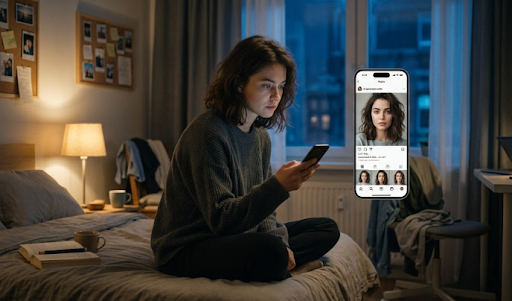
It started with a simple question: what would happen if I let AI rebuild the version of myself I usually show online?
Not the real, everyday version. Not the tired morning version, not the badly lit camera-roll version, and definitely not the version that takes ten photos before finding one decent angle. I mean the social media version — the slightly polished, better-lit, more confident version that appears in profile pictures, stories, and posts.
Most people already have one. We choose the best photo, adjust the light, crop out distractions, add a filter, and write a caption that makes the moment feel more effortless than it probably was. Social media has always been a place where people edit reality.
But AI takes that idea much further.
Instead of simply improving a photo, AI can recreate an entire look. It can change the mood, sharpen the features, redesign the background, adjust the lighting, and make an ordinary selfie feel like a professional shoot. I wanted to see whether it could recreate my online image.
The result was impressive. Then it got strange.
The First Image Looked Like Me on a Very Good Day
I started with a casual photo. Nothing special. The lighting was average, the background was messy, and the expression was not exactly profile-picture material.
The first AI version cleaned everything up. It made the lighting softer, the background smoother, and the overall image more polished. It did not look fake. That was the surprising part. It looked like a better photo of me, not a completely artificial one.
That is where AI photo editing becomes powerful. The most convincing results are not always the most dramatic. Sometimes, the most effective edit is the one that looks believable enough to pass as real.
It felt like the image I would post if I wanted people to think I casually looked that good.
And that is exactly why it made me uncomfortable.
Social Media Already Trained Us to Curate Ourselves
The more I looked at the AI-generated image, the more I realized it was not doing something completely new. It was simply doing what social media already encourages people to do.
We already curate ourselves online. We post the best angle, the best outfit, the best lighting, the best part of the day. We rarely post the boring middle, the awkward photo, or the version of ourselves that does not match the image we want others to see.
AI just makes the curation faster, smoother, and more convincing.
Instead of spending time finding the right light, you can generate it. Instead of needing a clean background, you can create one. Instead of waiting for a better photo day, you can turn an ordinary image into something that feels ready to post.
That convenience is tempting. It gives people more control over how they appear online.
But control is also where the problem begins.
The AI Version Had More Confidence Than I Did
The second version was more stylized. It looked like a polished influencer photo: cleaner skin, sharper details, better posture, and a slightly more confident expression.
It was still recognizable, but it had a different energy.
That was the weirdest part. The AI had not only changed the image. It had changed the personality of the image.
The person in the photo looked more relaxed, more attractive, and more self-assured. It was not a dramatic transformation, but it was enough to make the original photo feel plain.
This is one of the hidden effects of AI image tools. They do not just change how a person looks. They can change how a person is perceived.
A soft portrait can make someone look approachable. A darker edit can make them look mysterious. A luxury-style edit can make them look more successful. A bright, clean image can make them look more trustworthy.
That means AI is not only editing photos. It is editing social signals.
The Line Between Enhancement and Invention Got Blurry
At first, I thought the difference was simple. Basic edits were fine. Extreme edits were fake.
But after testing a few images, that line became less clear.
Was it fake if AI improved the lighting? Probably not.
Was it fake if it smoothed the skin? Maybe, depending on how much.
Was it fake if it subtly changed the shape of the face? That felt different.
Was it fake if the photo looked like it came from a shoot that never happened? That was harder to answer.
Social media has always blurred reality, but AI makes the blur harder to see.
A filter usually looks like a filter. A heavily edited photo often has signs. But a good AI-generated or AI-enhanced image can look natural enough that most people will not question it.
That creates a new kind of pressure. If everyone can look polished, cinematic, and almost professionally photographed, normal photos may start to feel less acceptable.
I Understood Why People Are Curious About More Extreme AI Tools
Once I started exploring AI photo trends, I quickly understood how broad the space has become. Some tools focus on simple portrait upgrades. Others create avatars, fantasy scenes, fashion edits, body transformations, and more sensitive image changes.
That is where curiosity can move from playful to complicated.
For example, a tool category like a nudifier shows how far AI image transformation has gone beyond ordinary filters. It also shows why conversations around consent and privacy are no longer optional. When AI can create intimate or highly personal-looking edits, the question is not only whether the result is realistic. The question is whether it should be created at all.
That is the part many casual users do not think about at first. The same technology that can make a fun profile picture can also be misused if people upload someone else’s image without permission.
The tool is not the whole issue. The intention and consent behind the image matter just as much.
The Most Realistic Edit Was the Most Unsettling
The extreme edits were easy to understand. If an image looked like a fantasy poster or a heavily stylized digital portrait, I could separate it from reality.
The most unsettling result was the one that looked almost completely normal.
It was the kind of image I could have posted without anyone questioning it. Better lighting, better background, slightly better expression, but nothing that screamed “AI.” It looked like a real photo from a better version of the day.
That made me think about how many images online may already be partly artificial.
Not necessarily fake in a malicious way. Just edited, enhanced, improved, regenerated, or polished until the original reality becomes hard to find.
For brands, influencers, and creators, this can be useful. A consistent visual style matters. A better image can improve trust, engagement, and professionalism. But for ordinary users, especially younger users, it can also quietly reshape what “normal” is supposed to look like.
AI Made Me Compare Myself to Myself
One thing I did not expect was that the AI versions would make me judge the original photo more harshly.
Before the experiment, the original photo was just average. After seeing the AI version, it looked worse. The lighting seemed flatter. The background seemed messier. My face looked less polished.
Nothing had actually changed. Only my comparison point had changed.
That is a real issue with AI-enhanced social media images. They raise the visual standard so quickly that regular photos can start to feel unfinished. If people spend enough time looking at optimized versions of themselves, they may start expecting real life to match the edit.
That is not healthy.
AI can be a creative tool, but it should not become the mirror people use to measure their worth. A generated image can be fun, useful, or even beautiful, but it is still a constructed version of reality.
Privacy Became the Bigger Question
At first, I was focused on the final image. Later, I started thinking more about the upload itself.
Every AI photo tool begins with data. You give it an image, and that image may contain your face, your body, your room, your location clues, or other personal details. Most people upload photos quickly without reading how the platform handles that data.
That matters.
Before using any AI image tool, it is worth asking a few basic questions:
- Is the platform clear about how uploaded images are handled?
- Are photos stored or deleted after processing?
- Can the images be used to train models?
- Does the tool allow users to remove their data?
- Is the image something you would be comfortable losing control over?
These questions become even more important when tools deal with personal, realistic, or sensitive transformations. Platforms such as nakedly ai are part of a wider trend where AI image tools are becoming more specific, more personal, and more powerful. That makes user awareness even more important.
The more personal the image, the more careful the user should be.
Consent Is the Rule That Should Not Bend
The clearest lesson from this experiment was simple: use AI tools only with images you have the right to edit.
Using your own photo is one thing. Uploading someone else’s photo without permission is another. Even if the edit is meant as a joke, the result can still embarrass, misrepresent, or harm the person in the image.
This is especially true with realistic AI edits. A fake image does not need to be perfect to cause damage. It only needs to be believable enough for people to pause, question, or share it.
A good rule is this: if you would not want someone doing it to your image, do not do it to theirs.
AI makes editing easier, but it does not remove responsibility.
The Best Version Was Not the Perfect One
After testing several AI versions, I expected to like the most polished image best.
I did not.
The best version was the one that still looked human. It had better lighting and a cleaner background, but it did not erase every flaw. It still felt connected to the original photo.
That was the version I trusted most.
Perfection can look impressive, but it can also feel empty. When an image becomes too smooth, too balanced, or too idealized, it starts losing personality. The small imperfections are often what make a photo believable.
AI can improve a social media image, but it should not remove the person from it.
Final Thoughts
Recreating my social media look with AI was more revealing than I expected.
At first, it felt like a fun editing experiment. Then it became a lesson in how easily digital identity can be shaped. AI did not simply make my photo look better. It created versions of me that looked more confident, more polished, and sometimes more believable than the original.
That is exciting, but it is also unsettling.
AI photo tools are changing the way people present themselves online. They can help users create better visuals, explore personal style, and build stronger digital identities. But they also raise serious questions about privacy, consent, self-image, and authenticity.
The biggest lesson is not that AI can recreate your social media look. It can.
The bigger lesson is that once it does, you may start questioning which version feels more real.
Stay in touch to get more updates & news on Magazine!

