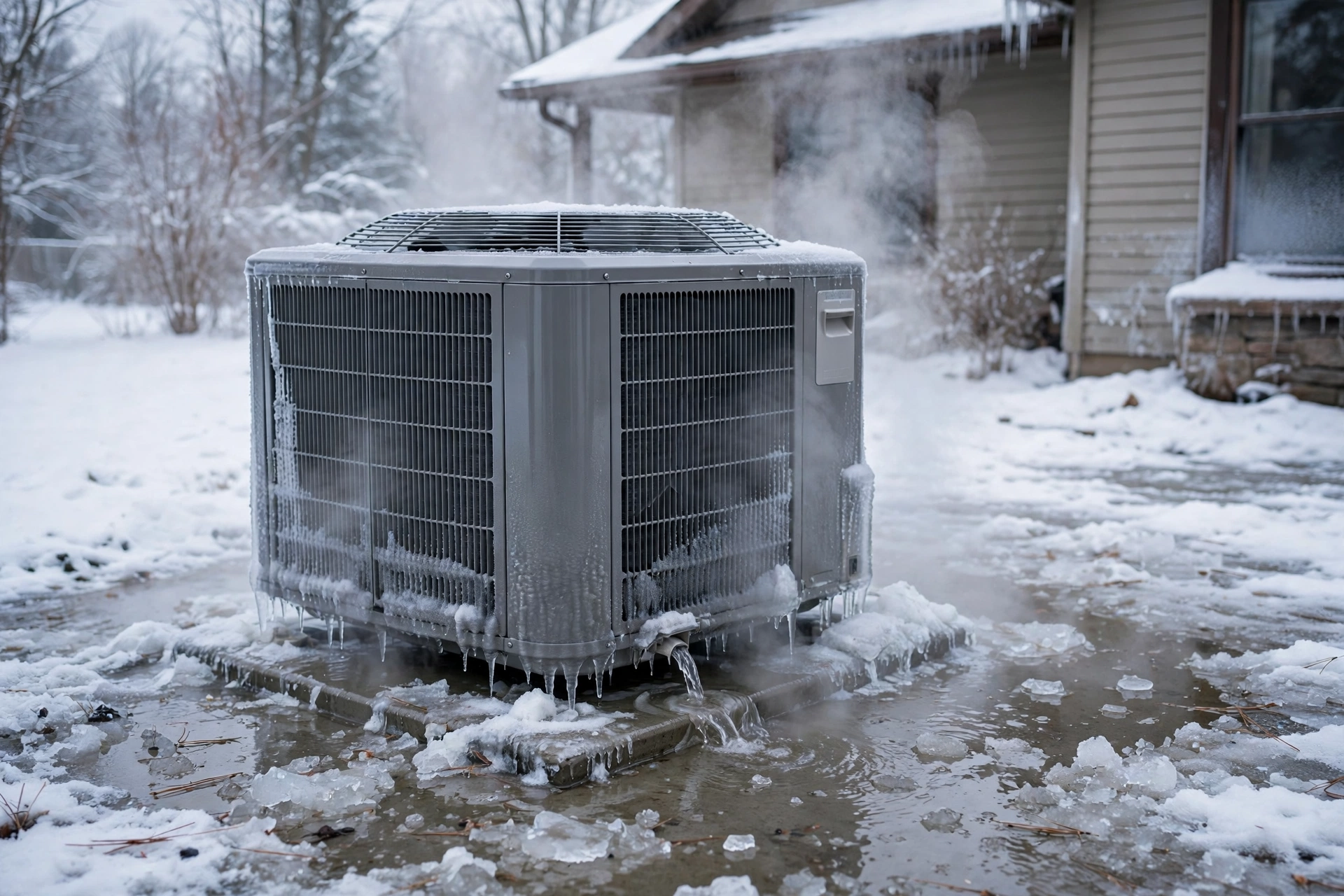
On a freezing January morning, a homeowner steps outside to find a sheet of ice spreading from the base of the heat pump. Usually the machine is doing exactly what it was designed to do: shedding water. The problem is rarely the water itself. It is what happens to that water after it leaves the unit.
The Short Answer: Defrost Water Is Normal, But It Needs Somewhere to Go
Here is the short answer: a heat pump in heating mode pulls heat from cold outdoor air, and moisture in that air freezes onto the outdoor coil as frost. Several times a day in cold, damp weather, the system briefly reverses itself to melt that frost, and the meltwater drains out of the bottom of the outdoor unit. Dripping, steam, and a wet patch under the unit are all normal. Trouble starts only when meltwater cannot drain away and refreezes around the base, where it can climb into the coil, block airflow, and strain the fan and compressor. Managing defrost water is mostly a drainage job: keep the unit raised, the ground open and graded away, and the drain path liquid.
Why a Heating Heat Pump Grows Frost in the First Place
A heat pump does not create heat the way a furnace does; it moves heat, extracting it from outdoor air even when that air feels bitterly cold. Refrigerant in the outdoor coil is made colder than the surrounding air so heat flows into it, but that cold coil also chills moisture in the air passing over it, and near or below freezing that moisture freezes onto the coil fins as frost. Frost is not a flaw, but it is an insulator: as it thickens it restricts airflow, so efficiency falls. That is why every air-source heat pump has an automatic defrost system.
Inside a Defrost Cycle: Reversal, Steam, and Meltwater in Under Fifteen Minutes
A defrost cycle is a short, automatic reversal of normal heating. Its stages are:
- Detection. A sensor monitors coil temperature and triggers defrost when frost has built up enough to matter.
- Reversal. The reversing valve switches refrigerant flow so hot refrigerant is sent to the outdoor coil.
- Fan pause. The outdoor fan usually stops, so cold air is not blown across the coil while it warms up.
Melt and drain. Frost melts and runs down through the cabinet, leaving through openings in the base pan. Water may drip from several points beneath the unit, and steam may rise as warm meltwater meets freezing air.
Return to heating. Once the coil reaches a set temperature or a time limit is reached — typically within five to fifteen minutes — the valve switches back and normal heating resumes.
When Meltwater Turns Against the Machine: How a Refreeze Chain Builds
A successful defrost cycle clears the coil, but it does not guarantee the water underneath stays liquid. On frozen ground, meltwater can pool in a hollow, sit against a flat pad, or collect in snow packed around the cabinet — and then refreeze. Refrozen meltwater seals the base pan drain openings, so the next cycle has nowhere to send its water. That water freezes inside the lower cabinet, the ice grows until it bridges the gap between ground and unit, and if it reaches the coil it blocks airflow; if it reaches the fan, it can damage the blades.
The same chain can start from water that never came from the heat pump: a dripping gutter or snow sliding off a roof edge. Before blaming the heat pump, look up.
Reading the Ground Beneath Your Outdoor Unit: What Healthy Drainage Looks Like
The ground beneath a heat pump tells you most of what you need to know. A healthy setup has four features, all checkable without tools:
- Clearance underneath. The unit sits raised on a stand, wall bracket, or raised pad, so meltwater falls freely and air circulates beneath the cabinet. United States building guidance has long required heat pump supports to be raised at least 3 inches above the ground to permit free drainage of defrost water.
- A surface that disperses water. Gravel or crushed stone lets meltwater spread and soak away. Bare earth that turns to mud, a flat slab with no fall, or a pad sitting in a hollow all trap water against the unit.
- A fall away from the house and the unit. The ground should slope gently away from both, so water travels outward rather than collecting around the base.
- Nothing damming the flow. Leaves, mulch, snowdrifts, and garden edging piled against the cabinet act as small dams, and meltwater trapped behind them freezes in place.
Lifting the Unit Off the Ice Line: Stands, Risers, and Gravel Beds That Actually Drain
Elevation is the single most effective defence against defrost-water problems, because it breaks the contact between meltwater and the machine. The right solution depends on climate, snowfall, and how the unit was originally installed.
Retrofitting elevation is a job for an installer: the unit must stay level and lines and electrics undisturbed.
Keeping the Drain Path Liquid: Base Pan Heaters and Heat Trace Explained
Where temperatures stay below freezing for long stretches, elevation alone may not be enough, because meltwater can still freeze in the base pan. A base pan heater is a small electric resistance element fitted at the bottom of the outdoor unit, and its job is narrow: to keep defrost meltwater liquid just long enough for it to drain clear of the cabinet, rather than refreezing in the pan and sealing the drain holes.
Aftermarket kits exist, but they must be approved for your specific model — an improvised heater is a fire and warranty risk. In milder climates, meltwater clears on its own and a heater adds cost without benefit.
A Winter Walk-Around You Can Do in Ten Minutes
A short routine, repeated a few times through winter and especially after the first hard freeze, catches most drainage problems while they are still easy to fix. No tools are needed, and never open the cabinet or touch electrical parts.
Look at the coil from a safe distance. A thin, even frost layer that clears during defrost is normal; thick ice encasing the coil or fan grille is not.
Check the base. If ice bridges from the ground to the cabinet, or drain openings are sealed with ice, drainage is failing.
Check the ground. Pooling meltwater, or a sheet of ice across a path, shows where the fall or surface needs changing.
Look overhead. Check gutters, downspouts, and roof edges above the unit for drips or snow sliding onto the cabinet.
Clear the perimeter. Brush snow, leaves, and debris away, keeping the manufacturer's clearances. Never pile shovelled snow against the cabinet.
Watch one full cycle. A normal defrost lasts roughly five to fifteen minutes, with the fan pausing and then restarting. A fan that never restarts, grinding noises, or a burning smell mean switching the system off and calling a technician.
Defrost Water Blunders That Turn a Puddle Into a Repair Bill
Most expensive defrost-water failures start as small, well-meant mistakes: mulch mounded against the cabinet, a stone border that dams meltwater, or snow shovelled against the unit. Each traps water exactly where it freezes hardest.
When the Ice Wins: Signs Your Heat Pump Needs a Technician, Not a Shovel
Some defrost-water problems are beyond homeowner fixes. Call a qualified HVAC technician if any of the following apply:
- Ice returns within a day or two of clearing the base, even though drainage looks open — this can point to a defrost sensor, control board, or reversing valve fault.
- The outdoor fan does not restart after defrost, or the unit makes grinding, banging, or loud buzzing sounds.
- Ice covers the coil thickly and never clears, even in milder weather — possible causes include low refrigerant charge, a failed defrost control, or severely restricted airflow.
- Your home loses temperature despite the system running constantly, or auxiliary heat runs far more than usual.
- You see oily residue on lines or fittings, or suspect an electrical fault. Refrigerant and electrical work are not DIY tasks, and in many jurisdictions they legally require certification.
A preseason check before winter lets a technician test defrost operation and assess drainage before the weather turns.
What Defrost Water Fixes Cost, in Honest Estimate Ranges
Costs vary by region, model, and installer, so treat these figures as planning estimates, not quotes:
The cheapest effective fix is usually the one done earliest: a gravel bed and a cleared perimeter cost almost nothing in autumn, while the same ice mass in February may need a technician, a stand, and a repair.
Heat Pump Defrost Water Questions Homeowners Ask in Deep Winter
Is it normal for my heat pump to drip water in freezing weather?
Yes. The water is melted frost from the outdoor coil, released during the automatic defrost cycle. Dripping, steam, and a wet patch under the unit are normal. What is not normal is water that pools, refreezes into a growing ice mass, or reaches the coil and fan.
How often should a heat pump defrost in winter?
It depends on temperature and humidity. In cold, damp conditions near freezing, a system may defrost every 30 to 90 minutes, each cycle lasting roughly five to fifteen minutes. In very cold, dry air, defrosts are less frequent. Frequent defrosting alone is not a fault; poor heating or ice that never clears is.
Can the ice under my heat pump damage the unit?
Yes, if it grows enough to touch the cabinet. Ice can block base drain holes, restrict airflow through the lower coil, and interfere with the fan. A thin layer of ice on the ground clear of the unit is mostly a slip hazard; ice bridging to the cabinet is a maintenance problem to deal with promptly.
Should I pour hot water on a frozen heat pump?
No. Boiling or very hot water can damage coil fins and components through thermal shock, and the water usually refreezes into denser ice. Never chip ice off the coil with tools either. Clear snow and debris around the unit, restore drainage if you safely can, and call a technician if ice is on the coil itself.
Does every heat pump in a cold climate need a base pan heater?
No. The need depends on your climate, model, and installation. Some cold-climate models include one as standard; in milder areas where daytime temperatures rise above freezing, meltwater clears without one. Only use a heater kit approved for your exact model, fitted by a qualified installer.
Can I just cover the heat pump to keep snow and ice off it?
Enclosing the unit closely in winter restricts airflow, traps moisture, and can increase frost while blocking service access. Keep the manufacturer's clearances around the unit, and use only covers or screens the manufacturer approves, fitted at the proper distance.
Final Thoughts: Give Defrost Water Somewhere to Go Before the First Hard Freeze
Defrost water is not a defect to be eliminated; it is a normal product of a heat pump doing its job in winter. The whole task comes down to one principle: meltwater must leave the unit, travel across a surface that disperses it, and never freeze into a mass that touches the machine. Elevation, a permeable graded base, a clear perimeter, and — in sustained cold — an approved base pan heater make that happen.

