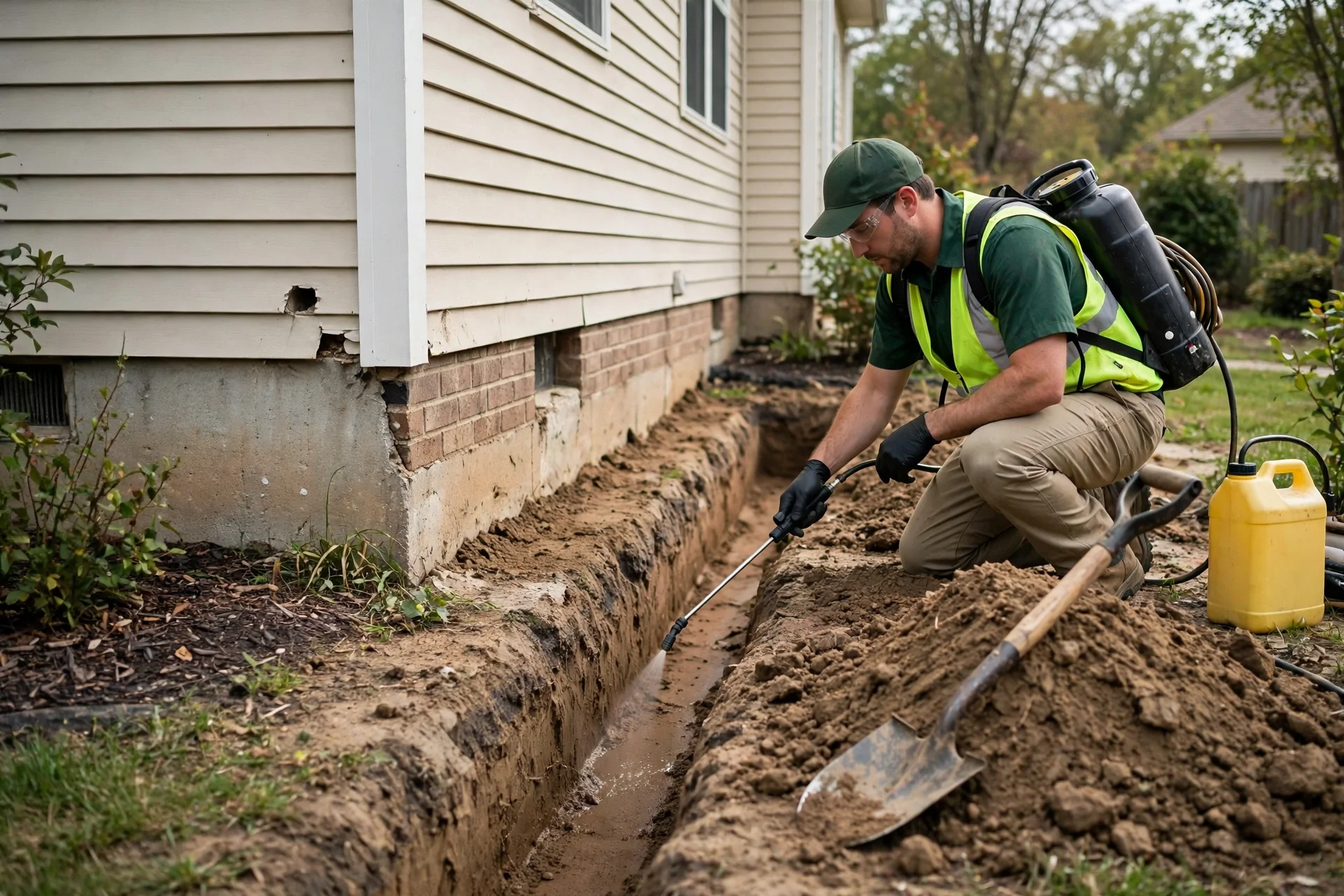
A termite barrier is a continuous zone of protection installed around, and often beneath, a building to stop subterranean termites ever reaching the timber structure. It does not try to kill every termite in the yard, which is impossible. Instead it blocks the concealed routes termites use to travel from the soil into the frame, or it treats the soil so termites cannot cross it, and in both cases it forces any attempted entry out into the open where an inspector can see it.
Why Subterranean Termites Reach Timber Without Being Seen
Subterranean termites live in the soil and forage through it in search of cellulose, which is the wood in a house’s frame, flooring, and trim. They avoid light and dry air, so they travel through mud tubes and concealed gaps: up the inside of a wall cavity, through a crack in a slab, around a pipe penetration, or behind a piece of cladding that touches the soil. By the time a homeowner notices sagging floors or hollow-sounding timber, the colony may have been feeding for years.
The risk is not evenly spread. In termite-prone regions, roughly one home in three is considered at risk of attack over its life, and warm, humid climates with timber-framed housing carry the highest exposure. The damage is structural and expensive precisely because it is hidden: termites eat timber from the inside out, leaving a thin shell that looks intact until it is pressed. Prevention, not repair, is the only economical response.
How a Termite Barrier Forces Hidden Entry Out Into the Open
No barrier promises a termite-free yard. Subterranean termites cannot be kept out of the soil around a house, so the aim of a termite management system is narrower and more honest: stop them getting into the building without being seen.
This is why a barrier is half a system without inspections. The barrier changes the termites’ behavior from hidden to visible, and the inspection is what reads that evidence. A home with a good barrier and no inspections is protected on paper and unprotected in practice, because a bridged barrier looks exactly like a working one until someone who knows what to look for examines the slab edge, the penetrations, and the perimeter.
Chemical Soil Barriers: How a Treated Zone Stops Termites at the Footing
A chemical barrier is created by treating the soil around a house with a termiticide, forming a continuous zone that termites cannot pass through. The liquid is applied by trenching and rodding around the perimeter and by treating the soil beneath the slab before it is poured. The modern standard is a non-repellent product, built on an active ingredient such as fipronil, which termites cannot detect in the soil. They walk straight through the treated zone, pick up the active ingredient, and transfer it to nestmates back in the colony, which can suppress or eliminate the colony rather than merely diverting it.
| Feature | Chemical Soil Barrier | Physical Barrier |
|---|---|---|
| How it stops termites | Treated soil zone, repellent or non-repellent | Mesh, sheet, or stone they cannot pass |
| Best stage | New builds and existing homes | Mainly new builds, at slab and penetrations |
| Ongoing cost | Re-treatment needed as the chemical ages | Very low once installed correctly |
| Weak point | Gaps in the treated zone from poor application | Damage or bridging by later alterations |
| Visibility | Invisible once applied | Forces mud tubes out into the open |
Repellent chemicals work differently: termites sense them and turn away, which sounds effective until the colony simply finds the one gap the applicator missed. That is why non-repellent products are now the premium choice for soil treatment.
Physical Barriers: Stainless Mesh, Graded Stone, and Impregnated Sheets
A physical barrier uses sheets, membranes, meshes, or treated foams built into the construction to seal off the concealed routes termites use. The best-known is fine marine-grade stainless steel mesh, with holes too small for termites, fitted around pipe penetrations, against the edge beam, and inside wall cavities. Graded stone or crushed glass particles work on the same principle at a different scale: laid to a specified particle size, depth, and compaction, they stop termites by preventing tunneling, though they lose effectiveness if landscaping or irrigation disturbs them.
- Stainless mesh: physical only, higher cost, very low maintenance, best at penetrations and slab edges.
- Chemical-impregnated sheets: a membrane infused with termiticide that blocks, repels, and kills on contact.
- Graded stone barriers: effective when installed to specification, vulnerable to later disturbance.
- Metal termite shields: flashings over foundation walls that make any activity visible above them.
Chemical-impregnated sheets deserve a closer look because they combine both families in one product. A single sheet membrane infused with a termiticide replaces the moisture membrane in new construction, blocks termites physically, and kills or repels them chemically on contact, with no ongoing recharging. Some systems double as waterproofing, which makes them an efficient choice when a build needs both termite protection and damp-proofing from a single installation.
Which Barrier Combination Suits New Builds and Which Suits Existing Homes
Most new slab-on-ground homes use a combination: the slab itself as the main barrier, plus a product at the perimeter and around every pipe that comes up through the slab. The penetrations and the perimeter are where termites get in, so the specification concentrates there. A continuous physical barrier at the slab edge, a four-to-six-inch gap between finished grade and any wood cladding or trim, and sealed joints around service penetrations together remove the easy access points before the frame goes up.
Existing homes have fewer options and need a different mix. A chemical soil barrier can be trenched and rodded around the perimeter at any time, and a reticulated pipe system can be laid so the zone can be re-treated later.
Pipe Penetrations and Slab Edges: The Two Gaps Termites Exploit First
Termites are not strong, and they do not need a large opening. A gap around a pipe, a shrinkage crack in a slab, or a joint where the slab meets the wall is enough, and those are the two places every specification returns to. The slab edge matters because it is the longest continuous junction in the building, and the penetrations matter because every service that enters the house punches a hole through the barrier line.
- Every pipe through the slab gets a collar, mesh, or impregnated sheet sealed tight around it.
- The slab edge is left exposed for at least 75 mm in many codes, creating an inspection zone termites must cross visibly.
- Control joints and construction joints are sealed so they cannot become hidden highways.
- Soil, mulch, and cladding are kept below the slab edge so termites cannot bridge over it unseen.
The exposed slab edge deserves emphasis because it is the cheapest protection in the whole system. Where the edge is visible, termites crossing it must build mud tubes on the open concrete, and a homeowner or inspector can see them during a routine walk-around. Covering the edge with soil, paving, or cladding removes that visibility and hands the termites a hidden bridge straight into the wall.
Reticulated Pipe Systems and the Re-Treatment Schedule That Keeps Protection Active
A reticulated chemical system is a network of perforated pipes laid around the perimeter, and sometimes under the slab, so termiticide can be pumped into the soil to create a treated zone without digging up the garden. The pipes are installed during construction or during a major perimeter treatment, with refill points set into the surface at accessible positions. When the chemical ages, a technician connects a pump and recharges the zone through the same pipes.
The schedule matters more than the hardware. Chemical barriers do not last forever: the active ingredient breaks down in the soil over years, and the manufacturer’s retreatment interval, commonly around five years depending on product and soil, should be treated as a deadline rather than a suggestion. A home whose reticulated system was never recharged is a home whose barrier quietly expired, and the only way to know is a dated service record kept with the house documents.
Inspections After Installation: Why a Barrier Without Annual Checks Is Half a System
Every termite management standard pairs the barrier with regular inspections, typically annual, and for good reason. Inspections catch the two things barriers cannot prevent on their own: bridging and damage. A new garden bed piled against the slab, a leaking tap that keeps the soil moist beside the footing, a renovation that cut through a membrane, or a cracked pipe collar can each defeat a barrier that was perfect on the day it was installed.
A proper inspection examines the slab edge, the penetrations, the subfloor, the roof void, and the perimeter soil, looking for mud tubes, damaged timber, and moisture that invites activity. The inspector should also check that the barrier’s own records are current, including the chemical used, the date applied, and the next retreatment due.
Termite Barrier Installation Errors That Leave a Hidden Path Into the Frame
Barrier failures are almost always installation failures. The products themselves are proven, but they depend on continuity, and continuity is easy to break during a busy build. The pattern is consistent: the barrier was specified correctly, installed quickly, and then bridged or damaged by the next trade or the first landscaping job, with nobody checking until the inspection that never happened.
- Leaving a gap in the treated soil zone beside a pipe or along one wall during chemical application.
- Pouring a slab with cracks, voids, or honeycombing that termites can travel through.
- Burying the slab edge under soil or paving, removing the visible inspection zone.
- Cutting a physical membrane during later work and never resealing it.
- Skipping the annual inspection, so a bridged barrier goes unnoticed for years.
Final Thoughts: A Barrier That Makes Termites Show Themselves Before They Reach Timber
A termite barrier is not a promise that termites will never come. It is a system that makes them visible when they do, and that visibility is the whole point. Choose the combination that suits the build stage, insist on continuity at the slab edge and every penetration, keep the retreatment schedule, and inspect every year. A barrier installed well and checked annually is the difference between a mud tube spotted on open concrete and a frame eaten quietly from the inside.
Termite Barrier Questions Answered Before You Choose a System
Do termite barriers kill termites?
A chemical barrier can kill or suppress a colony, especially a non-repellent product that termites carry back to the nest. A physical barrier does not kill termites at all; it blocks them and forces them into the open. Neither system kills every termite in the yard, and neither replaces inspections.
Which is better, a chemical or a physical barrier?
Neither is better in isolation, and most new homes use both. Physical barriers last the life of the house with very low maintenance and are ideal at penetrations and slab edges. Chemical barriers protect existing homes and can be re-treated. The combination, plus annual inspections, gives the most complete protection.
How often does a chemical barrier need re-treatment?
It depends on the product and the soil, but a common interval is around five years. Reticulated pipe systems make re-treatment straightforward, since the chemical is pumped through the installed pipes. Keep the service record with the house documents so the date is never guessed.
Can a termite barrier be added to an existing home?
Yes. A chemical soil barrier can be trenched and rodded around the perimeter at any time, and baiting stations can be added for monitoring and colony suppression. Physical mesh can be fitted around accessible penetrations. The result is effective, though it rarely matches the continuity of a system built into a new slab.
What is the difference between a barrier and baiting?
A barrier is preventive: it creates a continuous zone of protection so termites cannot reach the structure in the first place. Baiting is reactive and detective: feeding stations hold a cellulose bait that foraging termites carry back to the colony, destroying it at the source. Running both together gives the most complete long-term protection.
Does a concrete slab alone stop termites?
A well-made slab helps a great deal, since properly compacted and vibrated concrete with no cracks, voids, or honeycombing is itself a barrier. But slabs crack, joints open, and pipes penetrate them, so the slab is treated as the main barrier plus a product at the perimeter and around every penetration, not as a complete system on its own.

