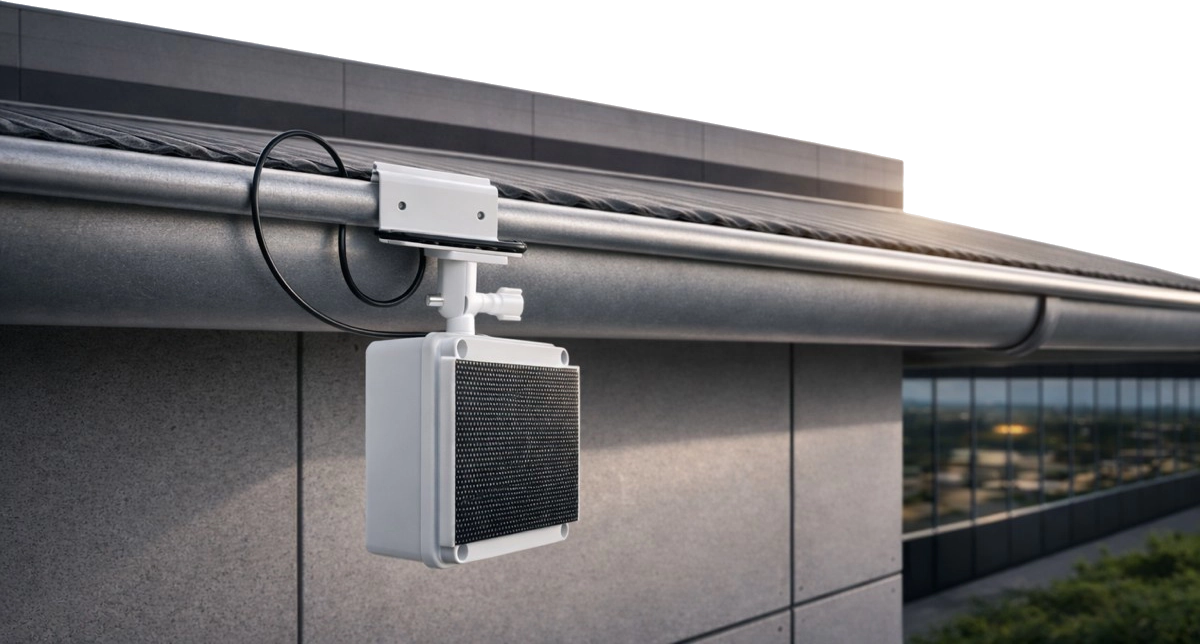
A gutter does not fail overnight. Leaves, moss and debris build up over weeks, water starts to stand, and the first sign of trouble is usually water running down the facade, a damp patch on a ceiling, or a flooded flat roof. By then the damage is done. A roof drainage sensor watches the gutter around the clock and raises the alarm while the blockage is still small.
In short, a sensor in the gutter detects standing water, compares it with rainfall, and alerts you by phone or email when water stands after the rain has stopped. That simple signal is the difference between a ten-minute clean and a ruined ceiling. This article explains how the sensors work, which types suit which roof, where to place them, and what they cost.
Why Blocked Roof Drainage Usually Gets Noticed Too Late
Roof drainage is out of sight and mostly out of mind. Gutters sit above eye level, downpipes hide behind corners, and flat roof outlets sit behind parapets, so nobody looks at them until something goes wrong. The gutter still copes with light rain, so the problem stays invisible until a heavy downpour overwhelms it.
The damage then arrives in several forms at once. Overflowing water runs down the wall, soaks the masonry and stains the facade. It can back up under roof tiles or over a flat roof edge, finding its way into the roof structure. On a flat roof, standing water adds weight the structure was not designed to carry and accelerates membrane failure. And because the overflow often happens during the worst weather, the roofer cannot get up there until the storm has passed and the damage has spread.
How Roof Drainage Sensors Spot a Blockage Before Overflow
A roof drainage sensor works by measuring what should not be there: water standing still. The commonest design uses a capacitive probe on the gutter bottom that detects standing water, paired with a rainfall reference that records whether it is raining. The two readings together are the key, because rain alone says little and standing water alone says little, but water standing while no rain is falling signals a blockage.
When that signal crosses a set threshold, the sensor sends an alarm by email, text message or a building app, often within the hour. Some systems measure water level rather than simple presence, using ultrasonic or pressure sensors that track depth in millimetres, showing whether a blockage is growing over days.
Capacitive Probes, Water-Level Sensors and AI Stormwater Sensors Compared
Three sensor families dominate residential roof drainage, and they suit different roofs. Capacitive gutter probes are the simplest and cheapest: a probe on the gutter bottom, a clamp bracket, a solar gateway and a mobile connection. They suit pitched roofs with accessible gutters. Water-level sensors suit flat roofs, where the question is how deep the ponding is next to a drain, and they measure every minute or so with millimetre accuracy..
| Sensor type | What it measures | Best roof type | Power source |
| Capacitive gutter probe | Standing water, rainfall, temperature | Pitched roofs with gutters | Solar, no batteries |
| Water-level sensor | Water depth near drains | Flat roofs, balconies | Solar, wireless |
| Connected roof monitor | Water level, temperature per drain | Large flat roofs | Battery, up to 10 years |
| AI stormwater sensor | Light and water in pipes | Flood-prone sites, estates | Mains or battery |
| Overflow pipe sensor | Water in the overflow pipe | Roofs with overflow outlets | Wired or battery |
For most homes the capacitive gutter probe is the right starting point: it is inexpensive, needs no drilling, and answers the one question that matters, whether the gutter is draining. Flat roof owners should look at water-level sensors, because ponding depth is the warning sign there, and a gutter probe tells you nothing about a central roof drain. Larger properties and housing estates are where connected roof monitors and AI sensors earn their price, because one gateway can watch many drains at once.
Where to Place Roof Drainage Sensors for Reliable Early Warnings
Placement decides whether the sensor warns you early or cries wolf. On a pitched roof, the probe belongs on the gutter bottom where water collects when a blockage forms, usually near the downpipe inlet, where the water level rises first. The bracket clamps to the front edge of the gutter without drilling, and the cable runs over the edge with a loose loop so it cannot obstruct flow or dip into the downpipe. The rainfall reference sits on the bracket, exposed to the sky, so it can tell rain from standing water.
On a flat roof, the sensor goes next to the drain or outlet, where ponding starts, and on a large flat roof each drain deserves its own sensor, because one blocked drain can pond water while the others flow freely. Avoid placing a probe where water collects for innocent reasons, such as a gutter section with a slight sag, or the system will alarm on every heavy shower.
- Pitched roofs: probe near the downpipe inlet, where standing water appears first.
- Flat roofs: sensor beside each drain, since one blocked drain can pond water alone.
- Keep the probe clear of the downpipe mouth so it cannot obstruct flow.
Installing a Residential Roof Drainage Sensor
Installation is a ladder job rather than a roof job, and most homeowners can fit a capacitive gutter sensor in under an hour. The bracket clamps to the gutter with thumbscrews, the probe lies on the gutter bottom, and the solar gateway aligns with the sensor over a short wireless link. No drilling, no wiring into the house, and no battery to change. The main safety rule is the ladder itself: work on a calm, dry day, keep three points of contact, and do not reach sideways.
Clamp the bracket to the front edge of the gutter near the downpipe inlet.
Lay the probe flat on the gutter bottom where water would collect if blocked.
Route the cable over the front edge with a loose loop, clear of the water flow.
Align the solar gateway with the sensor and confirm the link in the portal.
Check the first readings, set the alarm threshold, and add the people to notify.
The two mistakes to avoid are a probe that floats and a gateway that cannot see the sky. The probe must lie flat on the gutter bottom, because a probe that lifts on its cable reads dry while water stands beneath it. The solar gateway needs a clear view of the sky to stay charged, so do not tuck it under a deep eave. After fitting, pour a jug of water into the gutter and watch the portal: the reading should rise, then fall as the water drains, and the alarm should stay silent once the gutter is dry.
Connecting Roof Drainage Sensors to Alerts and Smart Home Systems
A sensor that nobody hears is no better than no sensor, so the alert path deserves as much thought as the hardware. Most residential systems send alarms by email or text to the people you choose, and readings reach the portal typically once an hour, with the interval adjustable remotely.
Larger systems connect further. A gateway with a relay output can trigger a visual or audible alarm in the building, and some platforms feed into a building management system or smart home hub, where a blocked gutter can switch on a warning light or send a push notification. Keep the alert logic simple: one clear message, naming the gutter or drain, beats a dashboard nobody opens. In a rental or holiday home, route the alarm to whoever can arrange the cleaning.
Roof Drainage Sensor Costs, Power and Maintenance
Costs are modest compared with the damage a blocked gutter causes. A single capacitive gutter sensor with a solar gateway is the cheapest option, and because it is solar-powered there is no battery to replace and no running cost beyond the portal subscription, if the maker charges one. Water-level sensors for flat roofs cost more per unit, and connected roof systems for large roofs are priced per drain, with a gateway shared across the building. Treat the figures below as broad estimates, since prices vary by brand and region.
| Item | Typical cost | Notes |
| Capacitive gutter sensor | Broad estimate, low hundreds | Solar powered, no battery |
| Flat roof water-level sensor | Broad estimate, mid hundreds | Measures depth every minute |
| Connected roof monitor per drain | Broad estimate, mid hundreds | Battery life up to 10 years |
| Portal or SIM subscription | Small annual fee, sometimes free | Check before buying |
| Gutter cleaning after alarm | Low, per visit | Only when the sensor says so |
Maintenance is light but not zero. Once a year, check the probe and cable for damage, clear leaves from the solar gateway, and confirm the portal still receives readings. After any alarm, inspect the gutter and downpipe, clear the blockage, and check that the reading falls back to dry; a sensor that keeps alarming after a clean may have a shifted probe or a failing battery.
Roof Drainage Sensor Blind Spots and When a Roofer Still Needs to Climb Up
Sensors detect standing water, not every drainage fault. A downpipe can be blocked below the gutter while the gutter itself drains, a hidden valley gutter can overflow where no sensor sits, and a flat roof membrane can fail without any ponding. A sensor also cannot see a gutter that has pulled away from the fascia, a joint that leaks at the back, or a downpipe shoe that discharges against the wall.
Keep the human checks as well. Inspect gutters and downpipes visually at least once a year, ideally after the autumn leaf fall, and after any severe storm. Call a roofer when the sensor alarms repeatedly after cleaning, when water appears inside, when the gutter sags or pulls away, or when the roof is too high or steep to work from a ladder safely. A sensor tells you when to look; the roofer still fixes what it finds, and any work at height should follow local safety rules for ladders and roof access.
- A sensor cannot see a downpipe blocked below the gutter, so check downpipes too.
- Valley gutters and hidden outlets need their own inspection, not just a sensor.
- Repeated alarms after cleaning mean a deeper fault, not a faulty sensor.
Roof Drainage Sensor Questions Homeowners Ask Before Buying
Will a roof drainage sensor stop my gutters blocking?
No, it only warns you. The sensor detects the blockage early so you can clean the gutter before water overflows, but leaves and moss still build up.
How does the sensor tell a blockage from heavy rain?
By combining two readings. The probe measures standing water in the gutter and the rainfall reference measures current rain. Water standing while no rain is falling is the blockage signal, while water during a downpour is normal and raises no alarm.
Do roof drainage sensors need mains power or Wi-Fi?
Most residential sensors do not. Capacitive gutter sensors are solar-powered and send readings over the mobile network, so they need neither mains nor house Wi-Fi. Connected roof monitors run on batteries that last up to ten years.
Can I fit a roof drainage sensor on a flat roof?
Yes, but choose a water-level sensor rather than a gutter probe. The sensor sits beside the roof drain and measures ponding depth, the warning sign on a flat roof. On a large flat roof, fit one sensor per drain.
What happens when the sensor raises an alarm?
You get an email or text naming the gutter or drain, and the portal shows the readings behind it. Inspect the gutter and downpipe, clear the blockage, and check the reading falls back to dry. If it does not, the probe may have shifted or a deeper fault may be present.
Are roof drainage sensors worth it for a small house?
Usually yes, if the house has tall gutters, large trees nearby, or a flat roof section. The cost is small next to a single ceiling repair or facade stain, and the sensor also saves money by replacing calendar cleaning with cleaning only when needed.
Final Thoughts: Catching Roof Drainage Blockages Before the Overflow
A roof drainage sensor is a small device that solves a large timing problem: it tells you about a blockage while it is still a ten-minute clean, instead of after it has become a damp ceiling or a stained wall. Choose a capacitive probe for pitched roofs and a water-level sensor for flat roofs, place the probe where water collects first, set the alarm to reach two people, and test it with a jug of water before the autumn leaves fall. The next step is simple: look at your gutters this week, count the trees above them, and if the answer is more than one, a sensor is cheap insurance against the next heavy storm.

