Two inches of the wrong bubble can cost you a $40 drinking glass.
Multiply that by a bad Q4, and you’re not looking at a packing quirk anymore. You’re looking at a margin problem.
Most sellers shipping 100 to 1,000 orders a month buy wholesale bubble packaging the same way they bought it at the start: whatever roll was cheapest, whatever bubble size the listing showed first. And it works, right up until the returns pile up. Glass and ceramics don’t forgive guesswork (neither do the carriers, for that matter).
Here’s what 20 years on the dock teaches you. Bubble size isn’t a detail. It decides whether a curved wall gets even support or a single point of pressure. Large bubble looks tougher, feels tougher, and sells itself with all that loft. But looking protective and being protective aren’t the same thing.
So which one actually holds up when the box hits the sorting belt?
Small bubble vs. large bubble: what the damage data from the dock actually shows
A pallet of hand-blown tumblers goes out wrapped in 1/2″ bubble because the roll was cheap and the packer figured bigger meant safer. Two weeks later, the breakage log says otherwise. Chipped rims. Cracked bases. Same story, different order numbers.
After 20 years on receiving docks, the pattern’s hard to miss. Sellers who switch to wholesale bubble packaging built around 3/16″ bubble typically see damage claims on glassware drop, often from around 4% to under 2% (your numbers will vary, but the direction doesn’t).
How 3/16″ bubble conforms to curved glass and ceramic walls
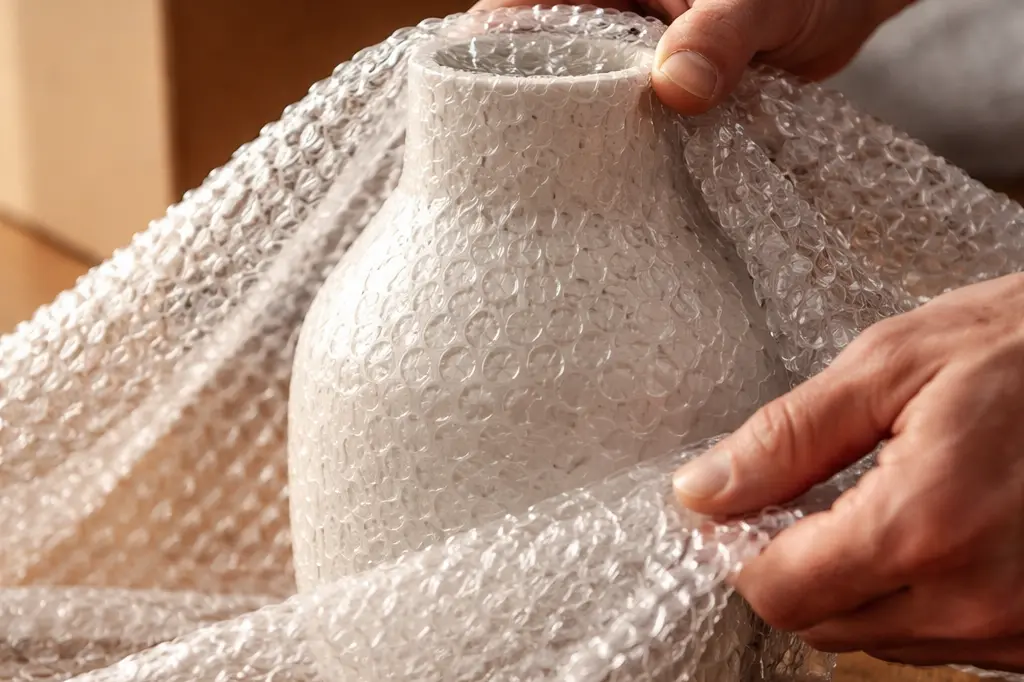
Small bubble wraps tight. It follows the curve of a mug or a jar without bridging gaps, so the wall of the piece sits against many tiny cushions instead of a few big ones. That spreads an impact across more surface.
Handmade ceramics, cosmetic bottles, and soap dishes all benefit. Two wraps, taped once. Done.
Why 1/2″ bubble leaves pressure points on stems, rims, and bases
Large bubble bridges. Wrap a wine glass stem, and the film sits on a few high spots, leaving air gaps around the thinnest part of the glass. Ship it, and the load concentrates exactly where the glass is weakest.
- Stems: big bubbles bend around them and snap under side load.
- Rims: one bubble carries the whole hit.
- Bases: flat glass rides on a few bubbles and cracks.
Save the 1/2″ bubble for heavy, dense items. Glassware isn’t one of them.
Buying wholesale bubble packaging by the roll: widths, lengths, and par levels for 100-1,000 orders a month
Buy by the roll, not by the foot. A 125-foot roll feels cheap until you’re cutting it twice a day, and a 500-foot roll cuts the per-order handling down fast. Small bubble (3/16″) should be your default for glassware, since it hugs curves and stems better than the big stuff.
Matching roll width (12″, 16″, 24″) to your most common glassware sizes
Pull your last 90 days of orders. Sort by item. Then match the width to what you pack most.
- 12″ width: shot glasses, small jars, cosmetic bottles, ceramic ornaments.
- 16″ width: pint glasses, mugs, candle jars, most handmade ceramics.
- 24″ width: wine glasses, vases, platters, anything you’d wrap twice around.
Stocking all three is overkill. Pick two. Most sellers shipping drinkware run 16″ and 24″.
Setting reorder points so you never run short during Q4
Running out of bubble on a Friday in November is a self-inflicted wound. Here’s the math warehouse managers use, and it works fine at your size.
- Estimate feet used per order (a pint glass typically takes 3 to 4 feet).
- Multiply by daily orders. At 600 a month, that’s roughly 20 orders a day, or 70 feet.
- Multiply by supplier lead time in days, then add a 7-day safety buffer.
- Raise the whole number by 40% from October through December.
Reorder when you hit that number. Not after.
Cutting per-unit cost without raising your damage rate
Where does the money actually leak when you ship glassware? Rarely in the wrap itself. It leaks in the extra 40 seconds a packer spends fighting a roll, and in the claims that follow a rushed job.
Small bubble (3/16″) hugs a stemmed glass or a ceramic handle.
Large bubble (1/2″) eats space and leaves gaps. Buy wholesale bubble packaging by the case, and the small-bubble roll usually wins on both fit and cube.
Pre-formed bubble bags vs. cutting bubble from the roll: time and material compared
Bags are fast. Pull, drop in, seal. A roll takes measuring, tearing, wrapping, taping. In practice, a bag saves roughly 15 to 20 seconds per unit, which adds up past 500 orders a month.
But rolls waste less on odd shapes. Here’s how it breaks down:
- Bags: best for uniform items like cosmetic jars, clear bottles, and small tubes.
- Rolls: best for mixed sizes, tall vases, and anything needing a double wrap.
Run a 50-unit test of each.
Count the damage. Then decide.
When a bubble mailer is enough and when the item needs a box
Light, compact, and low-profile? A bubble mailer works. Think electronics accessories, small soap bars, handmade ornaments under a pound.
Glassware is different. Anything hard, rigid, or heavier than about 12 ounces should go in a corrugated box with at least 2 inches of cushion on every side. A mailer has no crush resistance (it’s a squeeze-and-pray setup for a stemmed glass).
Bottom line: match the package to the item’s weakest point.
A simple test routine to confirm your bubble choice before you buy a full case
Seven out of 10 damage claims on glassware trace back to one packing choice, not the carrier. That’s what most dock managers find once they actually track it. So test before you commit to wholesale bubble packaging by the case.
Running a drop test with a six-pack of sample units
Order samples of both bubble sizes. Pack six identical glass items, three in small bubble and three in large. Same box, same tape, same void fill.
- Wrap each item with two full turns and tape the seam.
- Drop each box from 36 inches onto a hard floor, flat, then on a corner.
- Repeat on an edge, then open and inspect.
- Shake each box. Rattling means the wrap is too loose.
Small bubble usually wins here. It hugs curved bottles and stemware, so nothing shifts. Run it twice. One pass proves nothing.
Tracking damage claims by SKU to spot the weak link
A drop test only tells part of the story. Real shipping does the rest — and your order data shows it.
Log every claim by SKU for 30 days. Note the bubble size, the box, and the carrier. You’ll often find one tall vase or thin-rimmed jar causing most of the breakage (it’s rarely the whole catalog).
- Under 2% damage: keep the setup and reorder.
- 2% to 5%: add a second wrap layer on the problem SKU.
- Over 5%: switch bubble size or move to a sturdier carton.
Fix the weak SKU first. Then buy the case.
Pick the bubble that touches the glass the most. That’s the whole argument. Small 3/16″ bubble wraps curved walls, thin rims, and stems without leaving gaps, and it holds up through a 40-inch drop better than the fat stuff does. Large bubble still earns its keep on heavy, dense items. Just not on a stemmed wine glass.
The bigger lesson isn’t about bubble size at all. It’s about proof. A shop shipping 500 orders a month can’t afford to guess, and a six-pack drop test costs less than a single refunded order. Add SKU-level damage tracking and the weak link shows itself within a couple of weeks.
Once the data backs a choice, wholesale bubble packaging becomes a par-level exercise instead of a gamble: right roll width, a reorder point set well ahead of Q4, and no panic buys.
Next step: pull your last 90 days of damage claims, sort them by SKU — run a drop test on the worst offender using 3/16″ bubble before the next case order goes in.

