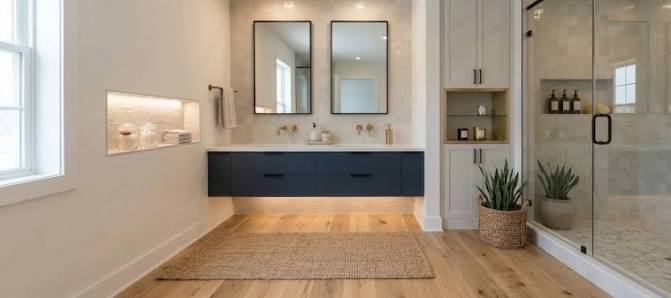
Small bathrooms punish every centimeter of wasted space. Cluttered shower caddies and bulky cabinets make a tight bathroom feel smaller. Recessed bathroom storage solves this by moving storage into the wall itself, gaining usable space without shrinking the room.
The short answer: for a narrow shower enclosure, build one vertical or horizontal tiled niche sized to your tallest bottle, slope the shelf so water drains, and waterproof it fully into the wall’s waterproofing layer. For awkward wall alcoves, recess a mirrored medicine cabinet or a slim open niche between the studs of a non-load-bearing wall. Plan the recess before you tile or buy the cabinet, and check the cavity for pipes and wiring first.
Why Recessed Storage Wins in Tight Bathrooms
Freestanding storage projects into the room. In a narrow shower, a corner caddy steals elbow room and wire baskets rust and clutter the sightline. A recessed niche sits flush with the wall, so you keep every centimeter of standing room while bottles stay within reach. The same logic applies outside the shower: a recessed medicine cabinet between studs gives you four or more inches of storage depth while projecting less than an inch into the room.
Built-in recesses are also easier to clean than wire caddies. The catch is that recesses are easiest to add during a renovation, when walls are open; retrofits need more care around waterproofing and hidden pipes.
Recessed Storage Ideas for Narrow Shower Enclosures
Shower niches are the most common form of recessed bathroom storage, and in a narrow enclosure their placement and orientation matter more than their size. The goal is generous storage that never interferes with showering space.
Horizontal Niches That Stretch Across the Wall
A horizontal niche across most of the shower wall is the most versatile layout. It holds tall bottles on one side and shorter items on the other, and the long clean line visually widens a narrow enclosure. It works best in enclosures around 900 mm (about 36 inches) wide or larger. Keep it at easy reach height, roughly 100 to 140 cm from the shower floor, and never in the direct path of the main spray.
Vertical Niches for Slim Enclosures
When the wall is too narrow for a wide niche, go vertical. A tall, slim recess between the studs fits taller bottles upright while taking minimal horizontal space. One adjustable shelf is usually enough. Vertical niches suit narrow alcove showers where the end wall is only 800 to 900 mm wide, keeping everything within reach of the shower head.
Corner Niches in Dead Space
The corner where two shower walls meet is often underused. A corner niche tucks storage into this dead space and works well in the smallest enclosures because it avoids the center of the wall. Purpose-built corner niche units install cleaner and waterproof more reliably at the joints than tiled triangular shelves.
Prefabricated Niche Inserts
If you are not retiling the whole shower, a prefabricated niche is the most practical route. Stainless steel or powder-coated aluminum inserts drop into a framed opening and seal around the edge with silicone. Foam-board preformed niches fit standard stud spacing, tile over directly, and carry an integral waterproofing flange that ties into the wall membrane. Standard sizes include 300 x 300 mm (12 x 12 inches) and 300 x 600 mm (12 x 24 inches); the trade-off is fixed dimensions.
Waterproofing: The Part You Must Not Skip
A shower niche is a hole in the most water-exposed wall in the bathroom. Without correct waterproofing, water wicks into the wall cavity and feeds mold and rot you cannot see until the damage is serious. Every surface inside the niche must be waterproofed and connected to the wall’s waterproofing layer. Grout and tile slow water down; they do not stop it.
- Membrane everything: Waterproof every interior surface with a liquid membrane or use a waterproof foam-board niche that carries its own waterproofing collar.
- Slope the shelf: Slope the bottom shelf about 2 to 5 mm toward the shower so water drains out instead of pooling.
- One-piece shelves: Use a solid one-piece shelf, such as stone or quartz, where possible. A single piece eliminates grout lines that trap soap scum.
- Flexible perimeter seal: Seal the perimeter where the niche meets the wall tile with flexible, mold-resistant silicone, not rigid grout, because the junction moves with temperature changes.
Niche lighting is a popular upgrade but an electrical job in a wet zone. Waterproof LED profiles sized to the niche exist, and the transformer must sit outside the wet area. Plan lighting with your electrician before the niche is built, not after it is tiled.
Recessed Storage Ideas for Awkward Wall Alcoves
Outside the shower, recessed storage turns dead wall space into useful capacity. The trick is working with what is inside the wall rather than against it.
Recessed Medicine Cabinets Between Studs
A recessed medicine cabinet is the highest-value recessed storage in most small bathrooms. Standard stud spacing of 400 or 600 mm on center leaves a clear cavity roughly 360 or 560 mm wide, and most recessed cabinets are designed to drop into exactly this space, so only the mirrored door sits nearly flush.
Before you buy, open the wall first. Cut a small inspection window and check the cavity for wiring, plumbing, vent pipes, and ducts; recessed cabinets cannot share the cavity with obstructions, and rerouting them adds cost. Load-bearing walls complicate the job: fitting a cabinet between existing studs without cutting them is fine, but cutting a stud in a load-bearing wall needs proper reframing with a header, which is professional work.
Slim Open Niches for Towels and Toiletries
Not every recess needs a door. A shallow open niche in the dry area, lined with matching or accent tile, makes a handsome display for rolled towels or daily toiletries. There is no splash risk here, so standard drywall finishing is fine, though a tiled back wipes down more easily. Best candidates are walls with odd geometry: beside a vanity, between a door frame and a corner, or above a toilet cistern. Keep depth around 90 to 150 mm so items stay visible and reachable.
Under-Eave and Sloped-Ceiling Recesses
Bathrooms under sloped ceilings have triangular dead zones standard furniture cannot use. A slim custom shelf fitted into the low wall space under the eave turns it into towel or linen storage that looks intentional. Keep stored items to one or two pieces per section, since shrinking headroom makes stacked items look cluttered and unstable.
Comparing Your Recessed Storage Options
The right option depends on location, whether the wall is open, and budget. This comparison covers the most common choices.
| Option | Best location | Typical depth | DIY difficulty | Relative cost |
| Custom tiled shower niche | Shower walls during a retile | 90-150 mm | High (waterproofing critical) | Higher |
| Prefabricated niche insert | Existing shower, framed opening | 75-100 mm | Moderate | Lower to mid |
| Vertical tiled niche | Narrow shower end walls | 90-150 mm | High | Higher |
| Corner niche | Small shower cubicles | 75-120 mm | Moderate | Mid |
| Recessed medicine cabinet | Dry wall near the vanity | 90-140 mm | Moderate (cavity check first) | Mid |
| Open dry-area niche | Awkward walls, above toilet | 90-150 mm | Low to moderate | Lower |
| Under-eave custom shelf | Sloped-ceiling bathrooms | 100-200 mm | Moderate (custom fit) | Mid |
Planning Your Recessed Storage Step by Step
Decide location first. Mark the position with painter’s tape and check reach height, sightlines, and whether it sits in the direct spray path.
Check the wall cavity. Cut a small inspection window and verify there are no pipes, wires, vents, or ducts before you commit.
Confirm the wall is suitable. Recessing into a load-bearing wall without reframing is not a DIY decision; exterior walls need care around insulation and vapor barriers.
Size for your tallest bottle. Measure it, add at least 25 mm clearance. Shared bathrooms need more width, not more depth.
Choose tiled or prefab. Retiling? Go tiled with a one-piece sloped shelf. Tile staying? Use a prefab insert in a framed opening.
Waterproof the wet-zone niche fully. Membrane every interior surface, tie into the wall waterproofing, slope the shelf, and finish the perimeter with flexible silicone.
Finish and maintain. Keep grout lines minimal and re-check the silicone perimeter once a year.
What Recessed Bathroom Storage Costs
Costs vary by region and materials, so treat all figures below as estimates. The cheapest recess is the one added while a wall is already open for other work.
| Item | Estimated cost range | Notes |
| Prefabricated niche insert | $50-$200 | Unit only; framing and finishing extra |
| Custom tiled shower niche (during retile) | $300-$800 | Labor, tile, waterproofing materials |
| Recessed medicine cabinet | $150-$500 | Cabinet only; basic models at the low end |
| Opening and reframing a wall cavity | $200-$600 | Higher if pipes or wires must be rerouted |
| Waterproof LED niche lighting | $100-$300 | Materials; electrician labor extra |
| Professional full installation | $500-$1,500+ | Varies by region and wall complexity |
Common Mistakes to Avoid
- Wrong placement: Placing the niche in the direct spray path, which dilutes products and forces constant cleaning.
- Skipping waterproofing: Tiling the niche without a waterproof membrane behind it, trusting grout to stop water.
- Flat shelves: Building the shelf dead level so water pools, staining grout and feeding mold.
- Blind cutting: Cutting into the wall before checking for pipes and wires.
- Undersized recesses: Making the niche too small or too divided, so tall bottles do not fit.
- Wrong sealant: Using rigid grout at the niche perimeter instead of flexible silicone.
Safety and When to Call a Professional
Recessed storage is safe DIY territory only when the wall is straightforward. Call a licensed professional when any of the following apply.
- The wall is load-bearing, or you are unsure. Cutting structure without proper reframing can compromise the building.
- You find wiring, plumbing, or vent pipes in the cavity that need rerouting. Bathroom electrical work is subject to strict safety rules in most regions.
- The niche is in a wet zone and you are not confident about waterproofing. A failed niche rots the wall from the inside, and the repair costs far more than professional installation.
- The home predates the late 1970s (possible lead paint) or the wall materials may contain asbestos. Get materials tested before disturbing them.
- Any niche lighting or powered accessories must be wired by a qualified electrician, with the transformer outside the wet zone.
Even in a simple dry-wall recess, wear a dust mask and eye protection when cutting, and shut off the relevant circuit before opening any wall.
Final Thoughts
Recessed bathroom storage is one of the few upgrades that gives you more space without taking any away. Pick one location, size it to your tallest bottle, and get the waterproofing right in wet zones.
Your clear next step: grab your tallest bottle, stand in your shower or in front of your vanity wall, and mark the ideal recess position with painter’s tape. That five-minute test sets size and placement before you cut.
Frequently Asked Questions
How deep should a shower niche be?
A depth of 90 to 150 mm (about 3.5 to 6 inches) suits standard bottles, and many prefab inserts are around 100 mm deep. Beyond 150 mm, bottles get lost at the back and the deeper shelf collects more standing water. Size width and height for your tallest bottle plus clearance.
Can I add a shower niche without retiling the whole shower?
Yes, with a prefabricated niche insert. You open a framed section of wall, fit the insert, seal the perimeter with silicone, and patch the surrounding finish. A fully tiled custom niche needs the wall opened and rewaterproofed, which usually means retiling at least that wall section.
Where is the best place to put a shower niche?
On the back or side wall at chest height, roughly 100 to 140 cm from the shower floor, within easy reach but out of the direct spray path. In narrow enclosures, a vertical niche on the end wall is often the most space-efficient choice.
Do shower niches leak?
A correctly built niche does not leak. Leaks happen when the niche is tiled without a waterproof membrane, when the shelf is dead level so water pools, or when the perimeter is sealed with rigid grout instead of flexible silicone.
Can I recess a medicine cabinet into any wall?
No. The cavity must be free of pipes, wires, vents, and ducts, so inspect before you cut. Exterior walls need care around insulation and vapor barriers. Cutting a stud in a load-bearing wall needs proper reframing with a header. Fitting the cabinet between existing studs without cutting them is the simplest and safest retrofit.
What is the standard size for a recessed medicine cabinet?
Most recessed cabinets fit between studs spaced 400 or 600 mm on center, with the body roughly 360 or 560 mm wide and 90 to 140 mm deep. Older homes with nonstandard spacing may need custom framing or a custom cabinet.
Should the niche shelf be sloped?
Yes. Slope the bottom shelf 2 to 5 mm toward the shower so water drains instead of pooling. A one-piece stone or quartz shelf with a slight fall is the best detail because it has no grout lines to trap soap scum.

