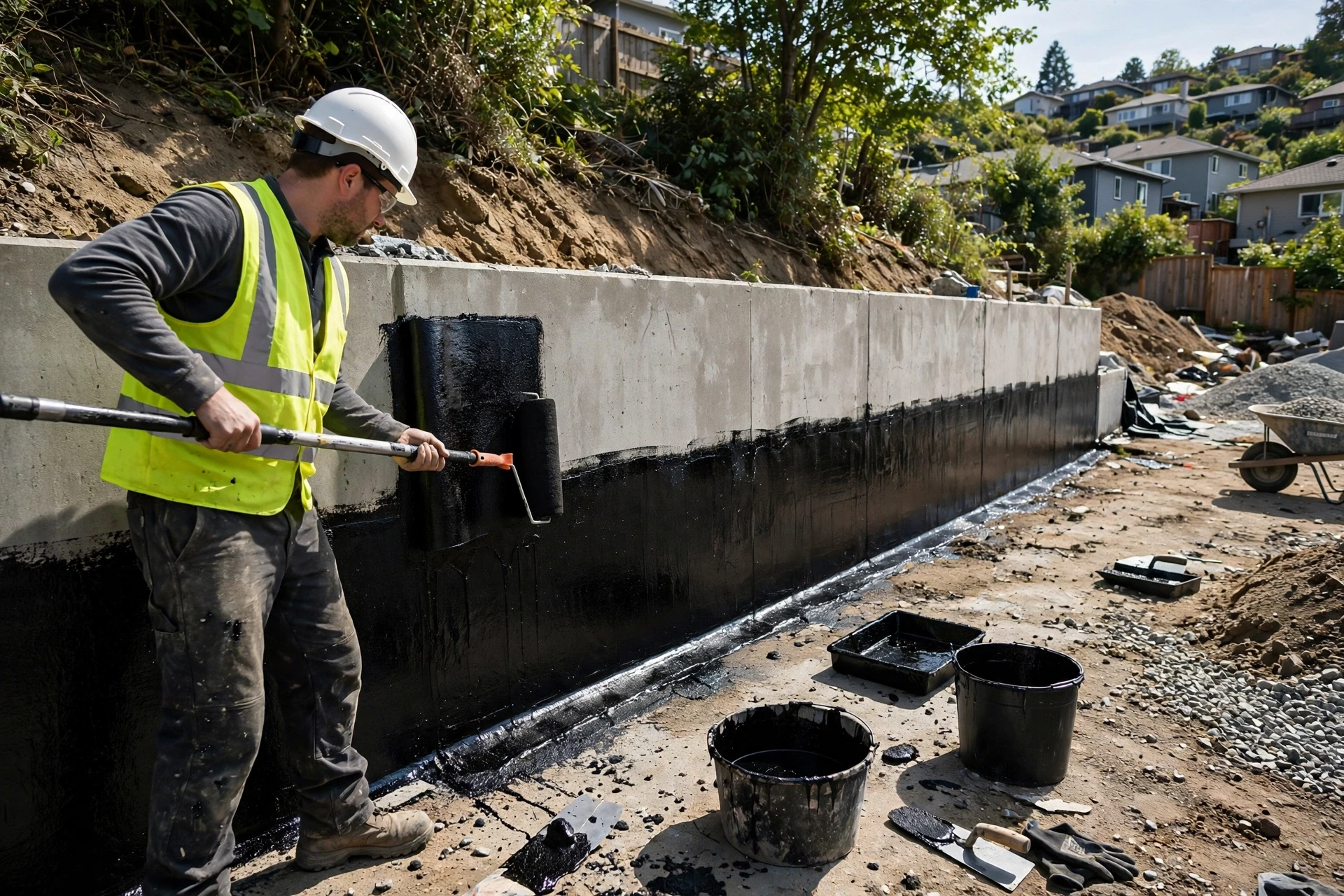
A retaining wall holds back tonnes of soil, and when that soil gets wet, the water pushes hard — sideways against the wall and down toward its base. Without waterproofing, moisture seeps through concrete and masonry, stains and weakens the face, and in cold climates freezes and cracks it from the inside. The durable answer is not a single product but a system: a waterproof membrane on the buried face, a drainage layer that carries water down, and a base drain that takes it away. This guide explains how to choose the right combination for your wall type, soil, and water pressure, so the wall stays dry and standing for decades.
Costs in this guide are broad planning estimates, not quotes, and requirements vary by location — walls above a certain height often need an engineer’s design and a permit, so check your local building code before starting work.
Why Retaining Walls Fail When Waterproofing Is Skipped
Water is the main reason retaining walls lean, crack, and eventually fail. Saturated soil behind a wall is far heavier than dry soil, and the water adds hydrostatic pressure that pushes the wall outward. At the same time, moisture moving through the wall dissolves salts that appear as white efflorescence, erodes mortar joints, and corrodes any steel reinforcement inside. In freezing weather, water trapped in pores and cracks expands as it turns to ice, opening the cracks wider with every cycle.
The damage is slow at first and then sudden. A wall that looks fine from the front can be bowing at the base or losing mortar at the back, where nobody sees it. By the time the face shows staining, leaning, or horizontal cracking, the wall has often been under stress for years. Waterproofing and drainage fitted during construction — or during a proper repair — cost a fraction of rebuilding a failed wall, which is why engineers treat them as part of the structure, not an optional extra.
What a Complete Retaining Wall Waterproofing System Includes
Effective retaining wall waterproofing is a multi-layer system, not just a coating. The goal is twofold: stop water reaching the wall material, and give any water that does arrive a fast, safe path away. Each layer has a job, and skipping one leaves the others to cope with pressure they were not designed for. A complete system has four parts that work together from the wall face outward into the soil.
- A primary membrane — sheet or liquid-applied — bonded to the buried face of the wall.
- A drainage and protection layer, such as a dimpled board, that channels water down and shields the membrane.
- Free-draining backfill — clean gravel or crushed stone — for the first stretch behind the wall.
- A perforated base drain at the footing, wrapped in filter fabric and discharging to a safe outlet.
Think of it as defence in depth. The membrane blocks water, the drainage layer relieves pressure, the gravel lets water move freely, and the base drain removes it. If any one layer fails, the others still slow the damage — but a wall with only a coating and no drainage will eventually build up enough pressure to push water through, no matter how good the coating is.
Sheet Membranes for Maximum Protection on High-Risk Walls
Sheet membranes are the strongest option for walls facing serious water pressure — high walls, walls holding back a slope, or walls in ground with a high water table. These are flexible, self-adhering sheets, usually high-density polyethylene bonded to a rubberized asphalt compound, applied by peeling a release paper and pressing the adhesive side onto a prepared wall surface. They give a consistent thickness, excellent puncture resistance, and proven durability of decades when correctly installed, and some products are rated for the highest hydrostatic pressures a residential wall will see.
Installation quality matters more than the brand. The wall face must be clean, dry, and smooth — high spots ground down, holes and honeycombing filled — or the sheet will bridge over gaps and leave channels for water. Seams must overlap in the right direction, be rolled firmly, and be sealed at laps and penetrations. Corners and the wall-to-footing joint need extra attention, often with a reinforcing strip of membrane. Because sheet membranes are unforgiving of poor preparation, they are usually a professional job, and on tall walls they should be installed alongside the drainage layer in the same visit so the membrane is never left exposed to backfill damage.
Liquid-Applied Coatings and Crystalline Treatments Compared
Liquid-applied coatings are the most common choice for smaller residential walls and DIY work. Polymer-enhanced asphalt emulsion or bituminous paint is brushed, rolled, or sprayed onto the back face in two or three coats, forming a seamless, monolithic membrane with no joints to fail. They conform to rough concrete and blockwork easily, bridge hairline cracks, and cost less than sheet systems. Their weakness is thickness: a thin or uneven coat is a weak spot, so apply the full specified coverage and check it with a wet-film gauge if the product calls for one.
Crystalline treatments work differently. A cement-based slurry is applied to the wall face, and active chemicals grow crystals inside the concrete’s pores, blocking water paths from within. They are useful as a negative-side treatment — applied from the inside face when the outside cannot be excavated — and for sealing concrete that is already damp. They do not replace a membrane on the buried face, and they cannot bridge a moving crack. Penetrating sealers are a lighter option still: they make concrete water-repellent but do not stop pressure-driven water, so treat them as a supplement, not a system.
| System | Best for | Pressure resistance | Typical lifespan |
|---|---|---|---|
| Self-adhesive sheet membrane | High walls, high water table | Very high | 30–50+ years |
| Torch-on bituminous membrane | Large walls, new builds | Very high | 30–50+ years |
| Liquid bituminous coating | Small walls, DIY, rough surfaces | Moderate | 10–20 years |
| Crystalline slurry | Negative-side, damp concrete | Moderate | Life of the concrete |
| Penetrating sealer | Light damp, above-grade faces | Low | 5–10 years |
Drainage Layers, Weep Holes, and the Base Drain
A membrane alone is not enough. Once backfilling begins, unmanaged water can build pressure against the wall and physically damage the fresh membrane. A dimpled drainage board fixed over the membrane solves both problems: the dimples create an air gap that channels water downward to the base drain, and the board shields the membrane from stones and compaction during backfilling. Some boards come with a bonded geotextile filter that keeps soil out of the drainage channels.
At the base of the wall, a perforated drain pipe sits just above the footing on a bed of gravel, with its holes facing down, and runs with a steady fall — at least half a percent — to a daylight outlet or storm drain. Weep holes through the wall base, typically spaced every one to two metres, give water a second escape route and are essential on masonry walls. Backfill the first 300 to 600mm behind the wall with clean crushed stone or gravel, not the excavated soil, and wrap the pipe and gravel in non-woven geotextile so fines cannot clog the system. Without these details, even a perfect membrane will be fighting pressure it was never meant to carry.
Matching the System to Concrete, Block, and Timber Walls
The right system depends on what the wall is made of. Poured concrete walls take almost any membrane well, and sheet membranes or torch-on systems are the natural choice for tall concrete walls because the smooth face bonds cleanly. Concrete block walls need their joints filled and the face parged smooth before a sheet membrane will adhere, which is why liquid coatings are often preferred on blockwork — they flow into the joints and seal them as they coat. Crystalline slurries also suit block walls, since they treat the masonry from within.
Timber retaining walls are a different case. Timber moves, shrinks, and eventually decays, so a rigid membrane bonded to it will crack and peel. The practical approach is a heavy-duty polyethylene sheet laid loosely behind the timber with a drainage layer, plus free-draining gravel backfill and a base drain — the sheet sheds water without needing to bond to the wood. Segmental block walls with no mortar rely on drainage more than on any coating: keep the gravel backfill and base drain in perfect order, and use a membrane only where the design calls for it. Whatever the material, match the system to how the wall moves and how water reaches it, not to the product with the longest warranty.
How to Judge Waterproofing Costs and Lifespan
Costs vary with wall height, length, access, and how much excavation is needed, so treat these as broad planning estimates. Professional waterproofing for a standard residential retaining wall commonly runs into the low thousands of dollars, with tall or difficult walls costing several times more. Liquid coatings are the cheapest professional option; sheet and torch-on membranes cost more in materials and labour but last far longer. A DIY liquid coating on a small garden wall may cost only a few hundred dollars in materials, but it cannot substitute for a designed system on a structural wall.
Lifespan follows the same pattern. A well-installed sheet or torch-on membrane can protect a wall for 30 to 50 years or more, while a liquid coating typically needs renewal after 10 to 20 years. Crystalline treatments last as long as the concrete they are in. The real determinant is drainage: a membrane of any type will fail early if the base drain clogs or the outlet is blocked, so budget for inspection and flushing as part of the system’s life, not as an afterthought. Ask any contractor for the membrane’s data sheet, the drainage detail, and the outlet route before accepting a quote — a price without those three things is not comparable with one that includes them.
Retaining Wall Waterproofing FAQs for Homeowners
Do all retaining walls need waterproofing?
Any wall holding back soil that stays wet needs it. A low garden wall in free-draining ground may manage with drainage alone, but a wall over a metre high, a wall holding back a slope, or any wall with living space behind it should have a membrane and drainage system.
Can I waterproof a retaining wall from the inside?
Partly. Crystalline slurries and cement-based coatings can be applied from the inside face and will reduce seepage, but they cannot relieve the water pressure pushing on the wall from behind. Lasting protection needs the membrane and drainage on the buried face.
What is the difference between damp-proofing and waterproofing?
Damp-proofing resists moisture vapour and light damp; waterproofing resists liquid water under pressure. A retaining wall holding back saturated soil needs true waterproofing — a tanking membrane — not a damp-proof coating.
How often should a retaining wall drainage system be checked?
At least once a year, and after any major storm. Check that weep holes are open, the base drain outlet is running, and no water is ponding behind the wall. Flush the drain through its cleanouts if flow looks slow.
Will waterproofing stop my retaining wall from leaning?
It removes one cause — water pressure — but it cannot fix a wall that is already leaning because of poor footings, inadequate design, or soil movement. A leaning wall needs a structural assessment before any waterproofing work.
How long does retaining wall waterproofing last?
A quality sheet or torch-on membrane can last 30 to 50 years or more when protected by a drainage layer and kept drained. Liquid coatings typically need renewal after 10 to 20 years, and any system fails early if its drain clogs.
Final Thoughts: Choosing a Retaining Wall System That Outlasts the Wall
Choosing a retaining wall waterproofing system is really choosing a team: a membrane to block the water, a drainage layer to relieve the pressure, gravel to let it move, and a base drain to take it away. Match that team to your wall — sheet membranes for high-risk concrete, liquid coatings for small block walls, loose sheeting for timber — and insist on the drainage detail, not just the coating. A wall built dry and kept drained is a wall that stands for decades; a wall left to fight water alone is a rebuild waiting to happen.

