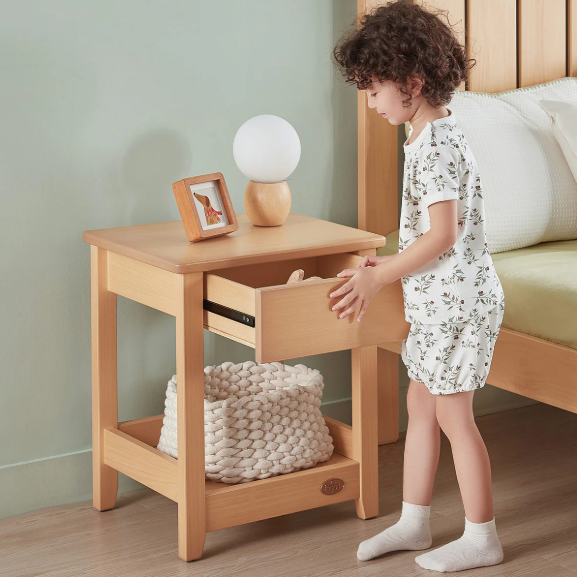
The bedtime routine in a child’s household is one of the most consistent and consequential daily events in family life. How smoothly it goes, how reliably it settles the child, and how effectively it builds the reading habit that accumulates over the years of childhood are all influenced by the physical environment in which it happens. The bedside table, often overlooked in favour of the more visually prominent bedroom furniture, is the piece of furniture most directly connected to whether the bedtime routine works smoothly and whether the before-sleep reading habit becomes genuinely established. A bedside table that is the right height, has the right storage, and is positioned correctly beside the right bed is a quiet but consistent contributor to one of the most valuable daily habits in a child’s development.
Key Takeaways
- Bedside tables for kids are not the same as adult bedside tables. Height, scale, storage format, and safety requirements differ between the two contexts in ways that matter for daily use.
- The bedtime routine is directly supported by a bedside table that holds the reading lamp, the current book, and the settling essentials within arm’s reach of the child without any adult intervention.
- The before-sleep reading habit, one of the most consistently effective literacy interventions in childhood, requires a lamp and a book within reach of the bed. The bedside table makes this effortless.
- Safety is a higher priority consideration for bedside tables in children’s rooms than in adult rooms because children are more likely to reach for the table in the dark, lean against it, and use it more roughly than adults.
- The best bedside tables for kids are stable, appropriately sized for the child’s bed height, equipped with at least one drawer or shelf, and finished to non-toxic Australian safety standards.
How the Bedside Table Supports the Bedtime Routine
| Routine Element | Bedside Table Role | What Happens Without It |
| Reading before sleep | Holds current book within reach | Book has no home; child searches or doesn’t read |
| Lamp for reading | Provides surface for the lamp | No nearby lamp; reading in dark or main light stays on |
| Settling without disruption | Holds water glass within reach | Child calls for adult to bring water or leaves bed |
| Lamp switch self-management | Lamp on surface child can reach | Adult must turn off lamp after child falls asleep |
| Morning routine | Holds alarm clock | Child depends on adult for waking; habit not built |
Choosing Bedside Tables for Kids
Matching Height to the Bed
The single most important criterion is height. A bedside table for a child’s room should have its surface at approximately the same level as the top of the mattress. This allows the child to reach the lamp, book, and water glass from a lying position without needing to sit up fully, which is disruptive to the settling state the bedtime routine is designed to create.
Choosing the Right Storage
A drawer is the most practical storage format for a children’s bedside table because it keeps the bedside essentials contained and accessible without adding to the surface clutter. For toddlers, an open shelf is more appropriate because it is easier to access in the dark and does not have the catch risk that a drawer does for small fingers. For school-age children, a drawer unit or a shelf-plus-drawer combination manages the slightly more complex set of bedside items appropriate for their stage.
Scale and Visual Fit
Bedside tables for kids should be proportionate to the child’s room and bed, not to adult scale. A large adult bedside table beside a single child’s bed looks disproportionate and takes up floor space that does not benefit the child. A compact unit of 35 to 45 centimetres in width and 30 to 40 centimetres in depth serves the function adequately in a proportionate scale.
Safety Requirements
Bedside tables for kids need to meet a higher safety bar than their adult equivalents because they are used in the dark, by a child who may be half-asleep, in a room without adult supervision. Specific requirements:
- Non-toxic, lead-free finish certified to Australian standards.
- All edges and corners rounded or bevelled with no sharp points.
- Drawer pull-stop mechanism so drawers cannot be pulled fully out and dropped in the dark.
- Stable base construction that resists tipping under lateral force from a sleepy child reaching in the dark.
For a full range of kids bedside tables designed to these specifications, visit https://boori.com.au/collections/bedside-tables.
Frequently Asked Questions
At what age should a child have a bedside table?
From the transition to a bed, typically 18 months to three years, a bedside table appropriate for the bed height becomes a functional addition. The toddler stage benefits from a simple low unit with an open shelf. The pre-school and school stage benefits from a drawer unit with a surface large enough for a lamp, book, and water glass.
Can the bedside table double as a small bookshelf?
Yes. An open shelf on the bedside table can hold the two or three books in active bedside rotation, creating a small bedside book display separate from the main bedroom bookshelf. This works particularly well for children who read more than one book at a time or who want their current and recently finished books within reach without going to the main bookshelf.
What lamp works best on a child’s bedside table?
A lamp with a warm-toned bulb, a stable weighted base that cannot be easily knocked over, and a switch the child can operate independently from a lying position. Clip-on lamps that attach to the headboard or the bedside table edge are an alternative for tables where the lamp base takes too much surface space. Touch-operated lamps are easier for young children to switch off independently without needing to find a small switch in the dark.
How do I stop a child’s bedside table becoming cluttered?
Establish a clear surface rule from the first day: lamp, current book or two books, water glass, and one small personal item maximum. Everything else belongs in the drawer. Maintain this rule consistently and the surface clutter does not develop. A bedside table that has started to accumulate items needs a deliberate reset rather than incremental tidying; remove everything, return only the designated items, and re-establish the surface rule clearly.
Final Thoughts
Bedside tables for kids are quiet workhorses of the children’s bedroom furniture set. They do not attract the attention that a well-styled bookshelf or a beautiful bed frame does, but they contribute to the daily bedtime routine and the before-sleep reading habit in a way that no other piece of furniture in the room can replicate. Chosen correctly, they make the routine smoother, the reading habit more consistent, and the child’s evening more self-managed. Chosen poorly or skipped entirely, they leave a gap in the settling environment that the rest of the bedroom’s furniture cannot fill.

