Most homes swing between too warm and too cool every single day. The afternoon sun pushes the living room several degrees above comfortable, then the evening cool-down leaves bedrooms chilly by morning, and the heating or cooling system works hard to chase a moving target. Heavy masonry walls used to smooth out these swings, but modern timber-frame homes are light, fast to heat, and just as fast to cool.
The direct answer is to give lightweight rooms the thermal inertia they lack, without adding tonnes of concrete. Phase change materials, or PCMs, absorb heat as they melt and release it as they solidify, holding room temperature near their melting point for hours. Built into wallboard, plaster, or floor layers, they act like a thermal battery that charges on daytime warmth and discharges at night, steadying indoor temperatures with no fan, compressor, or moving part.
The Indoor Temperature Problem Phase Change Materials Were Built to Solve
Lightweight construction is comfortable to build and quick to heat, but it stores almost no warmth. A timber-frame room can gain several degrees within an hour of strong sun through a window, then lose that heat just as quickly after sunset. Occupants feel the swing directly: sticky afternoons, cold mornings, and a thermostat that seems to run the heating and cooling systems in turns.
Traditional thermal mass solves this with weight. A thick concrete or brick wall absorbs daytime heat slowly and releases it at night, flattening the daily temperature curve. The problem is that most existing homes cannot take the extra weight, and most new lightweight homes are not designed for it. Phase change materials offer the same flattening effect in a thin, light layer.
What Happens Inside a Phase Change Material as Rooms Warm and Cool
A phase change material stores energy as latent heat, the energy absorbed or released when a substance changes state. When the room warms past the material’s melting point, the PCM begins to melt and soaks up heat while its own temperature stays almost constant. When the room cools below that point at night, the material solidifies and gives the stored heat back to the room, again at a nearly steady temperature.
This is very different from ordinary thermal mass. A concrete wall must get hotter to store more heat, so its surface temperature rises through the day. A PCM layer tuned to melt near 22 to 24 degrees Celsius holds the room near that comfort band for hours while it absorbs the same energy.
Paraffin, Salt Hydrate, and Bio-Based Phase Change Materials Compared
Three families of phase change material dominate residential construction, and they differ in cost, durability, and handling. Paraffin waxes are the most established: stable, reliable over thousands of melt-freeze cycles, and available in a wide range of melting points. Salt hydrates store more heat per unit volume and conduct it faster, but they can separate into layers over repeated cycles and may corrode metal fixings.
| Material family | Typical melt range | Main strength | Main weakness |
|---|---|---|---|
| Paraffin wax | 18 to 28 C | Very stable over many cycles | Low thermal conductivity; flammable |
| Salt hydrate | 20 to 30 C | High heat storage per volume | Phase separation; can corrode metals |
| Bio-based (fatty acid) | 20 to 26 C | Renewable source; non-corrosive | Higher cost; limited suppliers |
| Eutectic blends | Tuned to order | Sharp, precise melting point | Less proven at residential scale |
In practice, most residential products use paraffin or bio-based materials sealed inside tiny polymer capsules, a process called microencapsulation, so the liquid phase can never leak into the wall. Macroencapsulated panels, pouches, or mats are the other common route, with the PCM held in sealed sheets or tubes fitted as a discrete layer inside the wall or ceiling. Microencapsulated boards behave like ordinary plasterboard on site, while macroencapsulated mats usually need more care during installation.
Where Phase Change Materials Belong in a Home: Walls, Ceilings, and Floors
Placement decides how much of the PCM’s capacity a home actually uses. Interior walls in sun-facing rooms are the most effective location, because they sit where the heat arrives and where people feel it. Ceilings are the second-best location, since warm air rises and collects there, and a PCM ceiling layer intercepts heat before it soaks into the roof space.
Floors work well in a different way. PCM mats beneath tile or engineered flooring pair naturally with passive solar design and with radiant floor heating, absorbing direct sun that lands on the floor and smoothing the output of the heating system. Whatever the location, the PCM layer must face the living space directly, with no insulating layer between it and the room air.
Phase Change Wallboard and Plaster: What to Expect During a Retrofit
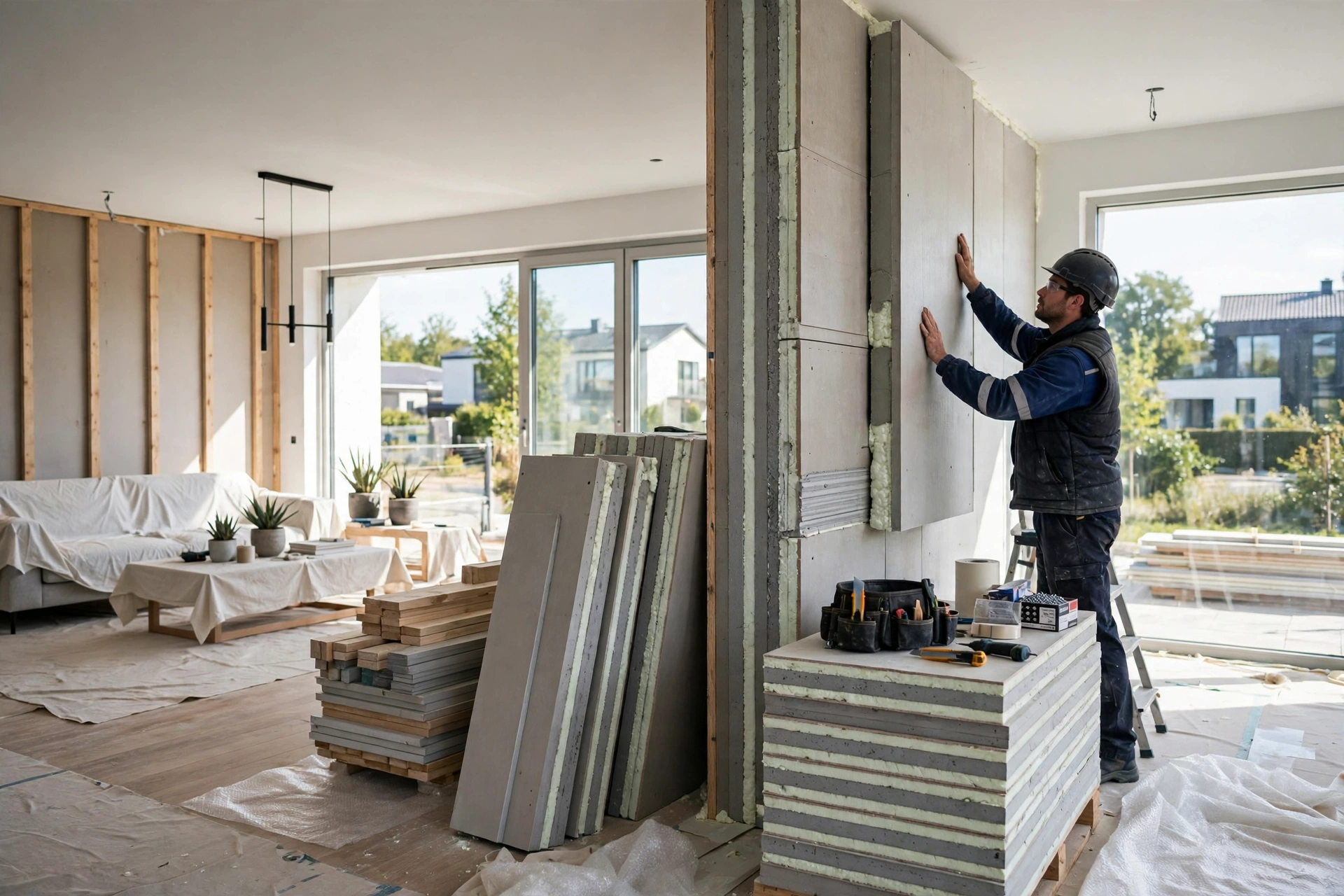
Retrofitting PCM wallboard is closer to a redecorating job than a structural one, which is part of its appeal. In most products the PCM is already inside the board, so the installer cuts, fixes, and finishes it like standard plasterboard, then tapes and paints as usual. A single room can often be lined in a day or two, and the only visible difference afterwards is a steadier temperature. Some boards are noticeably heavier than standard plasterboard, so fixings and framing should be checked before work starts.
PCM plaster and render are the lighter-touch alternative for rooms where replacing boards is too disruptive. A plaster containing microencapsulated PCM is applied in the normal way, in one or two coats, and can be used on walls and ceilings that are otherwise sound. The thermal effect is smaller than a full PCM board, because the layer is thinner, but it is often enough to take the edge off afternoon overheating.
Matching the Melt Point to Your Climate and Comfort Range
The melt point is the single most important specification, and getting it wrong wastes the whole investment. For occupied living spaces, the useful range is roughly 20 to 26 degrees Celsius, close to the temperature people find comfortable. The right choice sits just above the temperature you want the room to hold on a warm afternoon.
Climate narrows the choice further. In hot, sunny regions, a melt point near the upper end of the comfort range, around 24 to 26 degrees, targets afternoon overheating. In temperate climates with cool nights, a lower melt point near 21 to 23 degrees lets the material recharge fully overnight and contribute on both warm and cool days. Rooms with different uses may justify different melt points: a sun-drenched living room benefits from a higher melt point than a north-facing bedroom.
Pairing Phase Change Materials With Insulation, Ventilation, and Shading
A phase change material is not a substitute for insulation, and it performs poorly in a leaky, unshaded house. Insulation slows heat entering or leaving the building, shading controls how much sun reaches the glass, ventilation recharges the PCM overnight, and the PCM itself smooths whatever heat remains. Each layer does a different job, and the system works only when all four are present. The checklist below covers the pairings that matter most.
- Shade south and west windows first, so the PCM deals with residual heat rather than full sun.
- Ventilate at night, opening windows or running a fan, so the PCM solidifies before morning.
- Insulate the roof and walls to the local standard, so stored heat stays in the room.
- Keep the PCM layer exposed to room air, with no insulating lining between it and the occupants.
- Size the heating and cooling system for the flattened load, not the old peak, or the benefit is wasted.
Night ventilation deserves emphasis, because it is the recharge step that owners most often forget. A PCM that ends the day fully melted and never cools overnight has no capacity left for the next afternoon. Design the recharge path at the same time as the PCM layer, not as an afterthought.
Phase Change Material Limits, Leakage Risks, and Fire Safety
Phase change materials have real limits, and an honest assessment starts with them. They do not cool a house: they delay and smooth temperature change, which means a heatwave lasting several days with warm nights will eventually exhaust them, and mechanical cooling will still be needed for the worst days. They also add cost, often several times the price of standard plasterboard for the same area, and the payback depends on energy prices and how much cooling the household actually uses.
Leakage was a genuine concern in early products, but modern microencapsulated boards seal the PCM inside polymer shells a fraction of a millimetre across, and macroencapsulated mats use welded pouches. Fire safety needs attention too: paraffin-based PCMs are combustible, so boards must carry the required fire rating for their location, and salt hydrate or bio-based products may be the safer choice near kitchens or heating appliances. Always confirm the product’s fire classification and local code requirements before specifying it.
Phase Change Material Payback: What the Numbers Can and Cannot Promise
Published research gives a realistic sense of what PCMs can do, without promising any single outcome. A 2025 review of PCM integration in buildings reported indoor temperature fluctuations reduced by up to 46 percent, heat transfer through treated components cut by up to about 48 percent, and heating and cooling demand reduced by as much as 31 percent, depending on placement, climate, and melt point. Peak cooling demand reductions of around 25 to 35 percent are commonly reported for well-designed installations. These are upper-range findings from studies, not guarantees for any particular home.
| Factor | What helps payback | What hurts payback |
|---|---|---|
| Climate | Hot days with cool nights | Warm nights that block recharging |
| Placement | Sun-facing walls and ceilings | PCM hidden behind insulation |
| House type | Lightweight, fast-swinging rooms | Heavy masonry that already buffers heat |
| Energy prices | High cooling costs | Cheap electricity and mild summers |
| System design | Night ventilation included | No recharge path designed in |
Treat payback as a range, not a date. In a lightweight home with strong sun, cool nights, and expensive cooling, a PCM retrofit can pay back through lower energy bills and a smaller replacement cooling system within a reasonable period. In a mild climate with cheap electricity, the comfort benefit may matter more than the bill saving, and that is a legitimate reason to install it, provided the decision is made with open eyes.
Phase Change Material FAQs for Homeowners
What melt point should I choose for a living room?
Choose a melt point just above the temperature you want the room to hold on a warm afternoon, usually 22 to 24 degrees Celsius for living spaces. A higher melt point suits hot, sunny rooms, while a lower one suits temperate climates where full overnight recharging matters more.
How long do phase change materials last?
Well-made microencapsulated paraffin and bio-based PCMs are designed to survive thousands of melt-freeze cycles, which in a home means many years of daily use. Salt hydrates can degrade faster if they separate, so check the manufacturer’s cycle-life data and warranty before buying.
Are phase change materials safe if they leak?
Modern residential products seal the PCM inside microcapsules or welded pouches, so a leak of liquid material is unlikely. A damaged board can release small amounts, so follow the manufacturer’s guidance on drilling and fixing, and choose salt hydrate or bio-based products where fire safety is a particular concern.
Can I add phase change wallboard to an existing home?
Yes, and that is one of its main advantages. PCM wallboard is fixed like standard plasterboard, so a single room can be lined in a day or two without structural work. PCM plaster is an even lighter option for walls and ceilings that are otherwise sound.
Do phase change materials replace air conditioning?
No. They reduce and delay peak temperatures and can shrink the size of cooling equipment needed, but a long heatwave with warm nights will eventually exhaust them. Think of PCMs as a way to use less mechanical cooling, not to eliminate it.
What maintenance do phase change materials need?
Almost none. Once installed, PCM boards and plasters need no servicing, and there are no filters or moving parts. The only ongoing task is making sure the room can still ventilate at night, so the material recharges, and repairing any physical damage to the board promptly.
Final Thoughts: Whether Phase Change Materials Belong in Your Next Renovation
Phase change materials earn their place where lightweight rooms swing too far between hot afternoons and cold mornings, and where cool nights can recharge them. Choose the melt point for your climate, put the material where it faces the room, design the night ventilation at the same time, and judge the cost against comfort as well as energy savings. Done that way, a thin layer of wax or salt inside your walls can do the job of a much heavier one.

