Adding a home battery to your solar or backup-power setup is one of the smartest upgrades you can make — but where you put it matters almost as much as which one you buy. The wrong spot can shorten its lifespan, affect warranty coverage, create fire-safety risks, or fail inspection.
This guide explains home battery storage location requirements in plain terms: temperature and ventilation rules, the indoor-garage-outdoor decision, clearances for servicing, manufacturer safety instructions, and the fire-safety basics behind installer codes — covering popular lithium home batteries such as Tesla Powerwall and Enphase IQ systems.
The Quick Answer: Where Should a Home Battery Go?
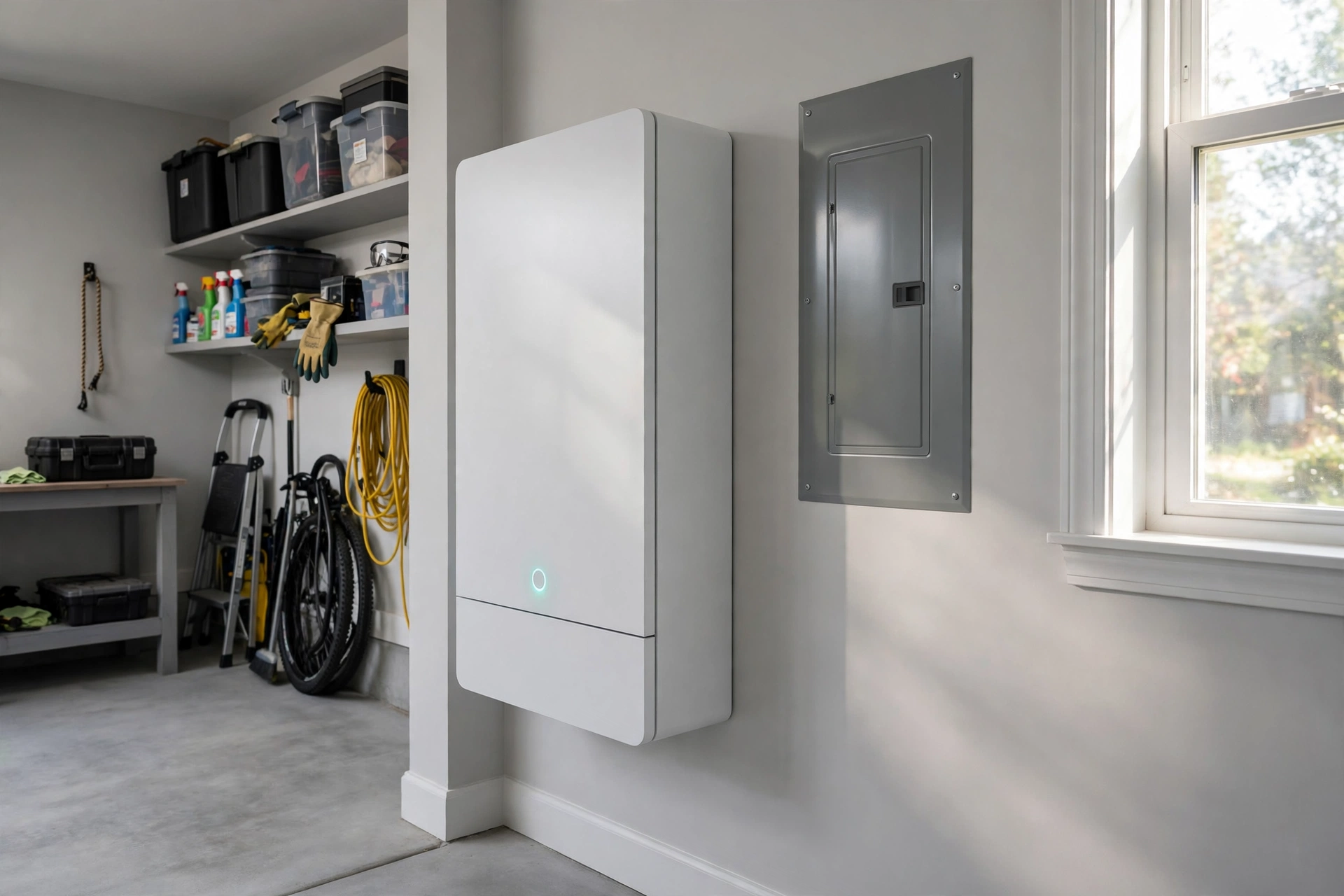
For most homeowners, the best home battery storage location is a garage or utility room that stays within the manufacturer’s temperature range, has good airflow, is protected from weather and flooding, and leaves clear working space. Outdoor mounting on a shaded wall suits weather-rated units where temperature extremes and codes allow. Bedrooms, living areas, and escape routes are not appropriate locations.
Five rules cover nearly every siting decision:
- Temperature: most lithium home batteries perform best between roughly 15°C and 30°C, even when rated for wider extremes.
- Ventilation: sealed lithium units need airflow for thermal management — keep vents clear.
- Access: keep the manufacturer’s clearances plus the electrical code’s working space for servicing.
- Safety: keep batteries out of habitable rooms, away from ignition sources and vehicle impact.
- Codes: placement is governed by standards such as NFPA 855 and NEC Article 706 in the US (national equivalents elsewhere). Use a certified installer.
How Location Affects Performance, Safety, and Warranty
Temperature and operating range
Temperature is the biggest environmental factor in battery life. In the cold, the battery management system (BMS) may restrict charging or discharging to protect the cells, cutting usable capacity; sustained heat accelerates degradation. The Tesla Powerwall 3, for example, is rated from -20°C to 50°C but derates above about 40°C, per specification data referenced by installer guides. Most installers treat roughly 15–25°C as the sweet spot. A mild garage or utility room beats an exposed wall in harsh sun or an uninsulated shed.
Ventilation and thermal management
Older flooded lead-acid batteries produce small amounts of explosive hydrogen while charging and must be vented outdoors. Modern sealed lithium batteries — including the lithium iron phosphate (LFP) chemistry in most home batteries — do not produce flammable gases in normal operation. For them, ventilation means thermal management: moving warm air away from the unit. A garage with normal air exchange is fine; a sealed closet is not. Keep vents clear of dust and stored items.
Why warranty terms care about placement
Most warranties require certified installation per the manufacturer’s manual, and operating outside the rated temperature range or in a prohibited location can affect coverage. A compliant location and your paperwork protect both warranty and home.
The Best Locations for a Home Battery, Compared
The garage: the default choice
An attached garage usually stays warmer than outdoors in winter through the shared house wall, yet counts as outside the habitable space for fire-code purposes. Mount on a side or back wall out of driving paths, above bumper height where contact is possible, and store petrol and solvents elsewhere. Cooling fans make roughly refrigerator-level noise — fine in a garage, worth noting beside a bedroom wall.
Utility rooms and basements
Indoor utility spaces give the best temperature stability, but fire-safety standards restrict batteries to non-habitable spaces — a spare bedroom converted to a battery room is not compliant. Indoor placement also needs minimum room dimensions; installer guides referencing Tesla’s manual cite roughly 5.25 × 5.25 × 8 feet for indoor Powerwall placement. Check your unit’s manual for its exact figures.
Outdoor mounting
Weather-rated units (commonly IP55, IP65, or NEMA 3R) can mount on exterior walls. This suits mild climates; elsewhere, choose a shaded wall, keep the unit above flood level and clear of downspouts, and confirm winter lows stay within the rated range. Outdoor-rated is not maintenance-free — keep vents clear of leaves and snow.
Locations to avoid
Never install in bedrooms, living rooms, or sleeping areas — fire codes exclude habitable spaces. Also avoid escape routes, uninsulated lofts that bake and freeze, flood-prone areas, and continuous direct sunlight or sprinkler spray. If no good spot exists, ask about a purpose-built ventilated enclosure rather than forcing an unsuitable space.
Clearances and Access Requirements
Installers and inspectors need working space, and the unit needs air space for cooling. Rules come from the manufacturer’s manual and the electrical code (in the US, NEC Articles 110 and 706).
- Sides: around 4 inches (100 mm) each side of a wall-mounted unit; more for multi-unit installs.
- Top and bottom: roughly 2 inches (50 mm) above and 1 inch (20 mm) below, keeping air paths open.
- Front: about 12 inches (300 mm) for airflow, plus the code’s working space — NEC 110.26 requires 36 inches (1 m) clear in front of electrical equipment in the US.
- Between units: fire guidance (NFPA 855 residential provisions) calls for at least 3 feet (1 m) separation unless the manufacturer documents closer spacing via large-scale fire testing (UL 9540A).
These are examples — your manual and local code have the final word.
Follow the Manufacturer’s Installation Instructions
Every reputable home battery ships with a manual specifying approved locations, clearances, temperature and humidity limits, mounting methods, and companion equipment. The manual is what the warranty, the permit, and the inspector defer to — read the siting section before committing, and ask your installer to confirm the chosen spot in writing.
The pattern repeats across brands: Tesla Powerwall units are indoor/outdoor rated for garages, utility rooms, basements, or exterior walls; Enphase IQ batteries are modular wall-mounted units for indoor or outdoor use. The formula is always the same: cool, dry, ventilated, accessible, non-habitable, within the rated envelope.
Installation involves high-voltage DC wiring, grid interconnection, and structural mounting — not a DIY project. Manufacturers require certified installers, who also handle permits and utility paperwork. If an installer suggests a spot that contradicts the manual — a sealed closet, say, or a bedroom wall — get a second opinion.
Fire Safety Considerations for Battery Placement
Lithium home batteries are very safe when installed correctly, but they store a lot of energy in a small space, so fire codes treat them with respect.
Siting rules from fire codes
In the US, NFPA 855 (Standard for the Installation of Stationary Energy Storage Systems) is the key reference. Its residential chapter limits systems to garages, utility closets, and outdoors — not bedrooms — with capacity and spacing rules. Widely cited baselines: 20 kWh per individual unit, about 80 kWh aggregate in garages and outdoors, about 40 kWh in utility closets or inside the home, and minimum 3-foot separation between units and from doors and windows. Your enforced code edition and local amendments decide what applies; other countries differ (Australia uses AS/NZS 5139), so verify locally.
Smoke alarms and detection
Many jurisdictions require smoke or heat detection where energy-storage equipment sits. Even where not required, a smoke alarm in the battery’s room or garage is cheap insurance.
Thermal runaway, in plain terms
Thermal runaway is the failure mode codes are designed around: a severely damaged or overheated cell can heat its neighbors in a chain reaction, releasing hot gases and possibly fire. Quality batteries defend in layers — a BMS watching every cell, thermal separators, and enclosures tested to UL 9540 and UL 9540A. Good siting adds another layer: spacing, ventilation, and separation from combustibles.
Separation from ignition sources
Keep the battery area clear of petrol, thinners, oily rags, and gas cylinders, and away from open-flame appliances unless clearances and codes allow it. In garages, protect the unit from vehicle impact and keep the area free of stored clutter.
Wiring, Inverter Co-Location, and Permits
The battery rarely sits alone — it connects to an inverter (or has one built in), a gateway or transfer switch for backup, and your main panel. Mount these near the battery and panel to shorten cable runs, confirm walls can carry their weight, and leave space for the labeled disconnect the code requires within sight of the system. Surface conduit through a garage is simple; routing through finished living spaces is disruptive and expensive.
A home battery almost always needs an electrical permit, often a building permit too, plus utility interconnection approval for systems that export power or island the home in an outage. The inspector checks clearances, working space, labeling, and disconnects. Keep the permit, sign-off, and manual with your house records.
Common Siting Mistakes to Avoid
Installing in a bedroom or other habitable room — fire codes exclude these spaces.
Blocking vents with stored boxes or an unventilated enclosure.
Ignoring the temperature range — a sun-baked wall or freezing shed ages the battery fast.
Forgetting service access — working space in front of the unit is an inspection item.
Mounting in a vehicle path without impact protection.
Placing it in a flood zone or under a downspout.
Skipping the manual — every brand’s siting rules differ, and the manual is the authority.
What Installation Location Means for Cost
The unit is the biggest cost, but location affects the installation bill. Figures below are rough estimates that vary widely — get itemized quotes from two or three certified installers.
- Simple garage wall-mount near the panel: usually cheapest, with labor commonly adding a four-figure sum.
- Long cable runs or a panel upgrade: distance from the panel or an undersized panel can add significantly.
- Outdoor enclosures and trenching: a weatherproof cabinet, pad, or buried conduit adds material and labor.
A code-compliant spot close to your electrical panel is the most reliable way to keep installation costs down.
When to Call a Professional
Battery installation is licensed-electrician territory: site assessment, permits, installation, and relocation. Afterwards, get professional help for persistent error codes, unusual heat, swelling or damage, burning smells, or repeated shutdowns. In a suspected battery emergency, de-energize if safe, evacuate, and call the fire service — never open or douse the unit yourself.
Final Thoughts
The right home battery storage location is a compromise: cool enough for the cells, ventilated enough for the electronics, accessible enough for service, and separated enough from living spaces to satisfy fire codes. A garage or utility room usually strikes that balance, with shaded outdoor mounting as a solid alternative for weather-rated units. Let the manual and your certified installer make the final call — and keep the clearances clear for the life of the system.
Next step: during the site survey, walk through two or three candidate locations with your installer, check each against the manual’s temperature, clearance, and ventilation rules, and confirm permit requirements before mounting begins.
Frequently Asked Questions
Can I install a home battery in my garage?
Yes — garages are among the most common and code-accepted locations. Mount on a side or back wall out of vehicle paths, keep flammables away, confirm temperatures stay within the rated range, and keep the required clearances.
Can a home battery go in a utility room inside the house?
Yes, if it is a non-habitable space such as a utility room or basement — not a bedroom or living area. Meet the manual’s minimum room dimensions and clearances, ensure adequate airflow, and comply with local fire and electrical codes.
Is it safe to install a battery outside?
Weather-rated units (typically IP55, IP65, or NEMA 3R) are designed for outdoor mounting. Choose a shaded wall above flood level, away from downspouts, and confirm temperature extremes stay within the rated range. Keep vents clear of leaves and snow.
Do home batteries need ventilation like a vented battery room?
Sealed lithium batteries do not vent hydrogen in normal operation, so they need no dedicated gas venting. They do need airflow for thermal management — keep vents clear and never seal the unit into an unventilated space.
How much clearance does a home battery need?
Typical guidance: a few inches of air space around the unit, about a foot clear in front, plus — under US code — 36 inches of working space in front of the equipment, and fire-code spacing between units and from doors and windows. Your manual and local code decide.
Can I install a home battery myself?
No. Installation involves high-voltage DC wiring, grid interconnection, and structural mounting, and manufacturers require certified installers. Most warranties depend on professional installation, with permits and inspections handled by the installer.
What temperature is best for a home battery?
Most lithium home batteries perform best around 15–25°C, even when rated wider (for example, -20°C to 50°C). Avoid sustained heat above about 40°C and freezing conditions where possible.

