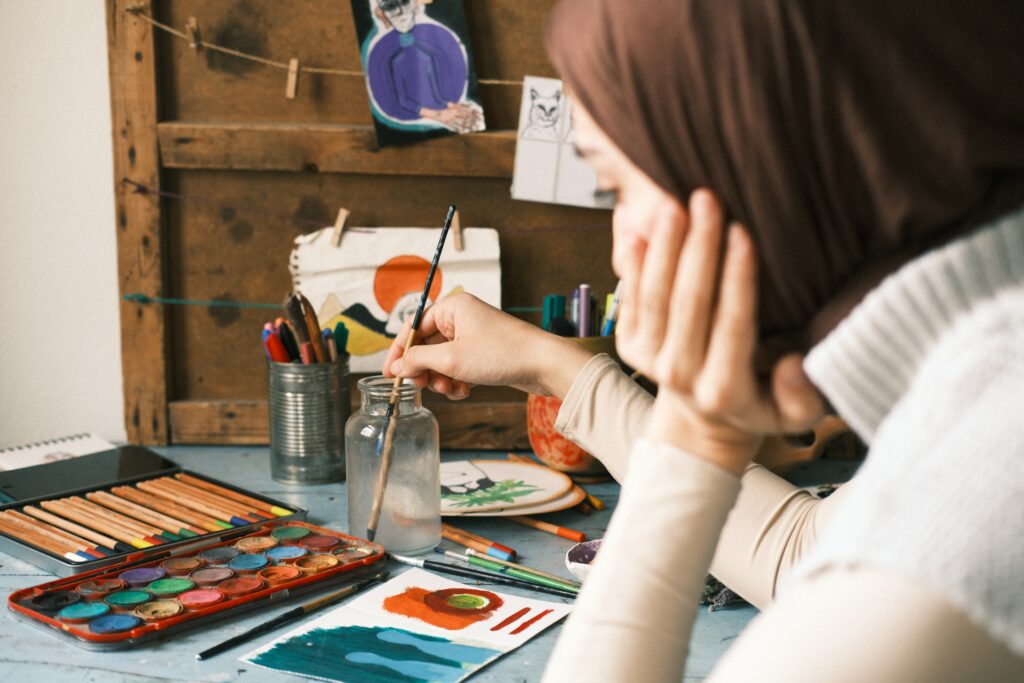
College art class is a playground for experimentation—an ideal time to stretch your skills, try new media, and build a standout portfolio. Whether you’re a studio art major or someone who just wants a creative outlet between lectures, this list contains over 50 project ideas to spark your next assignment, portfolio piece, or passion project.
These projects are organized to help you explore different materials and methods: low-cost, tech-forward, collaborative, experimental, and portfolio-ready. Bookmark the ideas that resonate and adapt them to your interests, course goals, and budget.
Quick Starter Projects (Great for beginners & tight budgets)
- Abstract self-portrait — Use shapes, textures, and colors to represent who you are rather than what you look like.
- Found-object sculpture — Make a 3D piece from discarded campus materials.
- Photomontage — Layer photos to tell a personal or political story.
- Pet paint by numbers — Turn a photo of your pet into a relaxed, guided painting project using a pet paint by numbers kit.
- DIY canvas painting — Try sponging, palette-knife work, or limited palettes.
- Papier-mâché sculpture — Recycle old newspapers into playful forms.
- Basic printmaking — Use leaves, potatoes, or foam sheets to learn inking and repeat patterns.
- Sketching walks — Urban or campus sketch sessions to sharpen observation.
- Mobile photography series — Capture a day-in-the-life theme on your phone.
- Recycled art — Upcycle plastic, cardboard, or fabric into textured artworks.
Digital & Tech-Forward Projects
- Digital painting — Use Procreate, Krita, or Photoshop to explore color and brushwork.
- 3D modeling with Blender — Create a simple object and 3D-print a prototype.
- Stop-motion animation — Use clay, paper, or objects to tell a short story.
- Augmented reality art — Overlay digital elements onto a physical canvas with AR apps.
- Experimental video piece — Combine found footage and original clips to explore a theme.
- Interactive web-based art — Build an interactive canvas with p5.js or simple web tools.
- Projection mapping — Turn a sculpture or wall into a moving canvas.
Material & Process Experiments
- Experimental printmaking series — Monoprints, cyanotypes, or linocuts in a series.
- Textile dyeing & printing — Shibori, tie-dye, or block-print your own fabric.
- Glass or metal workshop — Try small glass or simple metal-form experiments through campus shops.
- Clay/ceramic installations — Create multiples and assemble a group installation.
- Wire sculpture — Play with line, shadow, and negative space.
- Shadow-box assemblage — Build small, narrative dioramas.
- Light-painting photography — Long-exposure experiments with light sources.
Conceptual & Performance-Based Work
- Found-poetry visuals — Create typographic artworks from repurposed texts.
- Live art performance — Combine movement, sound, and visual art in an event.
- Sound installation — Use field recordings to create an audio-visual environment.
- Social practice project — Design an art action that engages a campus or neighborhood issue.
- Body-image exploration series — Use portraiture, collage, or performance to unpack identity.
- Public mural concept — Design a collaborative mural for a campus wall.
Collaborative & Community Projects
- Group mural — Coordinate a large-scale campus piece with other students.
- Community-driven exhibition — Curate a show with local community contributions.
- Collaborative book project — Each contributor provides imagery or text to assemble a zine or artist book.
- Service-learning art — Partner with a nonprofit to solve a real community need through creative work.
Advanced, Portfolio-Level Challenges
- Large-scale installation — Engage with space, materials, and viewer movement.
- Interactive sculpture — Mechanical or responsive works that invite touch or participation.
- Complex mixed-media installation — Combine video, sound, textiles, and found objects.
- Conceptual photography project — Deep thematic series with strong research and visuals.
- Advanced printmaking — Intaglio, lithography, or etching sequence.
- Design + fabrication project — Prototype a functional object or furniture piece.
Cross-Discipline & Experimental Ideas
- Art-science collaboration — Map data to visuals or test local environmental conditions and visualize results.
- Game-art hybrid — Create a small playable art game that explores narrative or mood.
- Performance video — Choreograph, perform, and film a short piece merging disciplines.
- Light and shadow installation — Use cut-outs and light sources to transform a space.
- Food-art experiment — Use culinary techniques to create ephemeral installations (and share the results).
Low-Commitment Daily Practices
- Art journal — Track process, experiments, and ideas daily.
- Five-minute drawing — Quick sketches to build observation skills.
- One-square painting — Paint one small square daily to make a larger composite.
- Found-sound collection — Build an audio library from campus life.
- Micro-collages — Small pieces that can be combined into larger work.
Displaying & Promoting Your Work
- Build a digital portfolio (Behance, personal site, or an Instagram grid).
- Enter campus shows, local cafes, or community centers for exhibitions.
- Collaborate with classmates to mount a pop-up exhibition or zine fair.
- Keep a visual diary to document process—this is invaluable for critique and job applications.
Budget Hacks & Studio Tips
- Reuse and upcycle—cardboard, thrifted fabric, and household items can be transformed into powerful materials.
- Use campus resources: print labs, woodshops, and shared studios often provide free or discounted access for students.
- Trade supplies with classmates to try new media without buying everything yourself.
Final Thoughts: Make It Personal and Persistent
College is your sandbox—use it. Try new processes, embrace mistakes, collaborate, and document everything. Whether you’re painting a portrait, designing an AR experience, or organizing a community mural, each project teaches technical skills and builds the creative confidence you’ll use after graduation.
Want a relaxing start? Try a simple guided kit—discover how accessible art can be with paint by numbers kits and explore pet-focused projects with pet paint by numbers to create something meaningful without pressure.
Keep experimenting. Keep sharing. Keep making.
Stay in touch to get more updates & news on Magazine!

