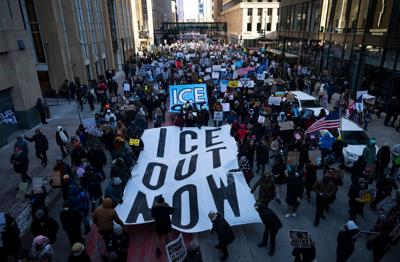
MINNEAPOLIS — What began as a local demonstration has grown into a nationwide movement, as protests against federal immigration enforcement policies expanded across several major U.S. cities over the weekend.
Thousands of demonstrators gathered in Minneapolis, New York, Los Angeles, Chicago, and Boston, calling for reforms to Immigration and Customs Enforcement (ICE) operations. Protesters carried signs demanding transparency, oversight, and what many described as more humane immigration practices.
The demonstrations were largely peaceful, though heavily attended. In Minneapolis, organizers described the rally as a “community response” to recent enforcement actions that have drawn criticism from civil rights groups and local officials.
“We’re asking for accountability,” said one protest organizer. “Communities deserve clarity about how enforcement decisions are made.”
Federal authorities have defended their actions, stating that operations target individuals in violation of immigration laws and are conducted within legal guidelines. An ICE spokesperson emphasized that officers prioritize public safety and operate under strict policy directives.
Still, critics argue that current enforcement strategies can create fear in immigrant communities and strain relationships between federal agencies and local governments. Advocacy organizations are pushing for legislation that would increase oversight and require additional transparency in detention and deportation procedures.
Local officials in several cities have expressed concern about the broader social impact of enforcement operations. Some mayors have reiterated their commitment to policies limiting cooperation with federal immigration authorities, while others have called for dialogue between federal and municipal leaders.
Law enforcement presence at the demonstrations was visible but restrained. Police departments coordinated with organizers to manage crowd control and ensure public safety.
The protests come at a politically sensitive time, as immigration policy remains a central issue in national debate. With elections approaching, both major parties are sharpening their positions.
Political analysts note that public opinion on immigration is complex and often regionally divided. While some voters prioritize stricter enforcement, others emphasize humanitarian considerations and pathways to legal status.
For many protesters, the issue transcends partisan lines. “This is about families,” said one attendee in Los Angeles. “It’s about how we define fairness and justice.”
Federal lawmakers are expected to revisit immigration policy discussions in the coming weeks as part of broader budget negotiations.
As demonstrations continue, the conversation around immigration enforcement appears far from settled. The scale and coordination of recent protests suggest that public engagement on the issue is likely to remain high in the months ahead.

