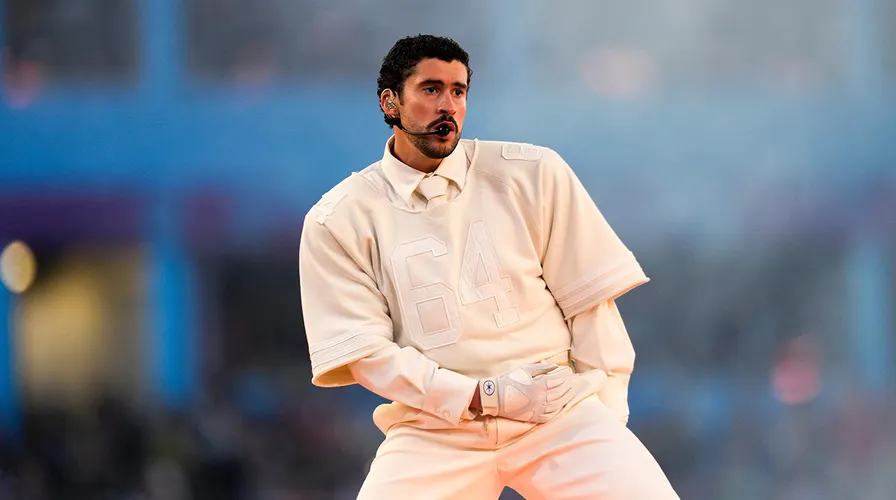
February 9, 2026 — Santa Clara, California In an electrifying and culturally charged spectacle at Levi’s Stadium on Sunday night, Puerto Rican artist Bad Bunny delivered a Super Bowl LX Halftime Show that has quickly become the focal point of national conversation — both celebratory and contentious. What began as a major entertainment event at the heart of America’s most‑watched sporting occasion has blossomed into a nuanced public debate about identity, culture, language and politics in the United States.
Bad Bunny, born Benito Antonio Martínez Ocasio, made history as the first solo Latino headliner of the NFL’s halftime stage — a moment hailed by many as a landmark for Latino representation on one of the world’s most visible stages. The Grammy‑winning artist, fresh off his Album of the Year victory at the Grammys for Debí Tirar Más Fotos, embraced the limelight with a dynamic performance steeped in his signature reggaeton beats, bold choreography, and vibrant cultural imagery. The set included hits spanning his career, surprise appearances and a finale that fused musical energy with a message of unity.
Throughout his 13‑minute set, Bad Bunny paid homage to the diversity of the Americas, closing with dancers waving flags from countries in South and Central America and lifting a football inscribed with “Together we are America” — a symbolic gesture interpreted by many as a call for unity beyond borders. At the show’s end, he addressed the crowd with the phrase “God bless America,” underscoring an overarching theme of connection and inclusivity.
NFL Commissioner Roger Goodell later praised the moment as a historic milestone in the league’s effort to expand its cultural relevance. In social media posts, the NFL showcased clips from the show, labeling portions “ICONIC” and celebrating how widely the performance was shared and discussed across global platforms.
Yet, the response has not been uniformly celebratory. Prominent conservative figures, including former President Donald Trump, blasted the show as “absolutely terrible” and argued that the performance was not reflective of traditional American values. Trump’s social media comments reiterated earlier criticism of Bad Bunny’s selection, with the former president and allies framing their objections around language choices and cultural focus. A handful of conservative groups even organized an alternative “All‑American Halftime Show” featuring pro‑Trump musicians to counterprogram the event.
On social media platforms, the reaction has been equally polarized. Celebrities and fans alike weighed in — with stars like Jennifer Lopez and Kacey Musgraves praising Bad Bunny’s performance and cultural impact, while some conservative commentators disparaged the set. Fan reactions captured a broad range of opinions, from appreciation of the music and production to critiques rooted in political and cultural perspectives.
Meanwhile, grassroots reactions tell a story of generational and regional differences. Watch parties from Puerto Rico to Miami exploded with applause; in some cases, communities paused broadcasts mid‑game in admiration of how deeply some felt represented. Others noted the performance as a rare and inclusive moment in mainstream American entertainment.
Critics of the backlash argue that Puerto Rico’s status as a U.S. territory makes the debate over “American identity” moot, asserting that the controversy reveals deeper cultural tensions in the country’s evolving demographic landscape. Supporters of Bad Bunny’s show contend that music — especially one that crosses language barriers — can serve as a bridge in a politically fragmented moment.
As television ratings for the game and halftime continue to be analyzed, sports analysts and cultural commentators alike say this halftime performance will resonate beyond the field. Whether viewed as a celebratory milestone, a politically charged moment or both, Sunday’s show has already etched itself into national dialogue as one of the most talked‑about halftime performances in recent memory.

