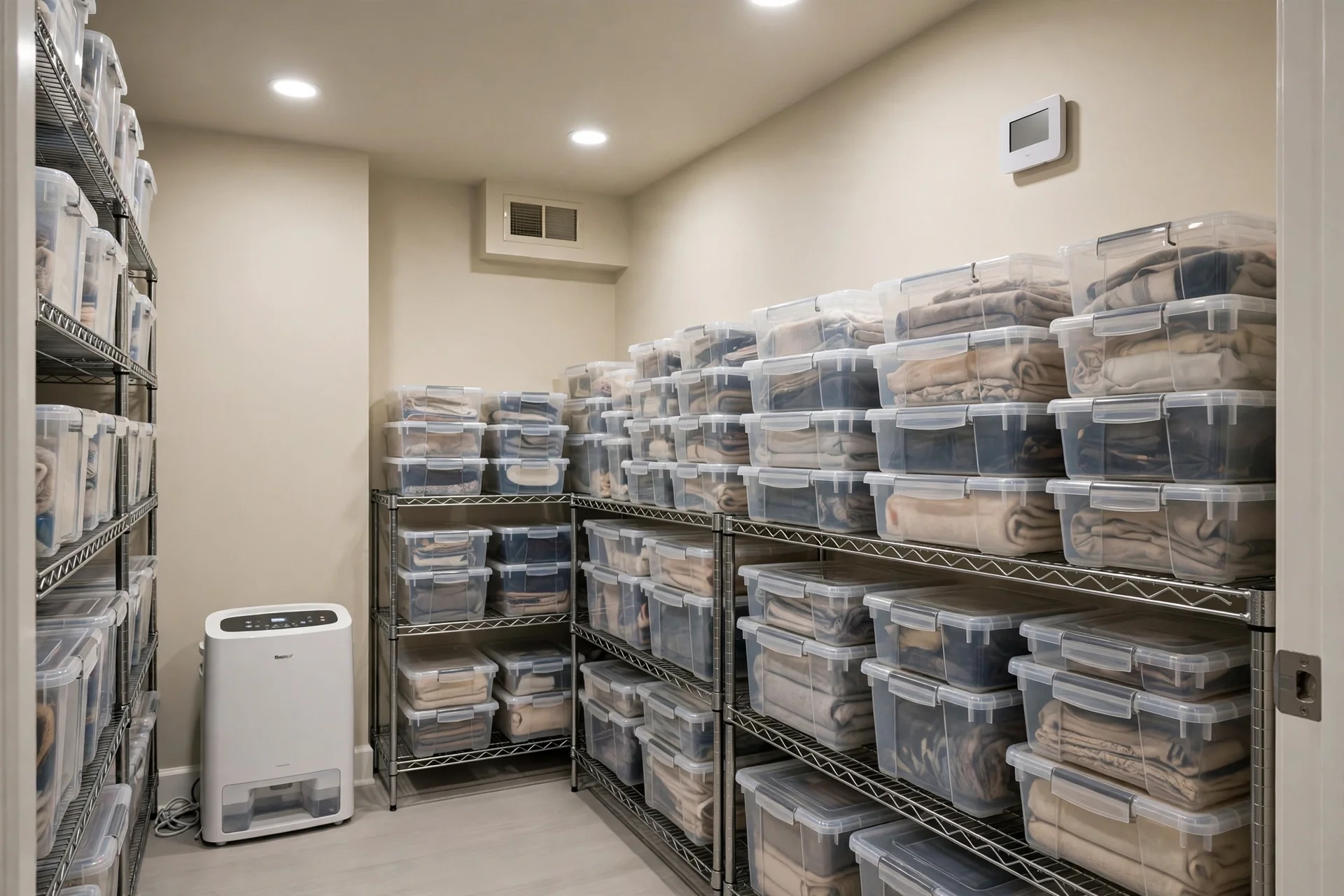
Photographs curl, wooden instruments crack, and leather grows mould — not because a home is badly kept, but because the air around stored items swings with the seasons. A temperature-controlled storage zone is a small, dedicated corner where temperature and humidity stay inside a narrow, steady band all year, so items that react badly to damp summers and dry winters stay safe. This guide explains how to choose the spot, seal and insulate it, pick the right equipment, and keep it running.
Why Seasonal Humidity Swings Damage Stored Household Items
Most household materials are hygroscopic, which means they absorb and release moisture as the air around them changes. Wood swells in a damp summer and shrinks in a dry winter, and that repeated movement loosens joints, cracks veneer, and warps flat panels. Paper and photographs absorb moisture and then dry out again, which cockles pages, fades inks, and sticks prints together. Leather dries, stiffens, and cracks when winter air drops below about 30 percent relative humidity, and it grows mould when summer humidity climbs above 60 percent.
Electronics suffer in a quieter way. Condensation forms on cold metal parts when warm, damp air meets a cool surface, and that thin film of water corrodes contacts, circuit boards, and connectors over time. Textiles absorb damp and hold it, which invites mildew and the musty smell that never quite leaves a stored garment. The damage is rarely caused by one extreme day. It is the swing itself — months of damp followed by months of dry — that slowly breaks materials down.
The worst storage spots follow the weather most closely: attics bake in summer and freeze in winter, while garages swing almost as much and often admit damp through the floor slab. Cardboard boxes make it worse by absorbing moisture and passing it to whatever sits inside. A storage zone breaks the link between the weather outside and the air around your belongings.
What a Temperature-Controlled Storage Zone Actually Is
A temperature-controlled storage zone is a defined space — a closet, an under-stair cupboard, or a small spare room — where insulation, air sealing, and a modest piece of equipment hold temperature and humidity inside a narrow band. The usual target is roughly 18 to 22 degrees Celsius with relative humidity between 40 and 50 percent, which suits most household items from books and photographs to wooden furniture and electronics. The zone does not need to be large. A single well-sealed closet can protect a family's photographs, documents, and instruments.
It is important to understand what the zone is not. It is not a second living room, and it does not need a full heating and cooling system. In many homes a small dehumidifier plus a low-wattage tube heater is enough, and in mild climates a well-sealed interior closet with no equipment at all may already hold steady. The goal is steadiness, not perfection: a zone holding 45 percent humidity all year protects items far better than a room swinging between 30 and 70 percent.
Mapping the Humidity and Temperature Swings in Your Home
Before building anything, measure what you are dealing with. A basic digital hygrometer costs little and shows both temperature and relative humidity, and models with minimum and maximum memory record the extremes while you are not watching. Place one in each candidate spot and leave it for two to four weeks, checking the readings morning and evening. You are looking for the spot that stays closest to the rest of the house and moves least when the weather changes.
- An interior closet on a middle floor, away from exterior walls and plumbing, usually swings least.
- An under-stair cupboard works well if it is dry, ventilated, and not against a cold outside wall.
- A spare bedroom wardrobe wall can serve if the room itself is heated in winter.
- A dry basement corner away from foundation walls is possible, but only after damp is ruled out.
- A hallway storage nook suits small collections of photographs, documents, and textiles.
The readings tell you how much work the zone needs. If a closet already sits between 40 and 55 percent humidity through a damp week, sealing and a small dehumidifier will finish the job. If it swings from 35 to 75 percent, check for damp coming through the wall or floor before spending anything — never build a storage zone over an active damp problem.
Choosing the Right Corner, Closet, or Room for the Zone
The best location is interior, on a ground or middle floor, and away from plumbing runs, exterior walls, and roof spaces. Interior rooms borrow warmth from the rest of the house, so they change temperature slowly, and their walls are not chilled by outside air, which is what causes condensation. Size matters too: the zone needs room for shelving plus air gaps around every box, because still air trapped against a cold surface is where mould starts.
Check the candidate spot for existing problems before you commit to it. Look for damp patches, peeling paint, a musty smell, or staining on the ceiling above, and check the floor for signs of past leaks. If the spot has a history of damp, choose another location or fix the source first — a dehumidifier cannot dry out a wall that is being fed by a leak.
Insulating and Sealing the Zone So Conditions Stay Steady
Insulation slows the movement of heat through the zone's walls, and air sealing stops damp outside air leaking in through gaps. Together they are what make a small piece of equipment effective — without them, a dehumidifier runs constantly and still loses the fight. Rigid foam boards or mineral wool on any exterior-facing surface work well, and a vapour control layer on the warm side of the insulation stops moisture condensing inside the wall build-up.
- Fit draught-proofing strips around the door and a threshold seal at the bottom.
- Insulate any wall that faces outside, the roof, or an unheated garage.
- Cover a bare concrete floor with a vapour barrier and raised flooring or pallets.
- Seal gaps around pipes and cables with caulk or expanding foam.
- Seal ceiling penetrations where pipes, wires, or light fittings pass through.
Do not seal the zone completely airtight. A trickle vent or a short daily opening of the door prevents the stale, still air that mould likes best, and a dehumidifier drawing air through the space also keeps it moving. The aim is to control the air, not to trap it.
Heating, Cooling, and Dehumidifying Equipment That Fits a Home Storage Zone
Equipment choice depends on your climate and your measurements. In a damp climate a compressor dehumidifier is the workhorse, holding humidity below 55 percent even through a wet summer. In a cold climate a low-wattage tube heater or small oil-filled radiator keeps the zone above the temperature where condensation forms. Where summers are hot and winters cold, a small mini-split handles both, though it needs professional installation and costs more.
| Equipment | Best suited to | Running note |
|---|---|---|
| Compressor dehumidifier | Damp summers and humid regions | Needs a drain or regular emptying |
| Desiccant dehumidifier | Cool, unheated spaces | Works well below 15 degrees Celsius |
| Tube or panel heater | Cold winters and frost protection | Low wattage, steady background heat |
| Mini-split unit | Year-round precision control | Professional install, highest upfront cost |
Size the equipment to the volume of the zone, not to the whole house. A dehumidifier rated for a large room will short-cycle in a small closet, switching on and off too often and wearing out early, while an undersized one will run all day and never reach the target. Place the equipment where air can circulate around it, keep its intake clear of boxes, and arrange condensate drainage to a sink or a small pump so the unit never stops because its tank filled up while you were away.
Shelving, Containers, and Air Gaps That Protect Sensitive Items
How items sit inside the zone matters almost as much as the air itself. Open metal or plastic shelving lets air move around every box, while solid timber shelves absorb moisture and pass it on. Keep boxes five to ten centimetres off the floor and a hand's width from walls, since floors and walls are the coldest surfaces and the first to collect condensation. Lidded plastic boxes protect paper, textiles, and photographs, with acid-free tissue inside for delicate items.
- Label every box on two sides so you never have to open them all to find one item.
- Leave a hand's width between boxes and walls for air to circulate.
- Store heavy items low and light, fragile items at waist height.
- Keep electronics in original packaging or anti-static bags with silica gel sachets.
- Never stack boxes directly on a concrete floor, even inside the zone.
Rotate the contents once or twice a year, checking for early signs of trouble such as a musty smell, foxing on paper edges, or white bloom on leather. Catching a problem early costs nothing; discovering it after two years of quiet storage can mean losing the item. A short inspection each spring and autumn is the cheapest insurance the zone has.
Monitoring Conditions With Hygrometers and Simple Alarms
A zone you do not monitor is a zone you are guessing about. A digital hygrometer with minimum and maximum memory costs little and shows whether conditions stayed in range while you were away. For more confidence, a wireless sensor can send an alert to your phone when humidity crosses 55 percent or temperature drops below 10 degrees Celsius, which is the point where condensation risk climbs sharply. Keep a simple written log of weekly readings so you can spot a slow drift before it becomes damage.
Learn what the numbers mean. Between 40 and 50 percent relative humidity suits almost everything in a home. Above 60 percent, mould can grow on paper, leather, and textiles within days in warm weather. Below 30 percent, wood shrinks and cracks and paper becomes brittle. Act on trends, not single readings: one damp afternoon means little, but a week creeping upward means the dehumidifier needs attention or a seal has failed.
Seasonal Routines That Keep the Zone Working Year-Round
A storage zone needs a little attention four times a year, and each check takes about ten minutes. In spring, inspect door seals and clean the dehumidifier filter after the damp season. In summer, empty the condensate container or check the drain, and watch humidity readings during humid spells. In autumn, test the heater before the cold arrives and check that boxes have not been pushed against cold walls. In winter, look for condensation on the coldest surfaces and confirm the heater is holding the temperature above 10 degrees Celsius.
| Season | Check to make | Why it matters |
|---|---|---|
| Spring | Inspect seals and clean filters | Repairs winter wear before humidity rises |
| Summer | Watch humidity and empty condensate | Damp season is when mould risk peaks |
| Autumn | Test the heater and re-space boxes | Cold arrives suddenly and condensation follows |
| Winter | Look for condensation on cold surfaces | Catches cold spots before they damage items |
Tie these checks to something you already do, such as changing smoke alarm batteries, so they actually happen. A zone checked seasonally protects its contents for decades; a zone built and forgotten drifts out of range within a year or two, and the first sign of trouble is usually a damaged item.
Storage Zone Setup Errors That Undo the Climate Control
The most common error is putting the zone in the worst spot in the house — the attic or the garage — because there is space there. Both swing wildly with the weather, and no affordable equipment can hold them steady. The second error is sealing the space airtight with no air movement, which traps stale air and invites mould. Oversizing equipment is another trap: a large dehumidifier in a small closet short-cycles, wastes electricity, and still leaves damp pockets behind the boxes.
Other mistakes are smaller but just as real: blocking the dehumidifier intake with stacked boxes, leaving the door ajar for weeks, storing items in cardboard instead of lidded boxes, and never checking the hygrometer. If the zone shows persistent damp on walls, mould growth, or a musty smell that will not clear, call a damp-proofing surveyor before spending more on equipment. Electrical work for a mini-split or a new circuit should always go to a licensed electrician.
Final Thoughts: A Steady Corner That Protects What You Store
A temperature-controlled storage zone does not need to be large, technical, or expensive. Measure the swings, choose an interior spot, seal and insulate it, add modest equipment sized to the space, and check the readings through the seasons. Steadiness is the whole point: a small closet holding 45 percent humidity all year protects photographs, instruments, leather, and electronics far better than a large room that follows the weather. Build it once, check it four times a year, and your sensitive items will outlast the seasons that used to damage them.
Temperature-Controlled Storage Zone Questions Homeowners Ask
What temperature and humidity should a home storage zone hold?
Aim for roughly 18 to 22 degrees Celsius and 40 to 50 percent relative humidity, which suits most household items including paper, photographs, wood, leather, and electronics. Stay below 60 percent to keep mould away, and above 30 percent so wood and paper do not dry out and crack.
Can I build a storage zone in a garage or attic?
It is not a good idea. Garages and attics follow outdoor weather closely, swinging from hot to cold and damp to dry, and holding them steady would need large, expensive equipment. Choose an interior closet or small room instead, where the rest of the house already buffers the temperature.
Do I need a dehumidifier and a heater, or just one?
It depends on your climate and your measurements. Damp regions usually need a dehumidifier, cold regions a small heater, and homes with both benefit from both. Let two to four weeks of hygrometer readings decide rather than guessing.
How much does a small temperature-controlled storage zone cost to run?
Running costs are modest as a broad estimate, often roughly the cost of running a small fridge, because the equipment is small and the space is sealed and insulated. A mini-split costs more to buy and run, while a dehumidifier and tube heater are the budget route.
What items should never go in a storage zone?
Never store flammable liquids, gas canisters, or chemicals in a storage zone, and keep food out because it attracts pests. Dry very damp items before they go in, and clean anything already mouldy or keep it separate so spores do not spread to clean items.

