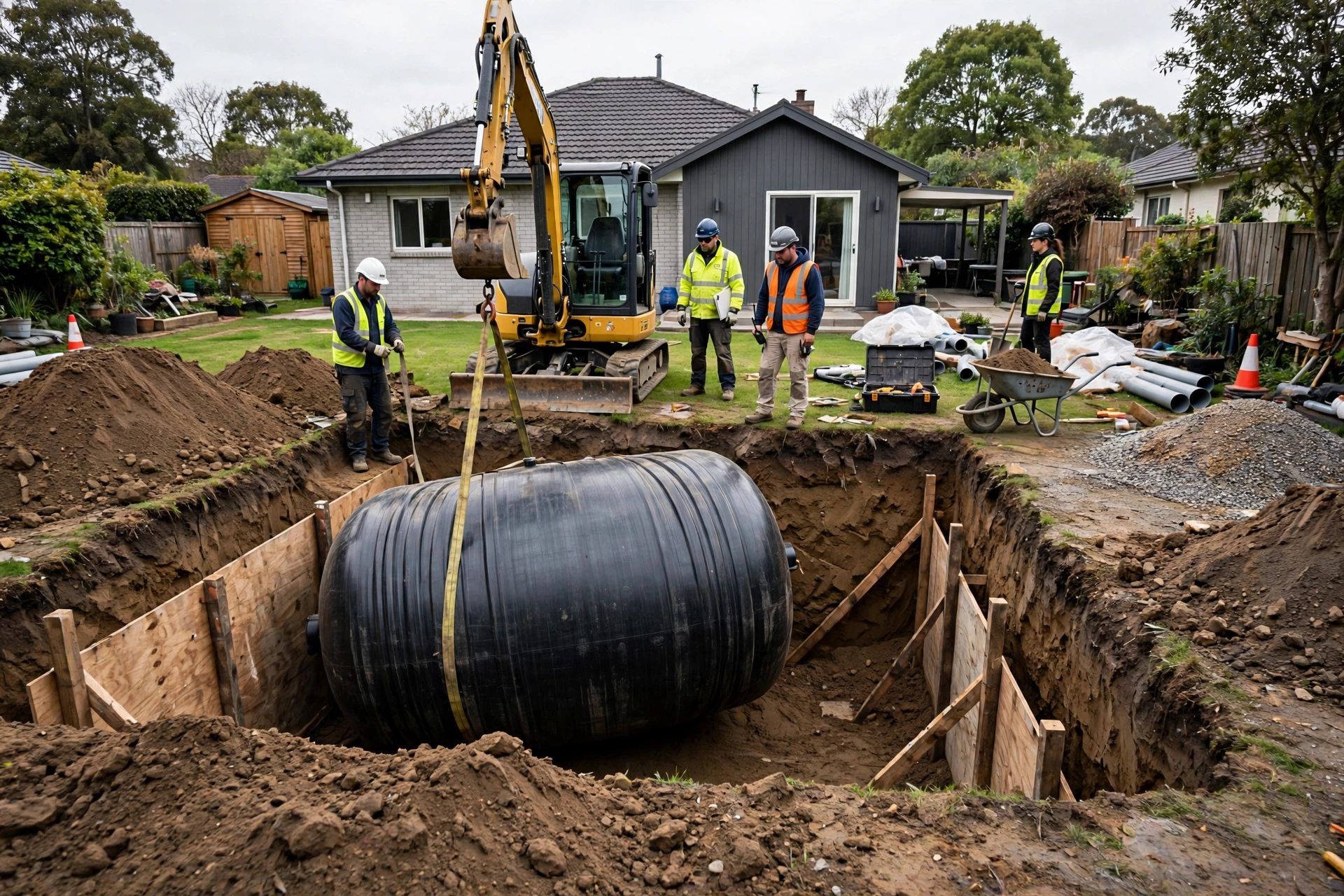
A small garden, a narrow side passage and a busy driveway can leave no obvious place for a water tank. Yet the roof above that home may collect tens of thousands of litres of rainwater a year. An underground tank solves that mismatch, hiding storage beneath ground you already use so the garden, patio or parking space above stays free.
A buried tank suits a home with limited surface storage space when the household wants several thousand litres of storage without giving up garden or parking area, and when excavation with safe maintenance access is possible. A tank of roughly 3,000 to 6,500 litres suits most small plots, costs an estimated $6,500 to $24,000 installed, and needs a pump, filter and overflow. A high water table, rocky ground, heavy clay or buried services can rule it out or push the price up.
Why Burying the Tank Works When the Garden Is Already Full
Above-ground tanks compete for the scarcest resource on a small property: flat, usable surface. A 5,000-litre above-ground tank can occupy two square metres or more, plus clearance, and still needs screening to look acceptable. Buried storage removes that trade-off: the tank sits under a lawn, patio or driveway, and the only visible signs are a discreet access lid and the pipework at the downspouts.
Burial also protects the water. Underground, temperatures stay cool and steady, and sunlight never reaches the stored water, which slows algae growth and keeps quality more stable than in a sun-warmed above-ground tank. The tank is shielded from frost, impact and ultraviolet damage, so a well-installed buried tank can last for decades. The trade-off is access: repairs below ground are harder, so the design must be right before backfilling.
- Surface stays usable: lawn, patio, parking or planting can continue above it.
- Water stays cooler and darker, discouraging algae growth.
Buried Rainwater Cisterns Compared: Polyethylene, Concrete, Fibreglass and Modular Crates
Four tank families dominate residential buried storage. Polyethylene tanks are the most common for homes: light enough to lower into place without a crane, corrosion-resistant, and available from around 900 litres to 10,000 litres. Concrete tanks are heavy and long-lived and resist flotation in high water tables, but need lifting equipment and cost more. Fibreglass is strong and corrosion-resistant but pricier. Modular crates form a large void from interlocking units wrapped in a membrane; they fit awkward shapes but are harder to clean.
Sizing a Buried Tank to Your Roof, Rainfall and Household Demand
Tank size starts with the roof, not with a catalogue. Every millimetre of rain on one square metre of roof yields about one litre of water, before losses from splashing, evaporation and the first-flush diverter. A 100-square-metre roof receiving 800 millimetres of rain a year can therefore collect roughly 80,000 litres in theory, though a homeowner stores only a fraction and uses it as it arrives.
For garden-only use on a small plot, 3,000 to 5,000 litres usually covers watering through a dry fortnight. Adding toilet flushing and a washing machine pushes demand towards 5,000 to 10,000 litres, provided the roof can refill it. Oversizing wastes money on excavation; undersizing means the tank runs dry in the first dry spell. An installer should run the numbers for local rainfall, roof area and daily demand first.
Fitting a Tank Under a Driveway, Patio or Narrow Side Passage
The most useful ground on a small property is often the driveway or patio, and both can host a buried tank if loading is handled correctly. A tank under a pedestrian patio needs only a standard lid and the manufacturer's specified cover depth, but a tank under a driveway needs a vehicle-rated lid and neck assembly, correct backfill and the right depth. Tell the supplier from the start that vehicles will pass over it.
Narrow side passages suit slim or bulb-shaped tanks, but access for the excavator matters as much as the tank's dimensions. If machinery cannot reach the spot, excavation becomes hand digging or a crane lift over the house, both of which add cost. Check what already lies beneath the spot: gas, water, electricity, drains and telecoms all need locating before digging.
- Driveway installations: vehicle-rated lid, correct cover depth and compacted backfill are mandatory.
- Patios and lawns: a standard pedestrian lid is normally sufficient.
- Keep the access neck reachable: maintenance happens through it for the life of the tank.
From Gutter to Tap: How a Buried Rainwater System Actually Works
Rainwater's journey starts at the roof, runs through gutters and downspouts, and passes a leaf guard and a first-flush diverter that discards the first dirty runoff from each storm. It then enters the tank through a calmed inlet, which slows the water so sediment stays undisturbed on the bottom. A floating intake draws from just below the surface, where the water is cleanest, and a submersible pump delivers it to garden taps, toilets or the washing machine.
Two details separate a reliable system from a troublesome one. First, any mains-water backup must connect through an air gap, never a direct pipe link, so mains water can never be contaminated by tank water. Second, every outlet, valve and pipe carrying rainwater must be clearly labelled as non-potable and visually distinct from drinking-water pipework.
- Roof runoff passes leaf guards and a first-flush diverter.
- Filtered water enters through a calmed inlet that keeps sediment settled.
- A floating intake draws the cleanest water from below the surface.
- A submersible pump sends water to taps, toilets or laundry on demand.
- Overflow drains safely to a soakaway or storm drain.
What a Buried Rainwater Tank Costs in 2026 — and What Pushes the Price Up
Published installed-cost guides put a residential underground tank system at an estimated $6,500 to $24,000, with a basic garden-only setup using a small polyethylene tank at the lower end and a large tank with pump, filtration and internal plumbing at the upper end. The tank itself is often less than half the bill: excavation, gravel base, backfill, pipework, pump and controls, and gutter modifications make up the rest.
Ground conditions are the biggest cost wildcard. Rocky soil or heavy clay can raise excavation labour by an estimated 20 to 40 percent compared with easy sandy or loamy ground, and a high water table may demand dewatering or a heavier concrete tank to resist flotation. Long pipe runs, hand digging where machinery cannot reach, permits and vehicle-rated driveway lids all add further cost. Get itemised quotes from at least two installers.
The Buried Tank Installation Sequence, Step by Step
A professional installation follows a predictable sequence, and homeowners should understand it well enough to spot shortcuts. The site is surveyed, services are located, and the excavation is dug to the manufacturer's dimensions with a level base. The tank is lowered in, checked for level, and connected to inlet, outlet and overflow pipework before any backfill goes in. Backfill, usually pea gravel, is placed in shallow layers and compacted evenly while the tank is filled with water, so it cannot distort or float.
Two shortcuts cause most later failures. Backfilling in deep, uncompacted layers leads to ground settlement months later, leaving dips in a lawn or cracks in a patio above the tank. And aligning pipe falls by eye rather than by measurement causes inlet and filter levels to mismatch, so water backs up or the filter never drains properly.
- Survey the site and locate buried services, soil and groundwater conditions.
- Excavate to the manufacturer's dimensions on a level gravel base.
- Lower the tank, check it is level, and fit the pipework.
- Backfill in shallow compacted layers while filling the tank with water.
- Adjust the neck and lid to ground level and test the system.
Keeping Buried Rainwater Clean: Filters, Sediment and Seasonal Checks
A buried tank needs less day-to-day attention than an above-ground one, but it is not maintenance-free, and neglect shows up as blocked filters, seized pumps and unpleasant smells. Gutters and leaf guards need clearing several times a year, since everything reaching the tank starts on the roof. Pre-filters and first-flush diverters should be cleaned every three to six months, and the pump strainer and sediment checked annually.
Seasonal timing helps: clean gutters and filters before the wettest season, test the pump before the main watering season, and check the overflow route after heavy storms. Where stored water serves toilets or laundry, backflow prevention devices may be required, tested periodically by a licensed plumber.
Slips That Sink a Buried Rainwater Project
Most buried-tank disappointments trace back to decisions made before the excavation, not to the tank itself. Choosing a tank on price without checking groundwater leads to a floating tank that breaks through the surface when empty. Burying the access neck under a patio or decking makes routine checks so awkward that they stop happening. Running rainwater through blue drinking-water pipe confuses future plumbing work, and a mains backup without an air gap creates an illegal cross-connection.
- Ignoring groundwater: an empty light tank can float up through wet ground.
- Hiding the access neck under decking or paving: maintenance stops, problems grow.
- Wrong pipe colours or missing labels: workers may mistake rainwater for drinking water.
When a Buried Tank Job Needs a Licensed Plumber or Structural Engineer
Excavation itself is groundwork, but several parts of a buried rainwater system belong to licensed trades, and local rules often require it. Any connection to internal plumbing, toilets, laundry or a mains backup needs a licensed plumber, for backflow prevention and inspection; unlicensed work has in some jurisdictions been fined or ordered removed. A structural engineer is worth involving when the tank sits under a driveway carrying heavy vehicles or close to foundations. Entering a tank to clean it is hazardous and should never be attempted by a homeowner.
Final Thoughts: Is a Buried Rainwater Tank Worth It for Your Small Plot?
For a home where surface space is already spoken for, a buried rainwater tank is often the only way to store enough rainwater to matter, and it does the job invisibly for decades. The case is strongest when the roof can refill the tank, the ground allows straightforward excavation, and the household will use the water for garden, toilets or laundry. Get a site survey and two itemised quotes, and insist on labelled pipework and an air-gapped mains backup.
Buried Rainwater Tank Questions Homeowners Keep Asking
Can a car drive over a buried rainwater tank?
Yes, provided the tank is installed with a vehicle-rated lid and neck assembly, at the manufacturer's specified cover depth, with the correct backfill. A standard pedestrian lid is not enough for driveway use.
Do I need planning permission for a buried rainwater tank?
In many areas, including much of the UK, an underground rainwater tank falls under permitted development and planning permission is not usually required. Building regulations still apply where the system connects to internal plumbing, so check with the local authority first.
How long does water stay usable in a buried tank?
Stored rainwater has no fixed expiry date; its life depends on filtration, light exclusion and use. Cool, dark, filtered water in a buried tank can remain suitable for garden and toilet use for months, but sediment and infrequent use degrade quality.
Can stored rainwater be used for drinking?
Rainwater from a standard buried tank is not drinking water without treatment. Drinking use requires dedicated filtration and disinfection, such as ultraviolet treatment, plus water-quality testing, and must comply with local regulations.
What happens to a buried tank in a flood or very wet winter?
A correctly installed tank handles storms through its overflow, which diverts excess water to a soakaway or storm drain. Problems arise when the overflow is blocked, undersized or discharges against foundations. In areas with a high water table, an empty lightweight tank can also be pushed upward by groundwater.
How do I know if my soil suits a buried tank?
Sandy and loamy soils are the easiest to excavate and backfill. Heavy clay slows digging and can hold water around the tank, while rock adds major excavation cost. A site survey covering soil type and groundwater depth answers the question before money is committed.

