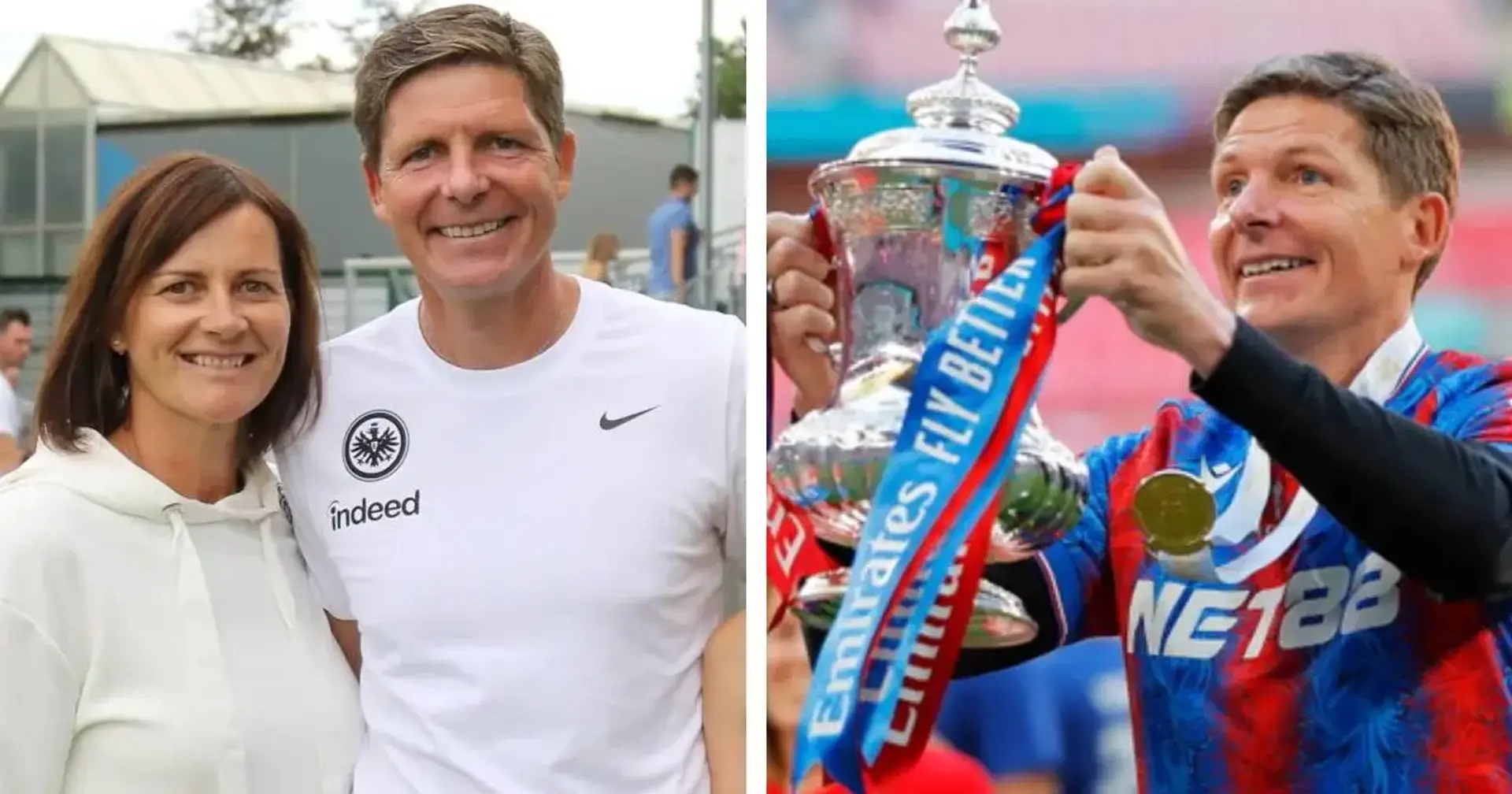
There’s a certain kind of football manager who walks into a club quietly and leaves it completely transformed. Oliver Glasner is exactly that kind of manager. The Austrian tactician arrived at Crystal Palace in February 2024 with a reputation built in Germany and not much fanfare in England. Two years later, he left South London as arguably the greatest manager in the club’s 119-year history — with an FA Cup, a Community Shield, and a Conference League title to his name. Not bad for a man who once played his entire senior career for a small Austrian club most football fans had never heard of.
Quick Bio Table
| Detail | Info |
| Full Name | Oliver Glasner |
| Date of Birth | 28 August 1974 |
| Place of Birth | Schärding, Austria (Innviertel region) |
| Age | 51 years old |
| Height | 1.81 m (5 ft 11 in) |
| Nationality | Austrian |
| Position (as player) | Defender |
| Education | Holds an MBA degree |
| Mother | Sieglinde Glasner |
| Father | Not publicly disclosed |
| Raised by | Grandmother and mother (single-parent household) |
| Wife | Bettina Glasner (married 2007) |
| Children | Three — sons Julian and Niklas, daughter Alina |
| Family background | Austro-Bavarian descent, working-class roots |
| Net Worth (est.) | £6.7 million (~$8–10 million USD) |
| Annual Salary (Palace) | ~£4 million per year |
| Current Status | Free agent (contract expired June 30, 2026) |
| Playing Career | SV Ried (1992–2011), LASK (loan, 2003–04) |
| Managerial Career | SV Ried, LASK, VfL Wolfsburg, Eintracht Frankfurt, Crystal Palace |
| Major Trophies | UEFA Europa League 2022, FA Cup 2025, FA Community Shield 2025, UEFA Conference League 2026 |
Growing Up in Austria: Where It All Started
Oliver Glasner was born on 28 August 1974 in Schärding — a small, picturesque town in Upper Austria sitting right on the German border. It’s the kind of place where everyone knows everyone, and life moves at a quieter pace compared to the big cities. He grew up in a modest, working-class household, raised largely by his grandmother and his mother, Sieglinde Glasner, in what was a single-parent home.
Football was his escape, his passion, and eventually his career. He came up through the youth ranks at SV Riedau before transitioning into the senior setup at SV Ried — a club he would go on to serve as a player for nearly two decades.
What’s interesting about Glasner’s background is that even while playing football professionally, he didn’t switch his brain off. He went ahead and earned an MBA, which tells you a lot about the kind of person he is. He was always thinking, always preparing for what came next. That intellectual curiosity would later become one of his biggest strengths as a manager.
The Playing Career: Two Decades at One Club
Glasner spent the vast majority of his professional playing career at SV Ried, a club based in Ried im Innkreis in Upper Austria. From 1992 all the way to 2011 — nearly 19 years — he wore that shirt as a defender. He had a brief loan spell at LASK in 2003–04, which is worth noting because LASK would later become one of the clubs he managed with great success.
He was never a top-flight European superstar, and he’d be the first to admit that. His playing career was solid, professional, and long — but it was built on consistency and commitment rather than flashy highlights. What it gave him, though, was an incredible grounding in football. Almost two decades as a defender taught him how to read games, how to organize a backline, and how to think tactically from the inside out.
His playing days came to an end in 2011, and rather than fade into retirement, Glasner immediately started building toward the next chapter.
The Transition to Management: Learning the Craft
After hanging up his boots, Glasner joined the coaching setup at Red Bull Salzburg in 2012. This was a smart move — Red Bull Salzburg at that time were one of the most progressive, tactically modern clubs in Europe, known for their high-pressing, energetic style of play. Working there as an assistant coach under Roger Schmidt from July 2012 gave him a masterclass in modern football philosophy.
He absorbed everything — the pressing triggers, the positional structures, the intensity. You can see the fingerprints of that Salzburg education in every team he has managed since.
His first head coaching job came when he returned to SV Ried as manager in 2014. He won his first match as head coach 3–2 against SC/ESV Parndorf in the Austrian Cup and followed it up with league wins that showed he was ready for the job. It was a homecoming of sorts — back to the club that had shaped him as a player — and he carried himself well in the role.
But bigger challenges were ahead.
LASK: Where He Made People Take Notice
The move to LASK in 2015 was where Glasner really started to build a serious reputation. Over four years from 2015 to 2019, he transformed LASK from a club fighting in the lower divisions of Austrian football to a genuine force in the Bundesliga and on the European stage.
He secured promotion and eventually guided them to a second-place finish in the Austrian Bundesliga — a remarkable achievement for a club that had been nowhere near the top of the table before he arrived. LASK also made it into European competition under his watch, which was a genuinely historic moment for the club.
By the time he left for Germany in 2019, Glasner had established himself as one of the most exciting coaching talents in the German-speaking football world. Clubs were paying attention.
VfL Wolfsburg: The Bundesliga Stage
Glasner took charge of VfL Wolfsburg ahead of the 2019–20 Bundesliga season, making the step up to one of Germany’s top clubs. Wolfsburg are a well-run, financially stable club with genuine ambitions, and Glasner delivered for them.
His two seasons in charge were solid — organized, competitive football that kept Wolfsburg in the upper half of the Bundesliga and gave them a platform to build from. It wasn’t always the most eye-catching football, but it was effective and professional. He showed he could handle the pressure of a bigger club and work with higher-quality players than he’d previously managed.
The stint at Wolfsburg was essentially a stepping stone — proof that he could operate at the top level of German football — and it opened the door to the opportunity that would truly define his managerial career up to that point.
Eintracht Frankfurt: The Night in Seville Changed Everything
If there is one moment that put Oliver Glasner on the global map as a football manager, it was the UEFA Europa League final on 18 May 2022 in Seville. Eintracht Frankfurt, managed by Glasner, faced Rangers in the final and won on penalties after a 1–1 draw. It was Frankfurt’s first major European trophy since 1980, and the night was made even more electric by the extraordinary number of Frankfurt fans who somehow made it to Seville and effectively took over the city.
Glasner had joined Eintracht Frankfurt in May 2021 on a three-year deal, and within his first full season, he had delivered a European trophy. That’s a special achievement by any measure.
His time at Frankfurt wasn’t without turbulence — the following 2022–23 season saw them compete in the Champions League for the first time in decades, and while they didn’t go as deep in that competition as hoped, the experience was invaluable. Glasner departed Frankfurt at the end of the 2022–23 season, with his contract not being extended. But he left with his head high and his stock through the roof.
The Europa League win had made him one of the most sought-after managers in Europe. It was only a matter of time before a Premier League club came calling.
Crystal Palace: A Fairy Tale in South London
In February 2024, Crystal Palace were struggling. Roy Hodgson had been managing the club but things weren’t going well, and the club made the decision to bring in Glasner. It was a bold call — Palace were in a tough spot, and Glasner was relatively unknown to the average Premier League fan at that point.
What happened next was nothing short of extraordinary.
In his first partial season, Glasner dragged Palace from trouble and guided them to a club-record 49 Premier League points in 2023–24. There were memorable victories against Liverpool, Manchester United, and Aston Villa that announced Palace as a team that could no longer be taken lightly. The football was direct, pressing-based, and genuinely exciting.
Then came 17 May 2025 — the day Crystal Palace fans had been dreaming about for 119 years. Glasner’s Palace beat Pep Guardiola’s Manchester City 1–0 at Wembley Stadium to win the FA Cup. The first major trophy in the club’s entire history. The scenes inside and outside Wembley that day were absolutely wild, as they had every right to be.
He followed that up by winning the 2025 FA Community Shield against Liverpool, adding a second major trophy in quick succession.
Then came the 2025–26 season, and with it the Conference League. Palace qualified for European football for the first time in decades, and Glasner took them all the way to the final in Leipzig, where Jean-Philippe Mateta’s goal five minutes after half-time beat Rayo Vallecano to deliver Palace’s first ever European title. It sent the Eagles into the Europa League the following season — though by that point, Glasner would no longer be in the dugout.
Why He Left Palace
Glasner had quietly told club chairman Steve Parish back in October 2025 that he would not be signing a new contract. He kept it private for a few months, before going public with the news in January 2026.
His explanation was simple and honest: he was looking for a new challenge. He made clear it wasn’t about the transfer window, wasn’t about any specific falling out, and wasn’t about money. He and Parish apparently maintained a good relationship throughout — both men put the club first, and the announcement was handled with a level of maturity and mutual respect that you don’t always see in football.
There were reports of some disagreements with ownership regarding the direction of the club, and frustrations over transfer business — particularly the departure of Eberechi Eze to Arsenal — but Glasner himself never publicly pointed fingers or made it messy.
He left on his own terms, as a legend.
The Man Behind the Manager
Outside of football, Glasner is a fairly private individual. He’s married to Bettina Glasner — they wed in 2007 — and they have three children together: sons Julian and Niklas, and daughter Alina. His family spends time between Austria and England, and by all accounts they’ve adapted well to life in London, even referring to it as a “second base.”
Bettina has actually featured in one of the more touching stories about Glasner — back in 2011, when he suffered a serious injury, she was the one who insisted he get proper medical attention. The fact that he still talks about that moment years later says a lot about how much he values his family and the role they play in his life.
He holds an MBA, which speaks to the intellectual side of him that’s always operating in the background. This isn’t just a guy who watches game footage all day — he thinks about structures, systems, and long-term strategy in a way that reflects a genuine academic curiosity.
The Tactical Mind: What Makes Glasner Different
Anyone who has watched his teams play knows that Glasner is obsessed with pressing. High defensive lines, compact shapes, relentless pressure in midfield, and quick transitions — these are the hallmarks of his football.
At Crystal Palace, he was particularly effective at building a team that could absorb pressure when needed but also explode forward at pace. The balance between defensive organization and attacking intensity was a big reason why Palace were so hard to beat under him. During one stretch, they went 19 games unbeaten — a run that wasn’t broken until October 2025 when Everton finally ended it.
He’s also known for being excellent with players individually. Multiple Palace players spoke publicly about how much Glasner’s man-management and tactical clarity improved their games. Jean-Philippe Mateta in particular enjoyed the best form of his career under Glasner, becoming one of the most feared strikers in the Premier League.
What’s Next for Oliver Glasner?
As of June 2026, Glasner is a free agent. His contract at Crystal Palace expired on June 30, 2026, and he’s taking some time to weigh his options.
There have been reports of interest from Bayer Leverkusen, who are looking for a new manager after a difficult post-Alonso era. Given Glasner’s strong connections to German football and his proven record in the Bundesliga, that would make a lot of sense. However, reports also suggest he had been hoping for a move to a bigger Premier League club — though those options appear to have narrowed, at least for the moment.
One thing seems pretty certain: Glasner won’t be out of work for long. A manager who has won the Europa League, the FA Cup, the Community Shield, and the Conference League — all with different clubs — is going to have no shortage of suitors.
A Legacy That Won’t Be Forgotten
Oliver Glasner walks away from Crystal Palace as the greatest manager in their history. That’s not hyperbole, that’s just the truth. No one else came close to delivering what he delivered in just over two years. Three trophies, a European final, a club-record points tally — the list is genuinely staggering for a club of Palace’s size and stature.
More than the trophies, though, he changed how the club thought about itself. Palace fans who had spent decades hoping just to stay in the Premier League were suddenly celebrating at Wembley and watching their team compete in Europe. That shift in identity and expectation is something that will last long after Glasner has moved on to his next chapter.
He came into English football quietly, and he left as a giant.
Whatever comes next for Oliver Glasner, you’d back him to succeed. The football brain, the personal values, the ability to connect with players and build teams that punch above their weight — those don’t disappear. They just get pointed somewhere new.
Austrian football has produced some interesting managers over the years. But right now, Oliver Glasner is the best of them, and it’s not particularly close.

