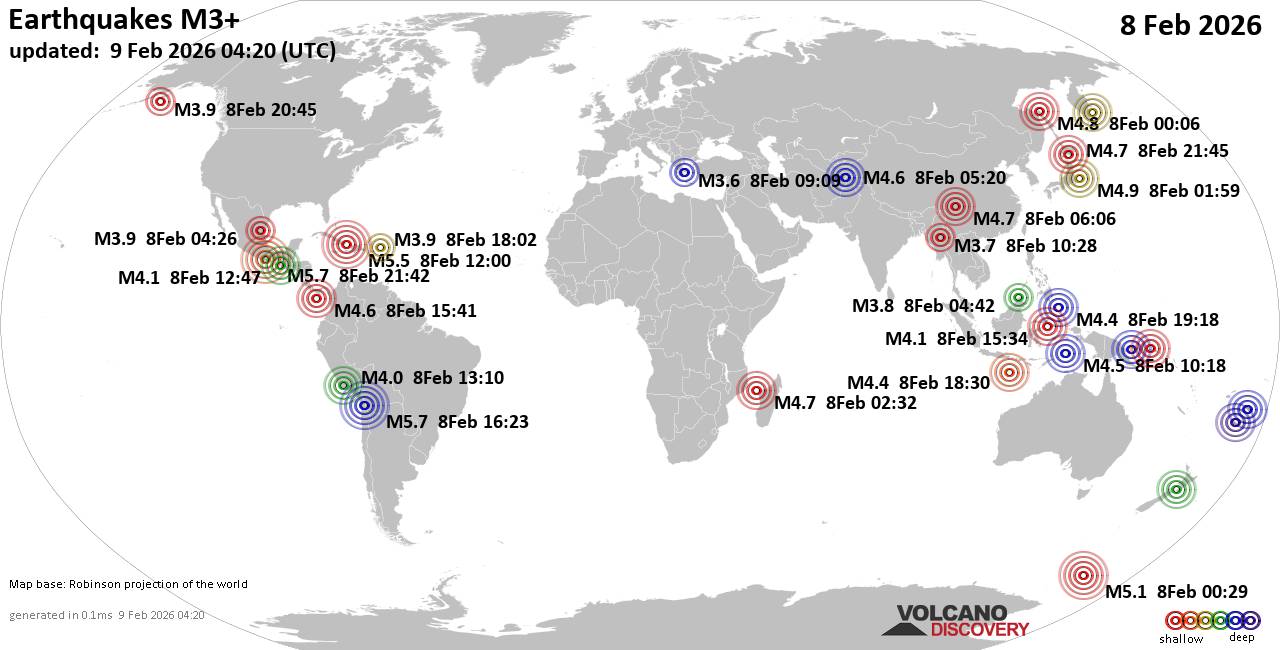
February 9, 2026 — Global Report A steady wave of seismic activity rattled regions around the world on Monday, marking one of the more active single days of earthquakes this year and drawing attention from scientists, emergency planners and international watch centers. The latest data — compiled from international monitoring agencies — shows a significant number of tremors affecting varied geographic zones.
According to worldwide seismic reports updated hourly, a total of more than 30 earthquakes registering magnitude 4.0 or higher were recorded since late Sunday, with at least three events exceeding magnitude 5.0. In total, more than 200 tremors of magnitude 3.0 and up occurred within roughly a 24‑hour period — a level of activity that underscores the planet’s dynamic crustal movements.
One of the most notable events during this period was a magnitude 5.5 earthquake near Pozo Almonte in northern Chile’s Tarapacá region. Located at a moderate depth beneath the surface, this tremor was registered by global seismic networks and prompted local alerts, though early reports indicate limited immediate damage.
In the Caribbean region on Sunday, a magnitude 5.5 quake was also recorded near Cuba, drawing the attention of meteorological and disaster response agencies. Officials there continue assessing aftershocks and potential infrastructure impact in affected areas, though no significant casualties or structural collapses have been confirmed.
Elsewhere in North America, seismic systems noted a magnitude 5.7 event near Puerto Escondido in southern Mexico that activated early warning alarms in Mexico City — though residents largely reported feeling little to no shaking directly.
Seismologists say these events, while not unusual in aggregated global statistics, highlight the importance of continuous monitoring as fault lines around the world — from the Pacific Ring of Fire to the Caribbean and Mediterranean regions — remain primed for frequent activity. Advances in early warning systems have improved preparedness, but scientists stress that infrastructure resilience and public readiness are still vital components in mitigating earthquake risks.
In addition to larger quakes, a number of smaller magnitude tremors — including a magnitude 3.9 event near Akhiok, Alaska — underscored the breadth of seismicity on multiple tectonic boundaries. While these smaller quakes rarely cause damage, they form part of broader patterns that researchers track to understand stress accumulation along crustal plates.
Earthquake monitoring centers around the globe continue to update their reports as aftershocks and additional events unfold through the day. Authorities in regions with significant population density are reminding residents to review safety plans and earthquake preparation protocols.
Volcanic and seismic experts emphasize that long‑term data, rather than single‑day anomalies, provide the most insight into tectonic behavior. Still, days with heightened activity serve as a reminder of nature’s unpredictability and the ongoing need for robust disaster response systems worldwide.

